
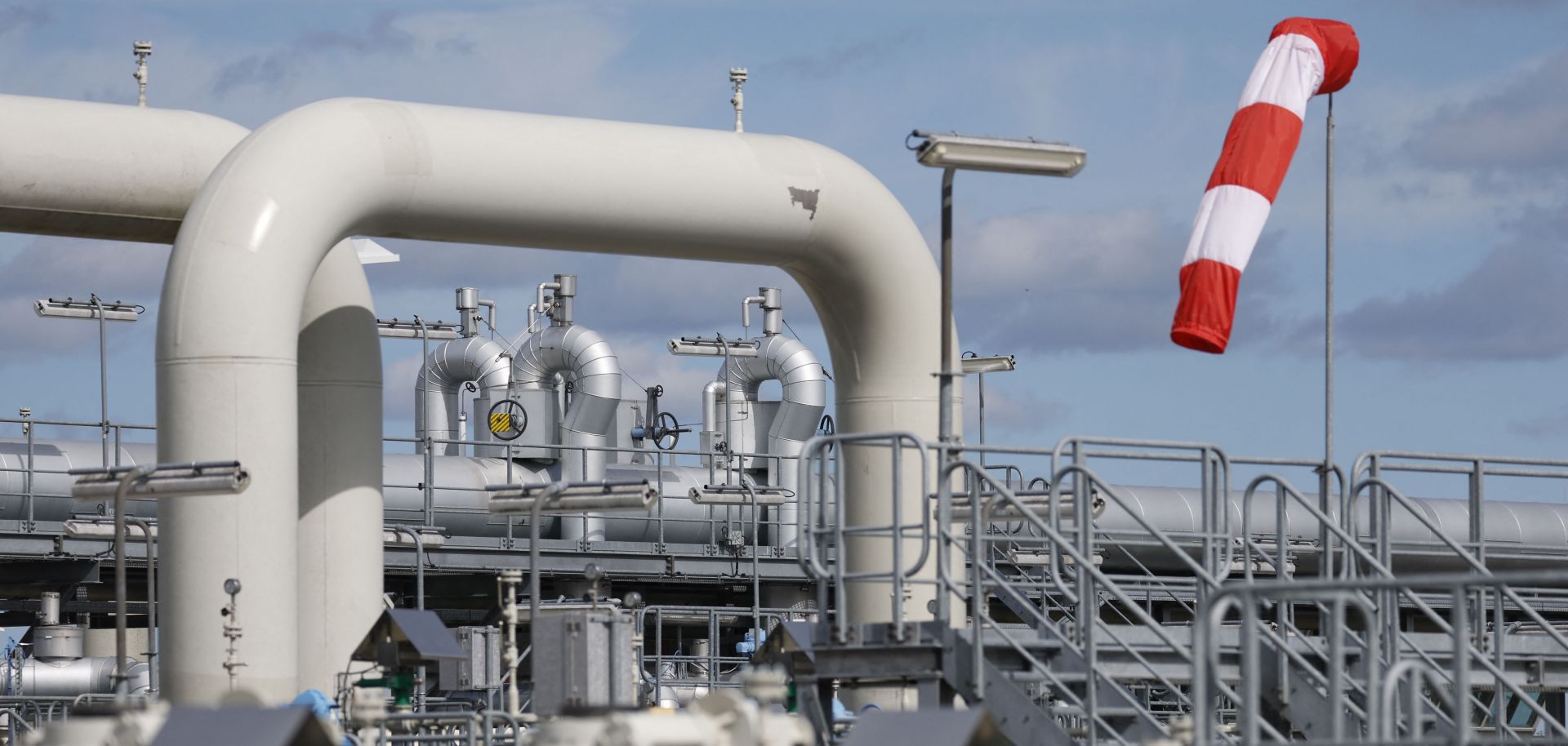
Facilities to receive and distribute natural gas are seen at a section of the Nord Stream 1 pipeline in Lubmin, northeastern Germany, on Aug. 30, 2022.
Russia's interruption of natural gas flows via the Nord Stream 1 pipeline will force European governments to prioritize coordinated demand reduction efforts before the winter, as well as increase financial support for households and utilities. Russian President Vladimir Putin's spokesman Dmitry Peskov announced on Sept. 5 that natural gas supplies to Europe via the Nord Stream 1 pipeline will not resume in full until the "collective West" lifts sanctions against Russia over its invasion of Ukraine. European benchmark gas futures jumped in the immediate wake of the Sept. 5 announcement before dropping later that day, as traders weighed on higher gas stockpiles across Europe and EU plans to intervene to control price surges. On Sept. 9, European energy ministers will discuss proposals to curb power prices and coordinate their response to Russia's latest escalation at an emergency meeting, which will likely focus on price caps for electricity generated by non-gas power producers and/or plans for windfall taxes on energy companies whose production costs are lower than market sale prices.
- European benchmark gas futures closed only 15% higher overall on Sept. 5. European equities fell and the euro also slid in response to Peskov's announcement, but both climbed back up again on Sept. 6 as previously surging gas prices somewhat eased.
Peskov is the latest high-ranking Russian official to openly hint that the slowdown of gas flows to Europe is politically motivated — directly contradicting Gazprom's assertion that the supply disruptions are due purely to technical issues beyond its control. Russia's state-owned gas giant Gazprom had so far blamed interruptions or reductions in supplies on technical faults, maintenance, or other technical issues related to sanctions. In fact, prior to Peskov's statement, Gazprom had already announced on Sept. 2 that Nord Stream 1 (which connects Russia with Germany via the Baltic Sea) would remain shut down indefinitely due to alleged faults with the pipeline identified during maintenance, scrapping a deadline to resume flows on Sept. 3. But Peskov's recent statement — in which he announced an effective embargo on gas deliveries via the pipeline, where Moscow is coming out with specific requests to reopen the valves — contradicts Gazprom's assertions that the supply disruptions are the result of technical issues (and not political pressure tactics), which may severely undermine the Russian gas company's claims of a force majeure in eventual arbitration proceedings. In the wake of Peskov's recent announcement, Gazprom's deputy chief executive Vitaly Markelov said on Sept. 5 that deliveries would not resume until Siemens Energy repaired faulty equipment on the pipeline, keeping the door open for a strategic reversal of a gas cutoff.
- On Sept. 4, Russia's former president and current deputy chairman of the country's security council, Dmitry Medvedev, also directly linked Germany's gas supply problems to its support for sanctions and arming Ukraine.
Russia appears to be escalating its weaponization of energy supplies in response to falling energy prices in Europe and Western plans to implement price caps on Russian oil and natural gas. The Kremlin's latest threat was most likely motivated by an Aug. 28 agreement reached by Group of 7 (G-7) members to implement a price cap on Russian oil, coupled with reports that the European Commission is also considering capping prices for Russian pipeline gas. But Europe's apparent increasing resilience against Russia's threatened gas cut-offs likely also helped convince Moscow that a further increase in pressure was needed. Prior to Peskov's statement, Russia had maintained ambiguity over the remaining 20% capacity of Nord Stream 1. This strategy had left European markets and governments guessing for how long supplies would remain halted, as well as if and how much they will be reduced once they're back online every time Gazprom announces an unscheduled maintenance on its key pipeline. But on Aug. 31, when Gazprom began shutting off Nord Stream 1 for its latest unplanned maintenance, energy prices actually fell in Europe for the first time in months — signaling that EU efforts to diversify supplies, curb consumption, and fill up gas storage ahead of winter were finally having an impact on the market.
- Europe's energy crisis has eased in recent weeks due to a confluence of factors. In addition to talks of price interventions, the European Union has made progress in increasing its stockpiles (which were 80% full as of Aug. 31) ahead of the winter heating season. The record surge in gas costs last month has also provided additional relief by dampening demand, with industrial gas usage decreasing by 25-30% across the Continent compared with last year.
- Power prices in Europe had settled 54% lower on Sept.1, the day after Gazprom started maintenance on Nord Stream 1, as markets reacted to recent EU efforts to ease the crisis, closing at 486 euros per mwh (about $486) down from the record 1,050 euros (about $1,050) reached the week prior, while gas prices fell as much as 30% at $68/MMBtu. Both extended losses despite fears that Russian supplies through the Nord Stream I pipeline may not restart after a three-day maintenance period ending Sep. 2.
Despite the recent easing, however, European energy prices remain high and volatile due to the continued uncertainty about Russian supplies. Russia is likely to resume supplying gas to Europe at some point in the fall, reserving a wider cut-off for the winter when demand peaks in order to maximize the impact. Such a resumption would grant Moscow more leverage to halt natural gas shipments again later, while its current suspension demonstrates Russia's willingness to do so. If Russia does not reopen Nord Stream 1, prices may again approach the historic highs seen in August when demand for heating increases over the coming months. In addition, while stockpiles have grown, Europe's overall gas supplies remain tight — increasing the likelihood of mandatory gas rationing measures across Europe this winter, which threatens to accelerate war fatigue among Europe's population. If prolonged, this fatigue could eventually erode European solidarity with Ukraine.
In response to this looming threat, the European Union is mulling several measures, including an EU-wide gas price cap that would risk encouraging demand or worsening Europe's Russia-induced energy crunch. Support for an EU-level solution has been growing, as country-level interventions to control energy prices in Europe are proving increasingly ineffective and financially unsustainable. Current plans include caps on wholesale gas prices that could either take the form of a ceiling on prices paid by EU consumers or a limit imposed directly on what can be paid for gas imported from Russia. However, implementing either of these options will prove risky, as the former plan could end up subsidizing demand while the latter plan could worsen Europe's energy crunch by pushing Moscow to retaliate. An EU-wide internal gas price cap, in particular, could sustain higher demand by making gas artificially cheaper, which is the opposite of what the European Union is trying to achieve. A price cap imposed directly on Russia, on the other hand, would risk triggering force majeure clauses in contracts with Gazprom — offering Russia legal grounds for further supply disruptions.
- European governments' response to the crisis has so far involved multi-billion-euro packages to support households amid surging energy bills and protect utilities from a liquidity squeeze. After Gazprom extended maintenance on Nord Stream 1 beyond the original deadline, several countries — including Switzerland, Finland, Sweden, and Germany — extended credit facilities to energy companies facing a potential liquidity crisis.
- The European Union will still try to reach an agreement on a price cap on Russian gas at the upcoming emergency meeting on Sept. 9. Commission President Ursula von der Leyen announced on Sept. 7 that the bloc will indeed propose one, but it remains unclear whether or not there will be enough traction among EU member states to pass it, as many European leaders are probably increasingly aware that this could very well be signing an agreement that ends gas supplies from Russia this winter.
Given the risks of enacting a bloc-wide gas price cap, the European Union thus remains more likely to provide financial support for households and utilities funded by windfall taxes and debt to curb soaring energy costs. EU leaders are also considering imposing windfall taxes on energy companies whose production costs are lower than market sale prices. This currently seems to be the preferred option of both France and Germany compared with the aforementioned EU-wide price caps. Such taxes would most likely be imposed on energy companies not relying on gas to produce power, as well as on upstream oil and gas producers. EU governments would then use the proceeds from these taxes to fund emergency liquidity instruments for struggling utilities and to support consumers through direct cash handouts that would not directly subsidize energy consumption. Much of this support, however, would also be financed through sovereign debt, which will probably delay plans across the EU to reduce debt-to-GDP ratios after the spike in public borrowing during the pandemic.
- Beyond that, European policymakers will probably focus on adopting coordinated demand reduction plans at the EU level, especially once supply diversification and fuel-switching options are exhausted. Further demand destruction remains the only feasible solution for winter should Russia keep Nord Stream I shut, even if record-high gas imports continue and low temperatures in winter do not exceed seasonal averages.
