
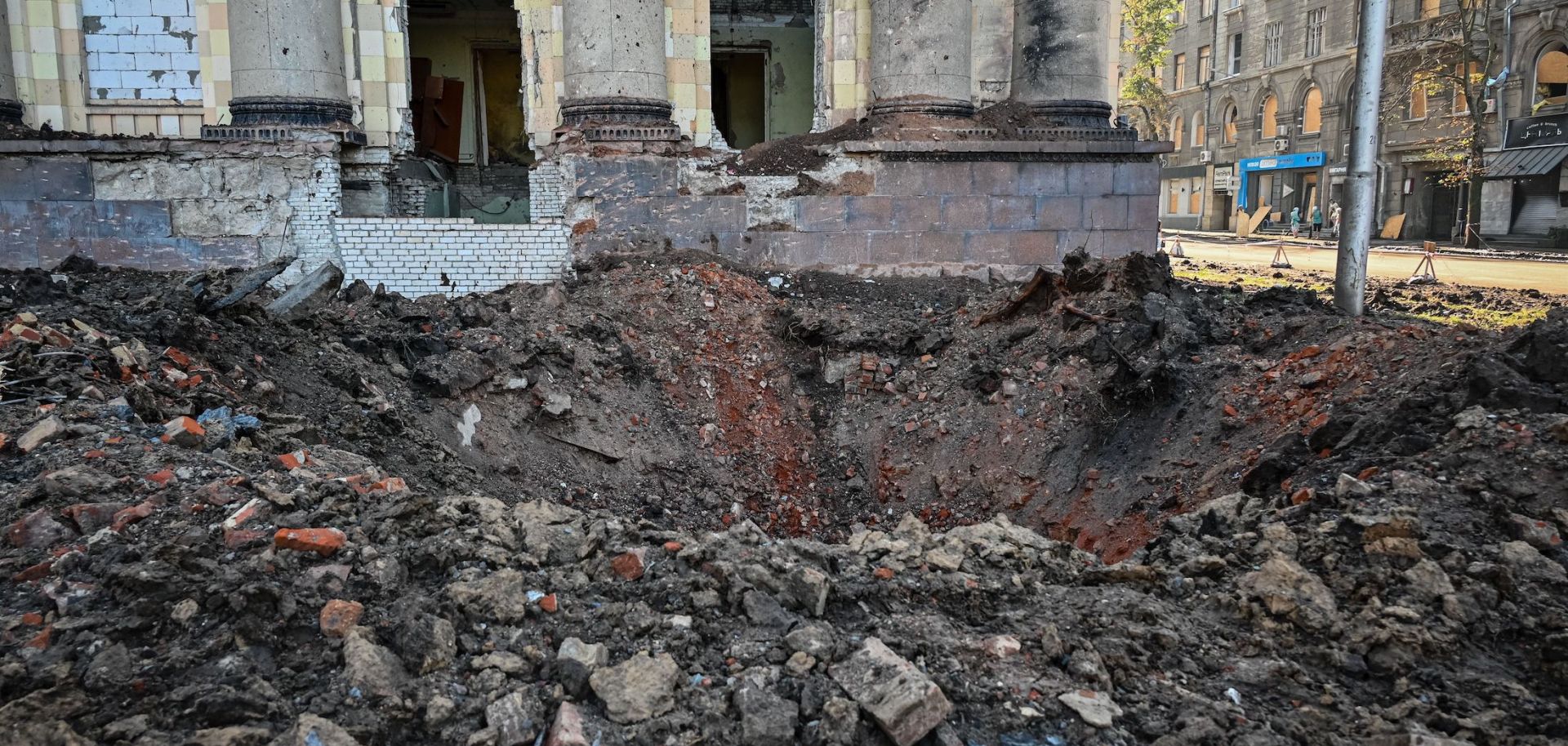
A crater near the damaged headquarters of the Kharkiv administration building following an overnight missile strike Aug. 29, 2022, in Kharkiv, Ukraine.
Russia plans to annex parts of Ukraine in the coming months, but will likely delay doing so to better secure the regions it wants to claim by seizing even more territory — and will time its move for maximum fracturing of Western unity and reduction of Kyiv's ability to respond. Pro-Russian occupation authorities in Ukraine for months have expressed their intention to hold referendums on joining Russia, calling them likely this fall. The regions have already taken several steps toward joining Russia, such as replacing the Ukrainian hryvnia with the Russian ruble, handing out Russian passports and taking Ukrainian media off the air. These steps have come amid reports allegedly detailing information from the Kremlin stating Russia plans to carry out its annexations in November or December, with the most recently suggested date being November 4, Russia’s National Unity Day. Officials in the pro-Russian puppet governments will continue to push the Kremlin to hold the referendums as soon as possible, as they see forcing Russia to escalate the war as the best and fastest way to guarantee their security. The Kremlin will, however, decide when to hold independence referendums on Russian annexation with minimal input from collaborators, instead basing its decision on the military situation in Ukraine and the political situation in the West.
- On Sept. 5 the top representative of the Russia-appointed administration in Ukraine's Kherson region, Kirill Stremousov, said the referendum on joining Russia had been "paused" due to the security situation. The statement backtracked on reports in Russian media and suggestions by Russian-installed officials in Kherson, as well as in the neighboring Zaporizhzhia region and the self-proclaimed Donetsk and Luhansk People's republics, in recent weeks that the referendums would be conducted in September, and suggested that even basic security requirements to give the referendums a veneer of legality could not be met.
- Western officials have on several occasions corroborated reports regarding Moscow's intention to annex additional Ukrainian territory. For example, the communications coordinator for the U.S. National Security Council on July 20 said his organization "has intelligence that Russia is laying the groundwork to annex Ukrainian territory."
While annexations are highly probable, Russia will delay them in a bid to weaken European support for Ukraine amid worsening economic conditions in Europe. Most Russians will not consider the invasion as having been worth the cost absent annexations of additional Ukrainian territory. Failure to meet this expectation accordingly poses an unacceptable risk to the stability of the Putin regime, and makes annexations almost inevitable. Failure to annex would also demoralize and discredit Russian allies in Ukraine and possibly push Ukrainians under occupation to take increased risks to aid the Ukrainian armed forces. But because Moscow intends to degrade Western and Ukrainian resolve, Russia is likely to exercise patience regarding annexations, waiting until it has satisfied minimal safety and territorial requirements to do so, and for a time when annexation is more likely to increase calls for a cease-fire and disagreement among Western powers over how to punish Russia. The Kremlin's strategic aim remains exerting control over as much of Ukraine as possible, including through additional offensives after reorganizing its forces. Because further offensives will likely be necessary to break the West's continued willingness to support Ukraine — and, subsequently, Kyiv's ability to continue resistance — in the near term, the Kremlin will likely delay annexations until later this fall or this winter, when it believes the annexation would better contribute to these objectives. Rather than further rallying the West by annexing now, when political unity in Europe is still strong, annexation later could exacerbate intra-European tensions and empower those arguing that Europe's continued support for Ukraine's resistance is futile and counterproductive. In fact, Moscow believes that disunity between European states will likely be higher in the midterm because of their growing economic woes due to high energy prices.
- Europe's economic outlook remains precarious, and expectations are widespread that it will worsen over the coming months. Economists have warned that eurozone inflation will hit double digits this fall and remain higher for longer than previously forecast as a result of surging natural gas prices.
While Moscow will probably seek to annex the Donbas first, it will not do so until it completely controls the area, which is unlikely to happen in the short to medium term. Russian President Vladimir Putin's statements in recent months that the main purpose of the operation is to "liberate" the Donbas area suggest Moscow will annex the Donetsk and Luhansk regions before or at the same time it annexes other Ukrainian territories such as the Crimea land corridor. But Russia is unlikely to annex the Donbas for the foreseeable future (and, therefore, the other occupied territory) because Moscow controls only about 60% percent of the Donetsk administrative region. While Russia will likely continue to gain some ground there, the head of the local pro-Russian authority has indicated that a date for a referendum would not be announced until the region was fully under Russian control. Therefore, Ukraine's continued hold on parts of the Donetsk region will likely delay Russia's annexation plans in the near term. Outside of the Donbas, the Kherson and Zaporizhzhia regions are also not fully under Russia's full control either — in the latter case, the namesake regional capital remains firmly in Ukrainian hands — which will likely dissuade Moscow from annexation attempts in the coming weeks. In any case, contradictory information from Russian sources about the timeline for annexations will continue to appear over the coming weeks and months as Moscow attempts to keep Ukraine and the West guessing and to provoke premature counterattacks by Ukrainian forces.
- Russia annexed Crimea in 2014 through a series of legal procedures only days after a referendum at gunpoint. There is a slight chance Moscow could push through referendums in newly occupied Ukraine but then delay the next procedural steps, giving Russian forces time to better secure the territories. But this is relatively unlikely because it would undermine its allies and draw criticism in Russia.
After annexation, Russia will likely use the threat of nuclear retaliation to pressure the West to stop providing weapons to Ukraine. Annexing more Ukrainian territory will allow Russia to claim that military attacks on those territories are by definition attacks on Russia proper, to which, per its nuclear doctrine, Moscow could respond with nuclear weapons. Despite the West not recognizing the annexations, Russia may believe that the West will cave to nuclear blackmail and pressure Ukraine to stop attacks on the territories using Western weapons. Russia would be motivated to defend annexed territory at extremely high human and material costs, as Ukraine retaking annexed territory would be highly unpopular and possibly endanger Putin's regime. After annexation, the Kremlin will intensify its efforts to fuel war fatigue in Europe and rupture trans-Atlantic unity with an information campaign targeting Europe and the United States, arguing that Western weapons' use on Russian territory risks World War III and that continued support for Ukraine will not reverse Russia's acquisitions. Moscow could also raise its nuclear threat level or noticeably change its nuclear force posture, for example by moving nuclear-capable systems closer to NATO states.
Annexations are likely to result in an escalation of the war because Ukraine is unlikely to give up on the lost territories in the short to medium term, underscoring some of the constraints on annexation for Moscow. Despite Russia's threat of nuclear retaliation, annexation is unlikely to stop Ukrainian attacks, including with Western support and weapons, because U.S. officials have repeatedly indicated Ukraine can use the weapons it supplies to strike within its territory. Reports suggest Kyiv is permitted to strike Crimea with Western weapons, and because the United States and other Western states will not officially recognize Russian sovereignty over newly annexed Ukrainian territory, they probably would continue to allow strikes with their weapons there. Failure by Russia to respond to such Ukrainian attacks with some sort of escalation would be a major blow to its deterrent credibility. For this reason, Russia will likely, at a minimum, respond with strikes on decision-making centers in Kyiv, should it forgo a more threatening nuclear weapons posture toward NATO. Furthermore, referendums risk an escalation of violence because polling locations will be known beforehand and the high concentration of collaborators in certain buildings would make them vulnerable to Ukrainian partisans, and a failure to secure safety during referendums would undermine the authority of leading officials allied with Russia while damaging Russian morale. Finally, annexation will be economically costly for Moscow because the territories incorporated have suffered extensive war damage and will be subject to further damage. This means that Russia will want any cease-fire negotiations with Ukraine to cover the annexed territories to ensure they are not subject to further Ukrainian offensives.
Western response measures pose risks to Russia, but are unlikely to significantly impede the Kremlin's pursuit of its goals in Ukraine in the near term. While U.S. military and financial support for Ukraine will continue after the annexations, it will face political headwinds if European support demonstrably falters as its economy deteriorates. For example, 11 Republican senators voted against the initial package of military support for Ukraine on May 16, with several of them claiming that Europe was failing to provide its share of military support, a concern likely to grow. Additional U.S. and European sanctions on Moscow over the annexations are very likely and could include stronger measures to prevent gasoline refined in third countries from Russian crude from reaching their markets, as well as moves to disconnect more Russian banks from SWIFT. But the West is unlikely to reveal its responses prior to the annexation referendums, making them unlikely to significantly impede Russia's war efforts or deter annexation considering Russia's high tolerance for economic pain.
- Annexation would boost the morale of both the Russian military and people. Annexation will result in a small rally in approval for Putin and the "Special Military Operation," although this effect will not be as large as that observed following the annexation of Crimea in 2014 — and would be at risk of quickly dissipating because the frontline will remain close to annexed territories, where battlefield setbacks are possible. High approval for defending Russia proper could provide the Kremlin with a strong enough justification for mobilization measures and other steps on the homefront it has so far declined to take.
- Diplomatically, Russia does not care about or need Western or even Chinese formal recognition, but annexation would also prompt new votes condemning Russia at the United Nations. Countries there will largely vote against Russia due to concerns over the precedent set by condoning the annexation of territories of their neighbors’ territory, which could undermine some of the indifference of neutral countries.
