
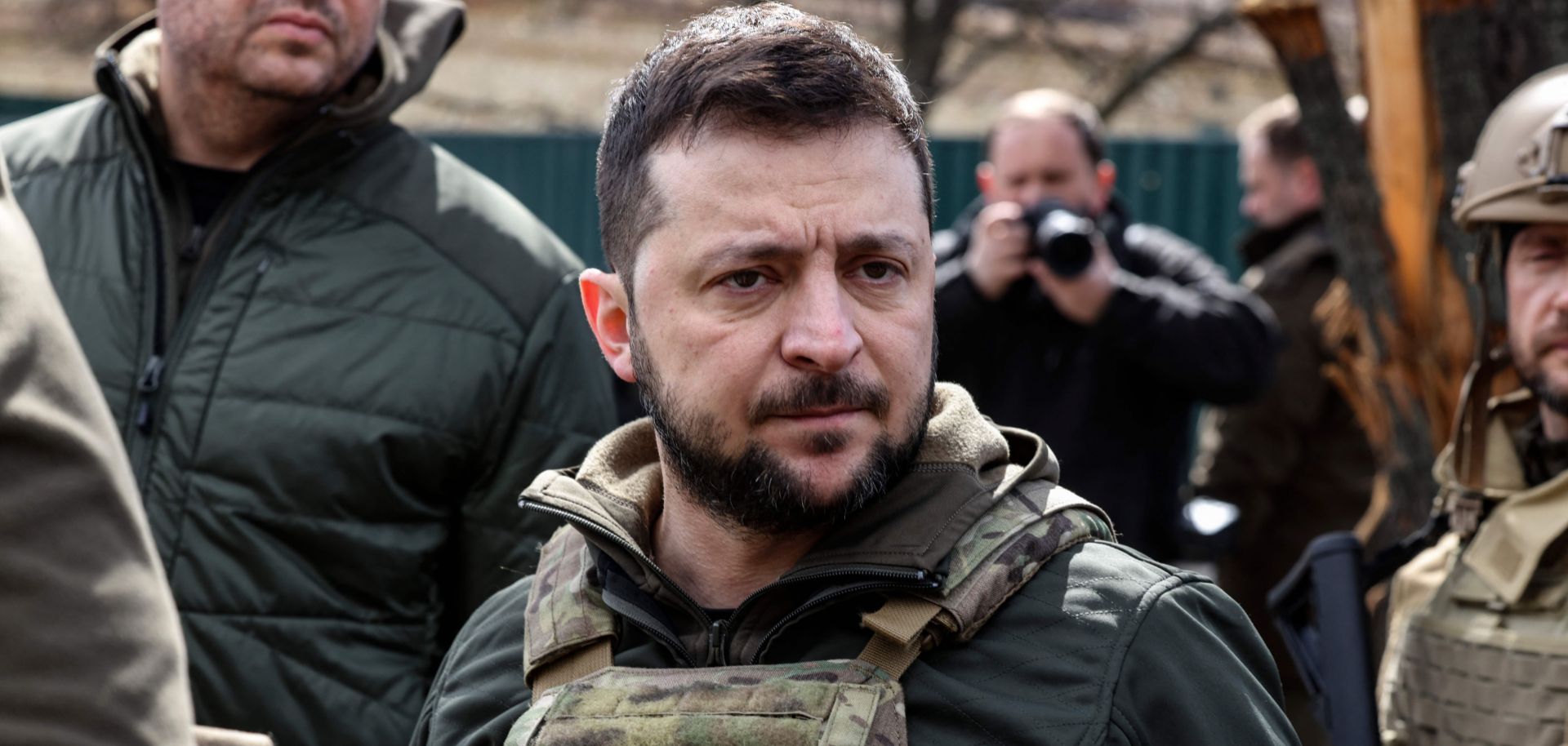
Ukrainian President Volodymyr Zelensky stands in the town of Bucha, northwest of the Ukrainian capital Kyiv, on April 4, 2022.
Editor's Note: This assessment is the first of a two-part series that explores whether Ukraine or Russia is more capable of emerging victorious from a protracted war. The second part of this series can be found here.
Since the start of Russia's invasion of Ukraine, and particularly in the last several weeks, competing narratives have emerged regarding the future trajectory of the war. These debates are often framed as a question regarding time — namely, on whose side is time in the war?
The Prospect of a Protracted War
This question came to the fore in May as it became clear that the peace talks that began shortly after Russia launched its invasion in February had, unsurprisingly, ground to a halt. Today, a peace deal remains distant due to Russia's insistence that it maintains control over — and likely eventually annexes — the land corridor to Crimea. But Ukraine has refused to even discuss surrendering this territory as it would effectively enshrine Moscow's control of the banks of the Dnieper River, which is the economic and ideological backbone of the Ukrainian state.
Russia controlling even one of the banks at the mouth of the Dnieper River would permanently neuter Ukraine from a strategic standpoint by granting Moscow control over traffic on the river. Russia's presence on the river would, therefore, function similarly to the Russian troops positioned just miles from Georgia's capital of Tbilisi as a result of its 2008 war with Russia, which have contributed to Georgia's struggles to develop its economy and foster closer ties with Europe.
The Ukrainian government will thus resist any cease-fire (let alone a peace accord) that involves Ukraine de facto accepting the loss of this territory. Ukraine will therefore continue to reject Russia's likely unilateral attempts to offer an end of hostilities, instead planning to achieve a stronger negotiating position after building up Western weapons for eventual counteroffensive operations.
In Russia, the popularity of the increasingly costly war largely hinges on the eventual annexation of Ukrainian territories, which will likely also see the Kremlin maintain its strategy of constantly reminding the United States and Europe of the alleged existential nature of the conflict for Moscow. Russia will continue to demonstrate, including through nuclear blackmail, that it will always be ready to pay a higher cost than the West is willing (or, in Ukraine's case, able) to pay for in order to retain the territory Moscow has already seized during the war, while maintaining ambitions on as much of Ukraine as possible.
In Ukraine, political leaders continue to insist an end to the ''active phase'' of the war will come some time this winter. However, the inability of either side to achieve sufficiently favorable conditions to do so means the conflict is increasingly likely to extend into 2023 and beyond, as the war becomes a protracted stand-off with the possibility of acute flare-ups. Peace talks will probably eventually resume, but they are unlikely to yield much progress so long as Russia, Ukraine and the United States continue signaling that maintaining the war is sustainable and preferable to the painful concessions at the negotiating table.
The Argument That Time Is on Ukraine's Side
The argument that time favors Ukraine largely rests on its continued access to modern NATO weaponry (specifically artillery systems and ammunition, including precision-guided munitions) — drawing a contrast with Russia's logistical, supply and military equipment production challenges. Statements from Western officials like U.S. Deputy Defense Secretary Kathleen Hicks — who on June 13 said the Pentagon was ''well-equipped'' to support Ukraine ''for five, 10, or 20 years into the future'' — support the notion that Ukraine will receive a steady supply of modern equipment in the long term. Russia, meanwhile, is increasingly economizing its use of precision munitions and certain systems amid doubts over its ability to replace them. A point could thus be made that the growing disparity in the two sides' weaponry will, eventually, enable Ukraine to not just hold the frontline, but conduct its own strategic counteroffensives.
This argument also points to Russia's manpower constraints. The fact that Moscow has repeatedly declined more extensive mobilization measures so far, when doing so would have been more beneficial the earlier they came, is strong evidence that the Kremlin is afraid to do so now or in the future because it could result in a drop in domestic support for the war. Russia is struggling to attract sufficient volunteers, many of whom are older and less fit for combat service. Ukraine, by contrast, is continuing to mobilize highly-motivated personnel who can be trained in the West. This means, over time, Russia will face force quality and availability issues that will put Russian soldiers' lives at risk during a Ukrainian counteroffensive.
Ukraine retaking Crimea or much of the Donbas is off the table for both military and political reasons. But if it retains its manpower and equipment advantage, the Ukrainian military could, so the argument goes, take back sufficient pieces of its territory to stop Russia from annexing or continuing to occupy some territory by making the political and economic costs of doing so unviable from Moscow. Indeed, Ukraine recovering or even just threatening a significant portion of the administrative borders of the Donbas region could throw a monkey wrench in Moscow's plans to annex the region or additional areas of Ukraine. This is because Russia is most likely to annex territory along easily defendable natural borders, such as the Dnieper River, or along administrative boundaries that will contribute to a veneer of legitimacy to Russia's actions. Denying Moscow full control over these administrative regions in a situation where it has not achieved its stated strategic goals could, over time, become politically untenable for Moscow. This, so it is hoped, could force Russia to eventually withdraw from some areas of Ukraine, easing the strain on Russia's military in what Moscow would call a ''goodwill gesture.''
Adding to the argument that time is on Ukraine's side are challenges to the Russian economy stemming from sanctions and the departure of Western companies. Despite years of funding ''import replacement'' programs, Russia's civilian and military production remains woefully reliant on imports of foreign (usually Western) equipment, most notably in technologically sensitive components and electronics. Russia may be able to withstand the fallout from Western sanctions through the rest of the year. But if sanctions remain in place in 2023 and beyond, the weakening of Russia's economy could reach a point where Moscow is forced to reduce its war aims due to military and civilian production shortfalls or subsequent political turmoil. Russia's ability to maintain budgetary stability could be severely undermined by an inability to paper over its economic challenges with oil sales. As Russia's breakeven price for oil production has likely gone up, a fall in oil prices could force Moscow to exhaust its foriegn currency reserves to make up the shortfall.
Another factor that could see time favor Ukraine is the Russian public's growing wariness of President Vladimir Putin's ongoing war. Domestic polling shows that, while Putin's popularity and support for his so-called ''special military operation'' in Ukraine spiked following the start of hostilities, both are now trending downward — and will likely continue to do so (albeit slowly) as the war drags on.
Versions of the above argument are of course popular in the West and in Ukraine. It is essential for Kyiv to spread this narrative because it – likely correctly — assesses that maintaining the public's attention and support in the West is contingent on the idea that Ukraine can not just survive the war, but ''win.'' Without this ''vision of victory,'' Western powers may be less inclined to keep providing material and financial support. The fact the Western support partially hinges on notions that Kyiv can ''win'' the war is well understood by Moscow, which will continue pushing the opposite narrative – that weapons deliveries will only lead to additional destruction among the Ukrainian army and people, while never allowing Ukraine to retake sufficient territory to change Moscow's position at the negotiating table.
The Caveats: Ukraine's Weak Position and Western Hesitance
It's true that Ukraine has been remarkably successful at preventing a vastly more powerful foe from taking control of even more of the country (especially given its poor preparations for a full-scale invasion). However, Russia's continued occupation of southeastern Ukraine and attacks on the rest of the country will make it hard for Ukrainians to take solace in this achievement. This is because true strategic Ukrainian victory would involve, at a minimum, Kyiv pushing Moscow's forces entirely out of the Kherson and Zaporizhzhya regions and thereby denying Russian access to the Dnieper River. In addition to Mariupol and the rest of the eastern Donbas region, the current lines would see Ukraine lose control over not only the river but strategic cities like Energodar (the site of Europe's largest nuclear power plant), Melitopol (an industrial center between the Donbas and Crimea) and Berdyansk (a major grain-exporting port on the Sea of Azov).
Western officials' rhetoric stressing that weapons are merely intended to help Ukraine's negotiating position, rather than achieve victory or defeat Russia, are intentionally ambiguous and reflect the grim reality that Ukraine faces a narrow military path for recapturing the territory it's lost since Russian troops began invading on Feb. 24, let alone Ukraine's internationally recognized borders. This strategic ambiguity will continue to dissuade Western officials from clearly defining the pace and limits of their support, as clearer commitments would admit to a definition of Ukrainian ''victory'' that is not one. This would provide information for Moscow to better pursue its own strategy, while severely demoralizing the Ukrainians. Instead, the West's approach involves draining Russian resolve and resources to continue the war over a long period, hoping this will lead to economic and political instability in Russia that will prompt Moscow to de-escalate.
The overall picture suggests that Western politicians are too concerned about the escalation with Russia and the political ramifications of war fatigue — both of which are poised to only grow as market disruptions brought on by the war further destabilize the global economy — to sufficiently supply Ukraine to achieve a victory. But war fatigue in Ukraine and the West was likely bound to increase with time, no matter the pace of support and weapons deliveries in the opening months of the war. Therefore, the West's policy of strategic ambiguity poses dangers for Ukraine because it belies the conditionality of Western support, and has put the onus on the Ukrainians to take risky action without sufficient support before Russian forces have time to fortify their positions. A premature attack would weaken the Ukrainians in a drawn-out conflict, and is therefore something Moscow is likely seeking to provoke.
Knowing that Ukraine's ability to conduct a counteroffensive now and in the future is entirely based on Western weapons supplies, Moscow does not need to break the will of the Ukrainians to keep fighting. Moscow needs only to break the will of the West to continue funding weapons deliveries and supporting Ukraine's civilian economy or eventual reconstruction, and to get the West to stop allowing its weapons to be used to attack its forces in the seized areas of Ukraine.
Reports that Moscow is preparing referendums as soon as September to justify subsequent annexation of the seized areas would align with that strategy. Given the administration of U.S. President Joe Biden's indication that one of its top priorities is preventing World War III, Moscow likely calculates that annexing seized areas and claiming they are under Russia's nuclear shield would help deter Ukrainian attacks on Russia using Western weapons. U.S. officials have said they are opposed to providing weapons that Ukraine ''could use to attack Russia'' — a logic that could be applied to a growing proportion of equipment at Kyiv's disposal. This would, of course, come with a major credibility risk for Moscow. But Russia's ability to blackmail the West (by, for example, raising its nuclear threat level) remains extensive, and would likely see more Europeans and Americans call for de-escalation. Russia's annexation plans serve as a wild card that could potentially most alter the future trajectory of the war, bringing new factors into play regarding each side's strategy.
Next: Bracing for a Protracted War in Ukraine, Part 2: Is Time on Russia's Side?
