
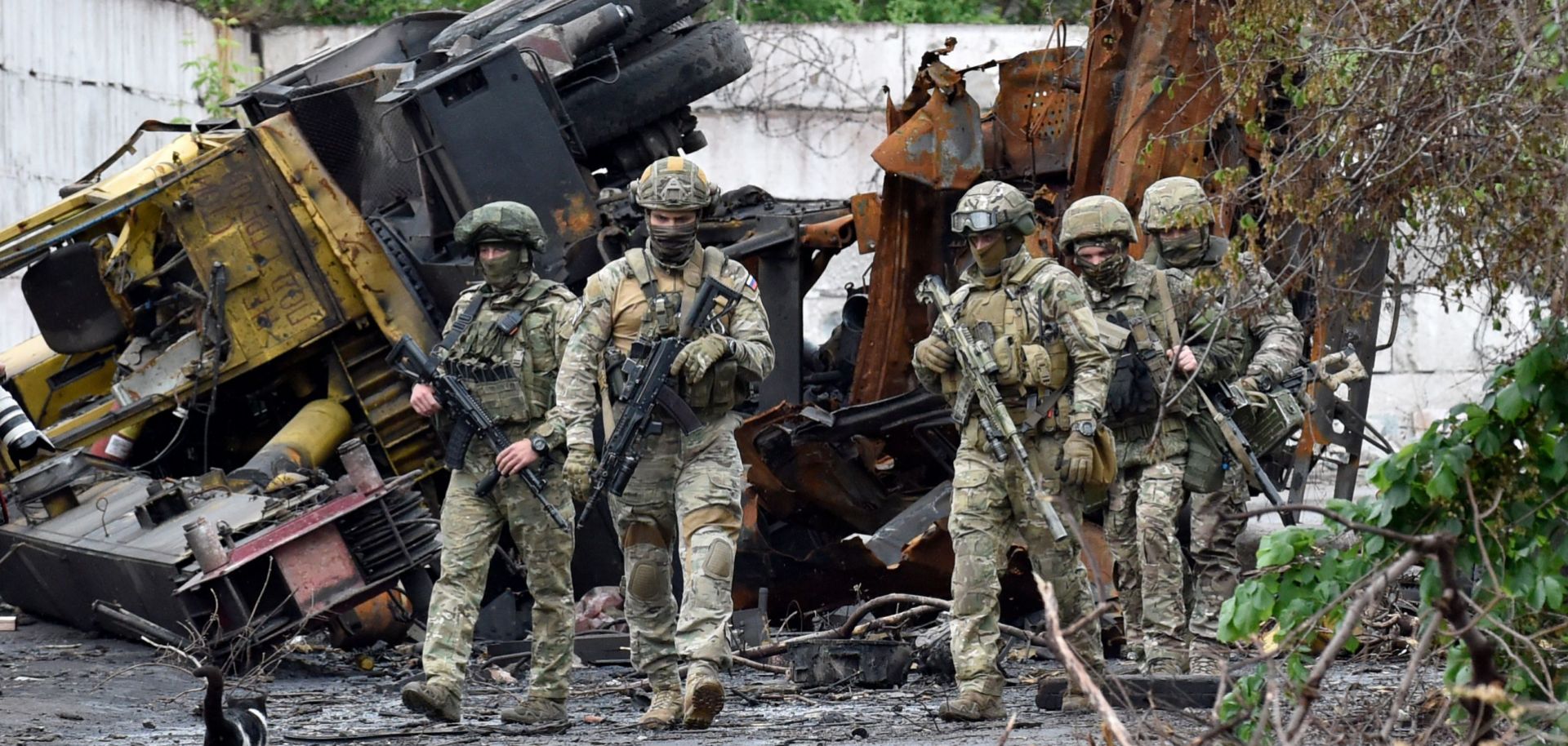
Russian servicemen patrol a destroyed part of Illich Steel and Iron Works in Ukraine's port city of Mariupol on May 18, 2022.
The fall of Mariupol will free resources for Russia's offensive in eastern Ukraine's Donbas region, secure a land corridor to Crimea and boost Moscow's internal propaganda efforts. On May 22, the last Ukrainian forces held up in Mariupol's Azovstal steelworks on the Black Sea surrendered to Russian forces, after 86 days of resistance and on orders from Kyiv. Two days earlier, Russia's Ministry of Defense claimed that since May 16, a total of 2,439 Ukrainian soldiers had surrendered at the plant. Russian Defense Minister Sergei Shoigu also reported to President Vladimir Putin on the complete liberation of the plant and the city of Mariupol. While Kyiv hopes the Ukrainian troops will be part of a prisoner exchange, the terms of the defenders' surrender are unclear. Even if an understanding was struck, however, there is no guarantee Russia will honor that commitment as Moscow will likely attempt to use the surrendered soldiers for propaganda purposes.
- On May 16, Ukrainian Deputy Prime Minister Iryna Vereshchuk claimed an initial group of 260 Ukrainian soldiers, including many severely wounded, had been ''evacuated'' to Russian-occupied territory and would be exchanged for Russian prisoners in what the Ukrainian Ministry of Defense called a ''humanitarian operation.'' The International Committee of the Red Cross has registered the Ukrainian prisoners of war who surrendered at Azovstal, which Kyiv hopes will provide them a level of protection from mistreatment.
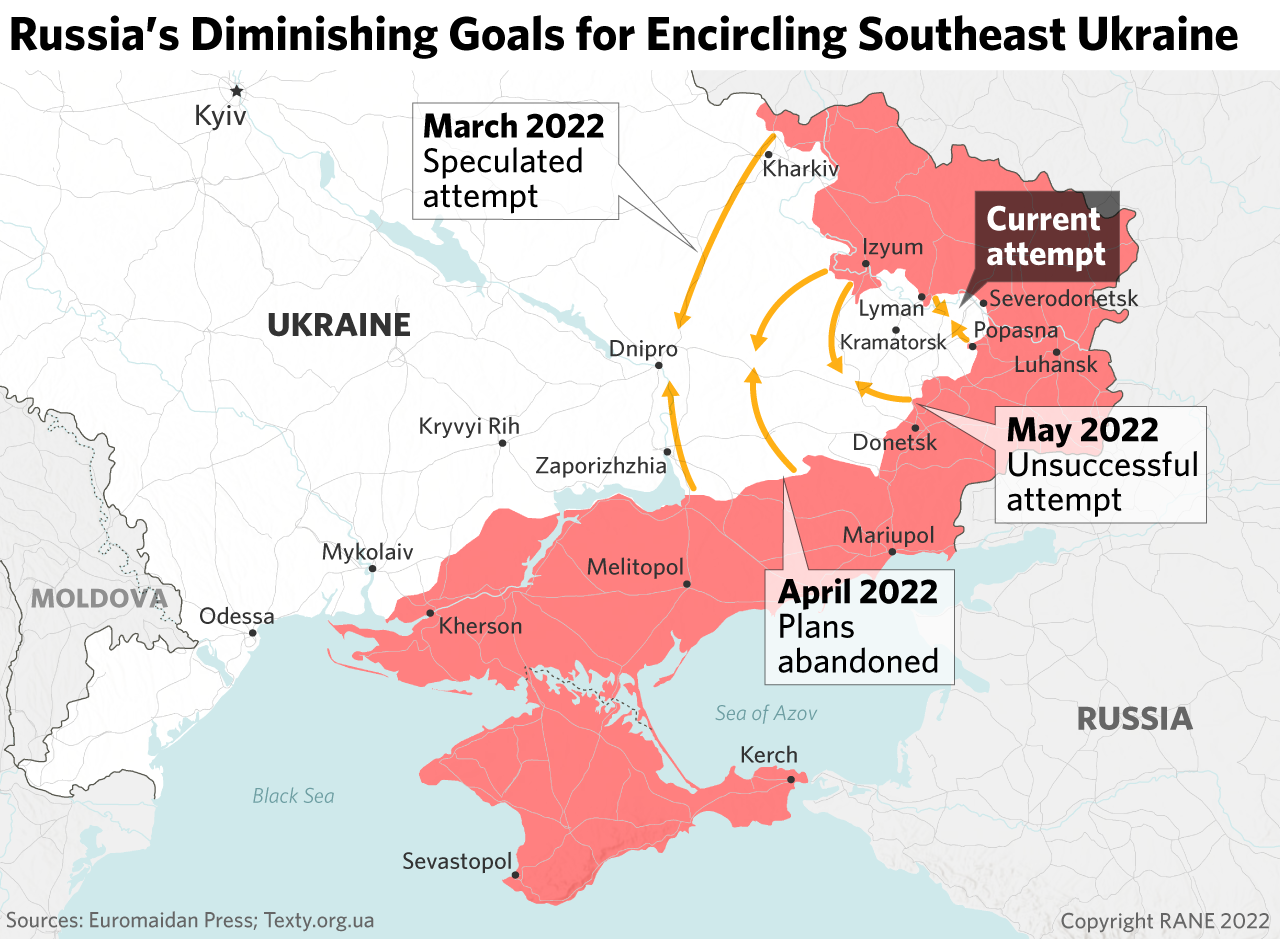
Russian forces that were in the city will move north to reinforce the ongoing offensive in the Donbas, which will likely make slow but steady gains in the coming weeks as Russian troops threaten Ukrainian forces with a small encirclement. The capture of Mariupol has freed human and material resources for Russia's ongoing offensive to retake the administrative borders of the Donbas. Russian forces have recently achieved new tactical breakthroughs in the eastern region, most notably at the town of Popasna along the heavily fortified line of contact that used to separate Ukrainian and Russian separatist forces prior to Russia's invasion, as well as near the town of Lyman. Russia's advances in these areas have put the Ukrainian stronghold of Severodonetsk in threat of encirclement, which may force Ukrainian forces to withdraw to a straighter and more defensible line. Some Russian forces from Mariupol have likely been deployed near these areas to exploit the breakthroughs before Ukrainian forces can adequately react.
Russia will use Mariupol's capture and trials of Ukrainian prisoners to point to the success of its ''special military operation'' in Ukraine, including the alleged ''denazification'' of the country and improvement of logistics in the occupied areas. The capture of the city will also further Moscow's other tactical objectives, including the maintenance of an uninterrupted land corridor to Crimea. Prior to Russia's Feb. 24 invasion, Mariupol was the largest city by population in the Donbas under the Ukrainian government's control after Russia-backed separatists seized the cities of Luhansk and Donetsk in 2014. While Mariupol's civilian population is now likely a mere fraction of the more than 400,000 who lived there before the war, Russia will claim that it has seized the most economically important city of the Donbas that was still under Kyiv's control. For Russia, the demining of Mariupol's port — which Russian naval forces reportedly completed on May 24 — will present improved logistical capabilities to the front in the Donbas. Mariupol's roads will also provide the quickest transportation route from Moscow to other seized areas of Ukraine (including Crimea, Melitopol and Kherson). The opening of this route will likely feature heavily in Russian propaganda as well, where it will be associated with claimed improvements in the quality of life in the occupied cities. Finally, Russia will likely increasingly advertise its preparations for holding trials, likely branded by Donbas separatist leaders as ''international tribunals,'' for the alleged war crimes committed by the leaders of the Ukrainian National Guard's controversial Azov Regiment and other Ukrainian soldiers as part of satisfying its goal of ''denazifying Ukraine,'' which has become increasingly difficult given Moscow's reduced war aims.
- The Ukrainian units that were Mariupol's last defenders before surrendering included the 36th Separate Marine Brigade, territorial defense battalions, the 12th brigade of the National Guard and, perhaps most notably, the Azov Regiment. The Azov Regiment — which is part of Ukraine's National Guard — grew out of a group called the Azov Battalion that was formed in 2014 to help Ukrainian troops fight against the Russia-backed armed uprising in Donbas. The unit has ties to the far-right and has been the focus of Russian propaganda since its formation, with the Russian Defense Ministry's chief spokesman recently referring to Azov fighters as Nazis.
- At the start of the invasion, Putin referred to Ukraine's political leadership as ''nazis'' and insisted on the country's ''denazification and demilitarization,'' which strongly implied Moscow's ultimate goal was regime change. Demonstrating a continued commitment to this maximalist war aim, however, has become increasingly difficult since regime change would likely require forcefully seizing Kyiv, which Russian forces failed to do after launching an offensive against the Ukrainian capital Moscow later described as merely a ''feint'' to prevent Ukraine from reinforcing the Donbas.
