
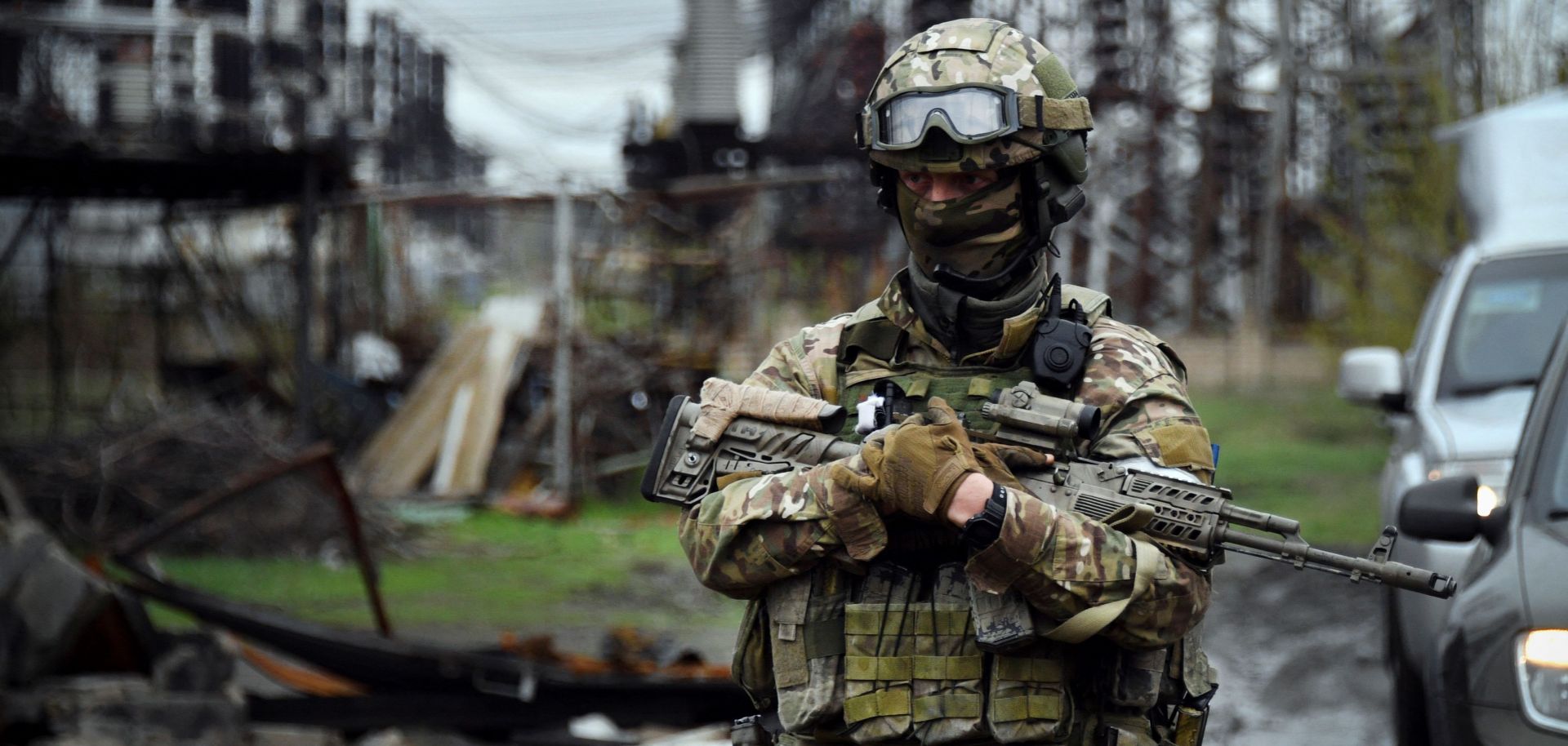
A Russian soldier stands guard at a power plant near Luhansk, eastern Ukraine, on April 13, 2022.
While Russia is unlikely to declare a full mobilization in the short term, it will likely need to deploy more soldiers to continue waging its war in Ukraine. This means that Moscow will likely mobilize at least some reinforcements, which could indefinitely prolong the conflict — exposing Russia to more economic problems and pressure from the West. As Russia's offensive in eastern Ukraine grinds on, military analysts increasingly believe the offensive capability of Russian forces in Ukraine will be largely exhausted in the coming weeks, regardless of whether they secure the entire administrative borders of the Donetsk and Luhansk regions. Russian troops now find themselves outnumbered in Ukraine after losing roughly 15,000 soldiers since the beginning of the war. As Kyiv raises, trains and moves territorial defense battalions to the frontlines, Russian forces will thus first and foremost need more manpower to conduct a new offensive operation, in addition to rest, resources and stronger logistical support.
Russia's Options for Military Reinforcements
Against this backdrop, the future of the conflict now rests largely in the Kremlin's hands, and in particular, on Russia's willingness to conduct mobilization by raising new troops and readying the country's economy to work on behalf of the war effort. Recent media reports suggest Russian President Vladimir Putin could declare additional mobilization measures — or even war on Ukraine — as soon as May 9, which is Russia's Victory Day commemorating the Soviet Union's role in defeating Nazi Germany in World War II. But even if Putin doesn't leverage the patriotic holiday to make such an announcement, Russia will still need to provide its battered troops in Ukraine with at least some reinforcement. Moscow has three main options for such mobilization — all of which pose considerable military, political and economic risks:
1) Keep the current course by conducting partial mobilization measures.
In this likely scenario, Putin would seek to maintain maximum flexibility by declaring Russia's ''special military operation'' a victory, but noting that defending the victory will be a long-term struggle requiring additional sacrifices from the Russian people. Moscow will choose from a menu of measures to draw additional manpower into the armed forces, which would represent a partial mobilization. The goal of this strategy would be two-fold: consolidate the current territorial gains in Ukraine (specifically the so-called ''land bridge'' connecting Crimea to the Donbas consisting of the southern portions of the Kherson and Zaporizhzhya regions on the left bank of the Dnieper river), and keep pressure on Kyiv to negotiate a peace deal favorable to Moscow.
Under this strategy, Russia's partial mobilization measures could include an unofficial mobilization of up to 60,000 reservists in Russia (which Ukrainian and Western sources believe may already be underway); a steady increase in the economic incentive of military contract service; a mobilization of troops in specific regions of Russia bordering Ukraine on the grounds of the alleged threat to them; a decree mobilizing a certain percentage of reservists or other employees with weapons training from federal agencies such as the interior ministry, bailiffs service, emergency situations service and others for temporary military service; an extension of last year's conscripts' service requirement and a movement of select conscripts into front-line roles; and, finally, a patriotic campaign declared by Putin himself calling for volunteers for military service.
- Drivers: Russia will probably require at least some additional manpower to confidently stabilize its current control of Ukrainian territory in the medium term, and the current pace of Russians' volunteering is insufficient to meet these requirements. These measures would be much less harmful to the Russian economy and politically risky than a general mobilization. The Kremlin's complete control of decision-making means that it can adapt mobilization measures to fit whatever it decides its next objectives are and the speed with which they should be completed. Because training requirements mean that it will take months before mobilized forces are combat-ready, a partial mobilization would give Moscow options and peace of mind no matter how things play out on the battlefield in the coming weeks. In addition, partial mobilization measures could sufficiently deter the Ukrainian army from major counteroffensives.
- Constraints: This option could raise expectations among the Russian populace without any guarantee of a greater victory. Hard-liners in the government and nationalist elements could criticize the measures as evidence that Russia's special operation has failed, but that the Kremlin still lacks the resolve to take the necessary steps to achieve a decisive victory. Should Russian forces prove capable of holding off Ukrainian counterattacks (or should Ukrainian forces be deterred from attempting such attacks), these partial mobilization measures would not significantly improve Russian military capabilities relative to Ukraine's, but would still have political and economic costs.
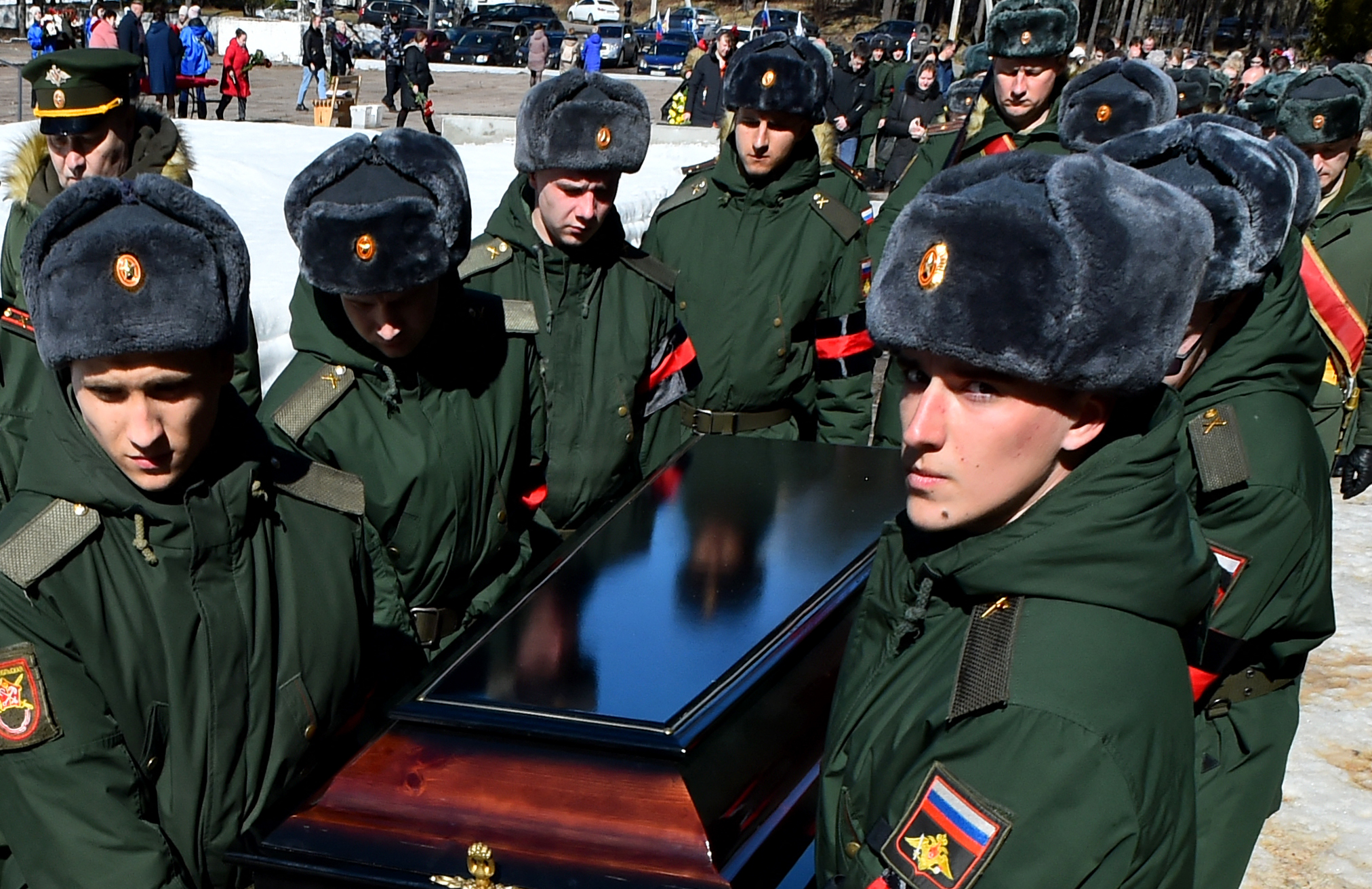
Soldiers carry the coffin of Nikita Avrov, a 20-year-old Russian serviceman killed in combat in Ukraine, during a funeral service in Luga, Russia, on April 11, 2022. (AFP via Getty Images)
2) Significantly escalate the conflict by declaring war and a national mobilization.
In this less likely but still possible scenario, Putin would rebrand Russia's ''special military operation'' into a war to justify extensive mobilization measures in a risky bid to achieve a decisive victory over Kyiv, reverting to the invasion's original maximalist aims. Putin would claim that this massive war effort was the only way to sufficiently ''demilitarize'' and ''denazify'' Ukraine and, in turn, ensure Russia's long-term security as otherwise, low-level conflict would continue to grind as Ukraine maintained its pro-Western course.
The declaration of war would open the door for Russia to declare martial law and a national general mobilization. This would make all men between the ages of 18-50 eligible for military service, depending on their category of fitness for the army. Men unfit for military service, meanwhile, could be placed in armaments production or other secondary roles. After several weeks or months of organizing and training these reserves, Russia would attempt to use its massive manpower advantage to surround Kyiv and annex as much southern and eastern Ukraine as it desires, linking up with Transdniestria or going further into Moldova, possibly leaving a rump state in western Ukraine or creating a puppet government modeled off of President Alexander Lukashenko's regime in Belarus.
- Drivers: Russia would use this massive mobilization as part of a bid, along with other measures such as raising the nuclear threat level, to intimidate Ukraine into submission in negotiations and deter additional Western support for Ukraine in the following weeks as Russian forces mobilize. Should this fail, Russia would attack with its now significant numerical superiority to achieve its most ambitious stated goals of ''demilitarization and denazification.'' This is because the Kremlin sees the installation of a pro-Moscow regime and occupation of the country as the only sure way to prevent Ukraine from resuming integrating with European and transatlantic structures in the long term. Russia could also use a declaration of war to force Belarus and Russia's other Collective Security Treaty Organization (CSTO) partners into the conflict that would otherwise resist doing so under all circumstances.
- Constraints: Putin's repeated false declarations that conscripts aren't fighting in Ukraine suggest that the Kremlin believes such a move would be highly unpopular and would effectively constitute an embarrassing admission that the war is not progressing as originally planned. Russia is already confronting shortages of equipment and rations. Bringing hundreds of thousands more poorly trained and poorly motivated troops to the frontlines in Ukraine would thus risk only worsening Russia's already poor logistical situation. Russia can already declare victory and can continue economically starving Ukraine indefinitely via its naval blockade, making such a complete victory not worth the cost. Such an extensive mobilization, however, would only exacerbate Russia's own economic woes by not only generating new Western sanctions but deepening the brain drain, as younger and more educated Russian men are forced from their jobs and many attempt to flee the country.
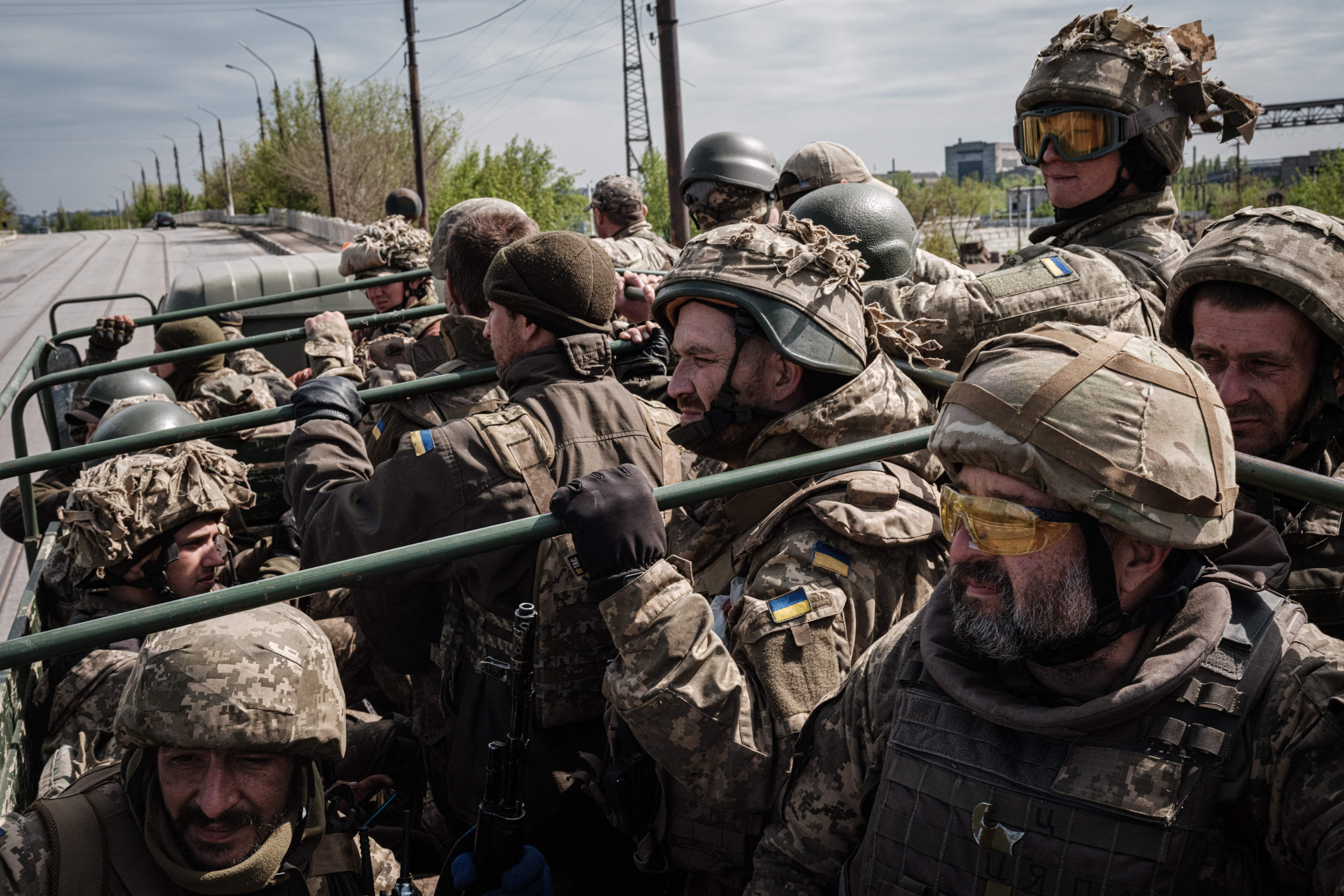
Ukrainian soldiers ride in the back of a truck after fighting on the frontlines near Kramatorsk, eastern Ukraine, on April 30, 2022. (YASUYOSHI CHIBA/AFP via Getty Images)
3) Pursue minimal mobilization and rely on negotiations to de-escalate.
In this more unlikely scenario, Moscow would declare its ''special military operation'' in Ukraine a victory and claim that it would now pursue de-escalation as it waits for Kyiv to accept the new reality of Russia's seized territories in southeastern Ukraine as part of a peace agreement. In this scenario, Moscow would likely unilaterally declare a cease-fire and make small tactical withdrawals to defensible positions. Moscow would also likely forgo additional mobilization measures under the assumption that its current forces can successfully defend their ground against Ukrainian counterattacks without major reinforcements. In addition, the Kremlin may decide against mobilizing more military reinforcements for fear that it'd provoke costly counterattacks on its troops by convincing the Ukrainian leadership to exploit a potentially unique window during which they have a manpower advantage. But should such Ukrainian counterattacks take place anyway and fail strategically by taking heavy losses, this would reduce the extent and necessity of Russian mobilization measures in the future.
- Drivers: Moscow may believe it has already sufficiently accomplished its strategic objectives, as Ukraine will continue to remain a broken, blockaded and outside of Euroatlantic organizations for the foreseeable future. Russia can always resort to mobilization in the future should it feel the situation is truly critical. There is also little strategic reason for Moscow to endure the economic and social consequences of mobilization until such reinforcements are absolutely necessary. Finally, this course of action would most effectively allow Russia to claim that it is Kyiv and the Ukrainians that are continuing the war and an obstacle to peace — an argument Moscow likely believes will be key in turning the narrative in Russia's favor internationally and helping sure up support domestically.
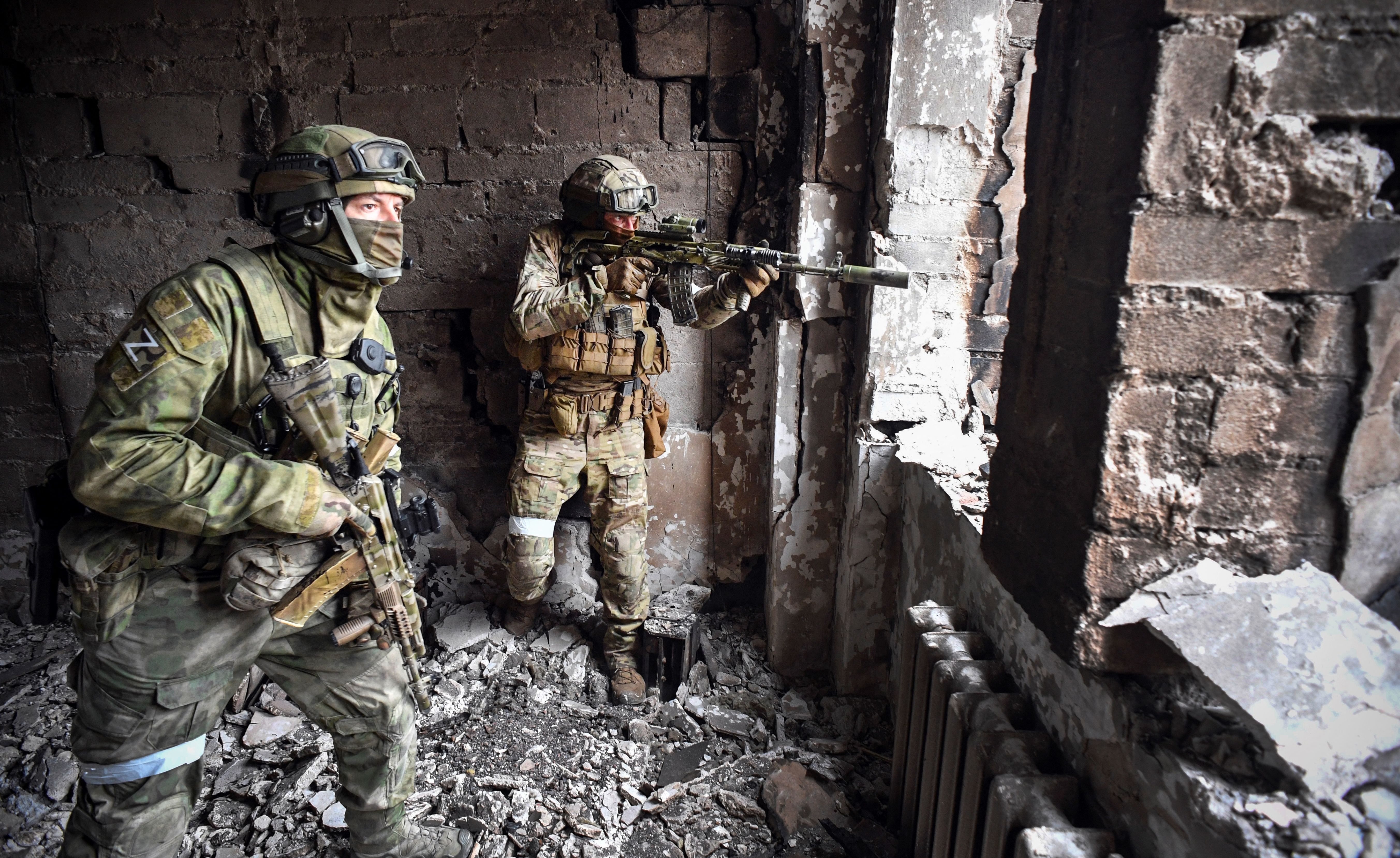
Russian soldiers patrol a bombed theater in the Ukrainian city of Mariupol on April 16, 2022. (ALEXANDER NEMENOV/AFP via Getty Images)
- Constraints: Without more forces, many military experts believe that Russia may not be capable of holding their current lines in the coming weeks, in particular on the right bank of the Dnieper in the Kherson region. However, it will take months to adequately assemble, train and transport more Russian soldiers to the frontlines in Ukraine. Failing to start this process now would risk leaving outnumbered and increasingly outgunned Russian troops particularly vulnerable to counterattacks by extending the window in which Ukraine has more manpower. A failure to mobilize could also suggest that Russia is comfortable with abandoning at least some seized territory, which would disappoint Russian nationalists and collaborators in Ukraine. The situation on Russia's frontline could deteriorate suddenly and quickly, meaning Russia's mobilization could come too late after Ukrainian forces have launched a counterattack — allowing Ukraine to return significant territory before sufficient Russian soldiers can stabilize the front.
