
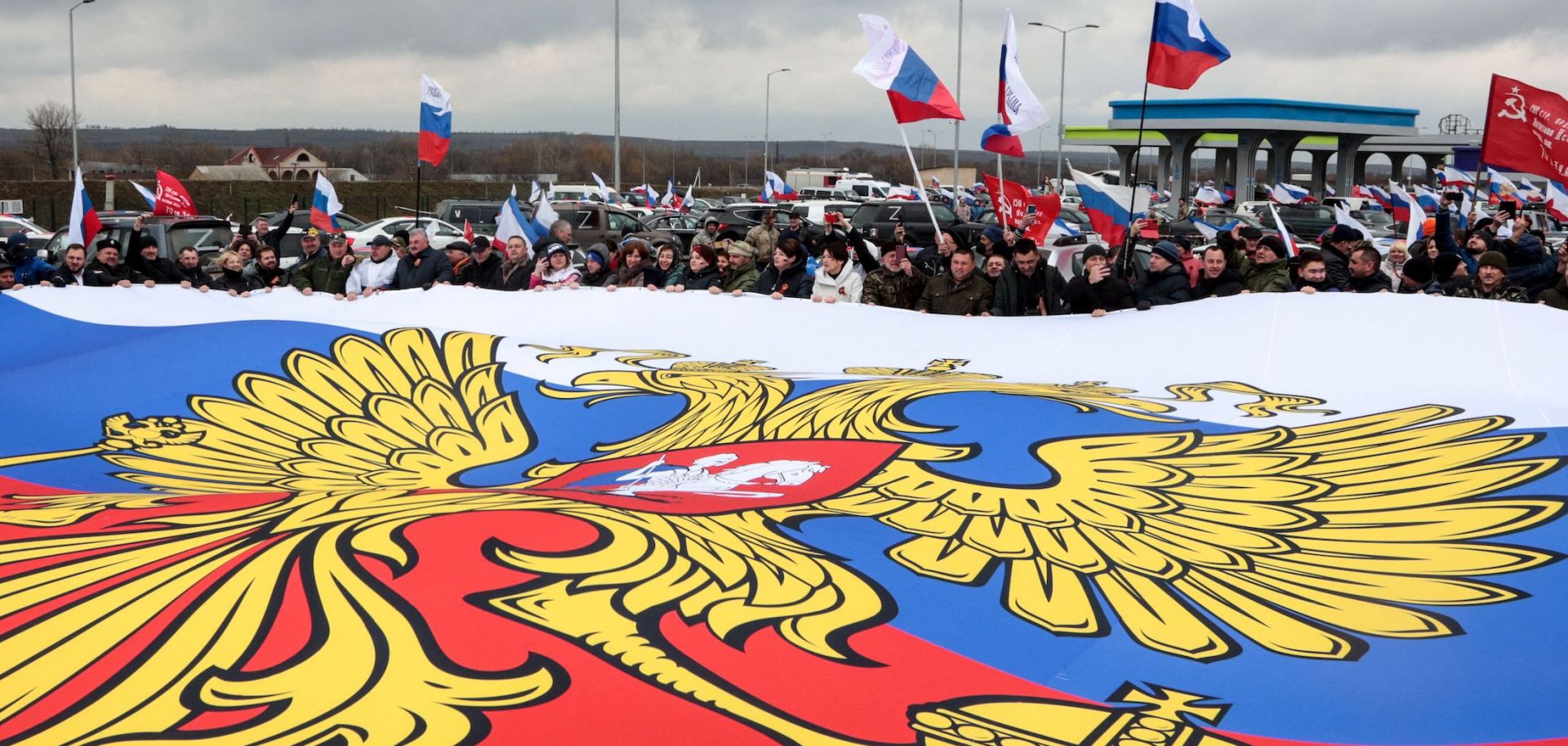
People in a village outside Simferopol, Crimea, hold a giant Russian flag during a rally in support of Russia's ongoing war against Ukraine on March 5, 2022.
Just how popular is the Ukraine conflict in Russia?
A survey conducted by the state-run pollster VTsIOM released on March 5 said that 71% of Russians supported the war effort. And according to a more recent VTsIOM poll published on April 8, domestic support for Vladimir Putin has only grown since Russian troops began entering Ukraine, with 81.6% of Russians saying they trusted their president compared with the 67.2% who said the same prior to the Feb. 24 invasion.
But while those figures may be exaggerated (as respondents answer in the way Russian state media has told them is acceptable), it's nevertheless indicative that, barring no major anti-war movement, the Kremlin's domestic front is currently secure. How long it will stay that way is less certain, though Russian history shows it could be a while. Repression at home and foreign confrontation abroad didn't preserve the Czarist or Soviet systems in the long run. Though that formula, despite its autocratic inefficiencies and corruptions, gave Russian leaders the ability to weather multiple major setbacks before the inherent dysfunctions of their political models pulled them down.
If there is to be a crack that gives way to a larger political revolt, it will only come after a series of failures by President Vladimir Putin and other Russian leaders — and possibly years of sacrifice by the Russian people, who will increasingly feel the weight of the war at home the longer it drags on, through the loss of both national blood and treasure.
The Importance of the Domestic Front
In long wars, domestic support for the conflict often emerges as a major factor in determining the victor. The United States never lost a major battle in Afghanistan or Vietnam, yet the collapse of support at home ultimately compelled the U.S. military's withdrawal and subsequent defeat in both conflicts. If a population cannot be convinced to keep up the fight, there are little even advanced militaries can do to succeed.
With the retreat from Kyiv, Russia will now clearly endure a longer military campaign than originally planned — and the bite of sanctions that come with it. Some observers have assumed this will mean the steady erosion of Putin's base of support, paving the way for his eventual overthrow. This view, however, assumes three key factors:
- The Russian people will value their material welfare over the nationalist ideology Putin is now pushing.
- Russians will be casualty averse (as Western countries now are), and will react badly as the body count rises.
- Russians will find some way to organize a serious anti-Putin uprising, possibly in collusion with elites.
While all these assumptions are questionable under the current circumstances in Russia, they are not wholly without merit, given the country's history.
Russia's last czar, Czar Nicholas II, so disastrously managed World War I that not only did he lose to the Germans, but his own military and citizens turned on him. An improvised Soviet coup by would-be Stalinists in 1991 fell apart when soldiers refused to open fire on defiant crowds, acting as the final nail in the coffin of the Soviet Union. In other words, there's an established record of Russians turning on poor leadership who think too little of their blood and treasure.
Now, Ukraine's military doggedness has battered the Russian military superiority narrative; even the Kremlin now admits to ''painful'' losses. Russian families will be receiving thousands of war death notifications. And even with state media peddling firmly pro-war propaganda, these losses will be impossible to conceal the loss of Russian troops from the general public. Meanwhile, the standard of living in Russia is set to drop even further as the full weight of sanctions sinks in. The U.S. government estimates that Russia's GDP could contract anywhere from 10-20% this year. Modern goods like iPhones and computer chips, meanwhile, are becoming increasingly difficult to find in Russia as the ruble remains volatile and more countries cut their business ties with Moscow.
To make Putin the next Nicholas II, Russia's current situation will at the least have to continue for a prolonged period. However, if Europe (or at least major parts of it) decides to bite the bullet and cut some or all Russian energy exports, it could trigger a major current accounts crisis that even Russian state media could not conceal. Such a drastic and obvious deterioration of Russia's domestic stability would increase the likelihood of a combination of oligarchs, military leaders, and the general public turning on Putin — a revolution of sorts, either bloody (like in 1917) or peaceful (like in 1991).
Putting Putin's Strength in Context
But it will probably take more time, as well as more setbacks on Putin's part, for such a revolution to unfold in Russia. First, if we are to keep the comparison to Czar Nicholas II, it's important to remember that he made a series of major mistakes during his reign — from the crushing defeat in the Russo-Japanese War to the bungling of reforms after the abortive Russian Revolution of 1905. And these mistakes also followed centuries of Czarist misrule. It was thus not a single trigger that pushed Russian citizens and soldiers to revolt during World War I, but many piled on top of one another.
Putin, in comparison, does not have the same kind of record. While the outcome of the Ukraine invasion remains undetermined, each of his previous military interventions was successful: Chechnya, Georgia, Syria, and even the previous invasion of Ukraine in 2014 that culminated in the annexation of Crimea were all widely supported by Russians and achieved Moscow's strategic objectives. While the current war against Ukraine is proving to be a greater test than anticipated, the invasion has not yet discredited Putin's military leadership. Indeed, there's still a chance for Putin to come out relatively unscathed — especially if he can eke out a victory that looks credible in Ukraine.
Until the recent sanctions were imposed, Putin also oversaw an economic record that was much stronger compared with the volatility of the 1990s; at least Putin's economic strategies provided for a gradually growing standard of living and overcame the chaotic ''shock treatment'' that followed the fall of the Soviet Union.
Once more, it will take time for the full weight of sanctions to hit the Russian public, and for the Russian public to then decide that such material sacrifice is Putin's fault. Given Putin's current strength as a leader, the dreams of a generals' coup, or at the very least of an army that might let anti-Putin protestors crawl on their tanks (like the anti-Soviet protestors did in Red Square in 1991), are currently unlikely to manifest.
Systematic Barriers to Change
But even if the military or public were to grow disgruntled with Putin, they currently have no credible political options for change. Russians, of course, have no free elections in which they can democratically choose a new government. But the Kremlin's sweeping crackdown on dissent over the past two years has also left Russians with no organized opposition to join, or even an underground movement to lead. Hundreds of thousands of potential Russian dissidents have already fled the country, and more may well flee as the situation at home becomes even more unsustainable. Many of the dissidents who remain in Russia, meanwhile, are now behind bars — including imprisoned opposition leader Alexei Navalny, who survived a suspected assassination attempt by Russian security services in August 2020 only to be arrested several months later in Moscow. This, combined with the thousands of arrests in the initial days following the recent Ukraine invasion, suggest that the boldest elements of the Russian opposition have already been defanged.
Perhaps more importantly, however, is the fact that the members of Russia's internal elite are currently wedded to the system. For a revolution to work, elites must either be divided or in disarray. The generals who would be counted on for a military coup know they could be held responsible for the reported war crimes in Ukraine and elsewhere; overthrowing the system exposes them to accountability and, as they know from Russian history, the potential of another break-up of the Russian Federation and perhaps civil war. The oligarchs, meanwhile, have grown rich off state patronage and corruption. And going against the Kremlin would put that wealth at risk, especially if the final result is a more accountable, democratic government or a civil war. Both sets of elites will also know that now is a time where loyalty is the ultimate prize. In their own internal rivalries, they will hope to portray their rivals as disloyal, seeking to oust them from power and seize their positions and riches. Behind closed doors, turning in rich ''traitors'' could well be lucrative. To get elites to a point of revolt, economic and military conditions would have to deteriorate much more than they already have, to the point of threatening their own lives.
Standing the Test of Time
For now, the Russian system is well-positioned to keep the domestic front in check. But how much longer it will stay that way is less certain. For one, it's not clear whether Russians are prepared to fight another drawn-out Cold War with the West (especially knowing that they lost the first one), or how they would react to a potentially humiliating withdrawal from Ukraine (the battle for the eastern Donbas region looms, but after Russia's failed drive for Kyiv, no longer does the world assume Ukraine's army is outmatched). It's also uncertain how well Russia can keep its war narrative alive at home.
Russians can and already are using things like virtual private networks to break through the Kremlin's information barrier. And finally, there is the looming question surrounding the long-term sustainability of Russia's current governance style, anchored as it is on the personality and politics of Vladimir Putin himself. Putin may be able to arrange a succession, possibly as soon as two years from now when his current term ends in 2024, that can manage the domestic front as well as he has. But if he can't, the vast power vacuum may leave Russia ripe for yet another revolution.
