
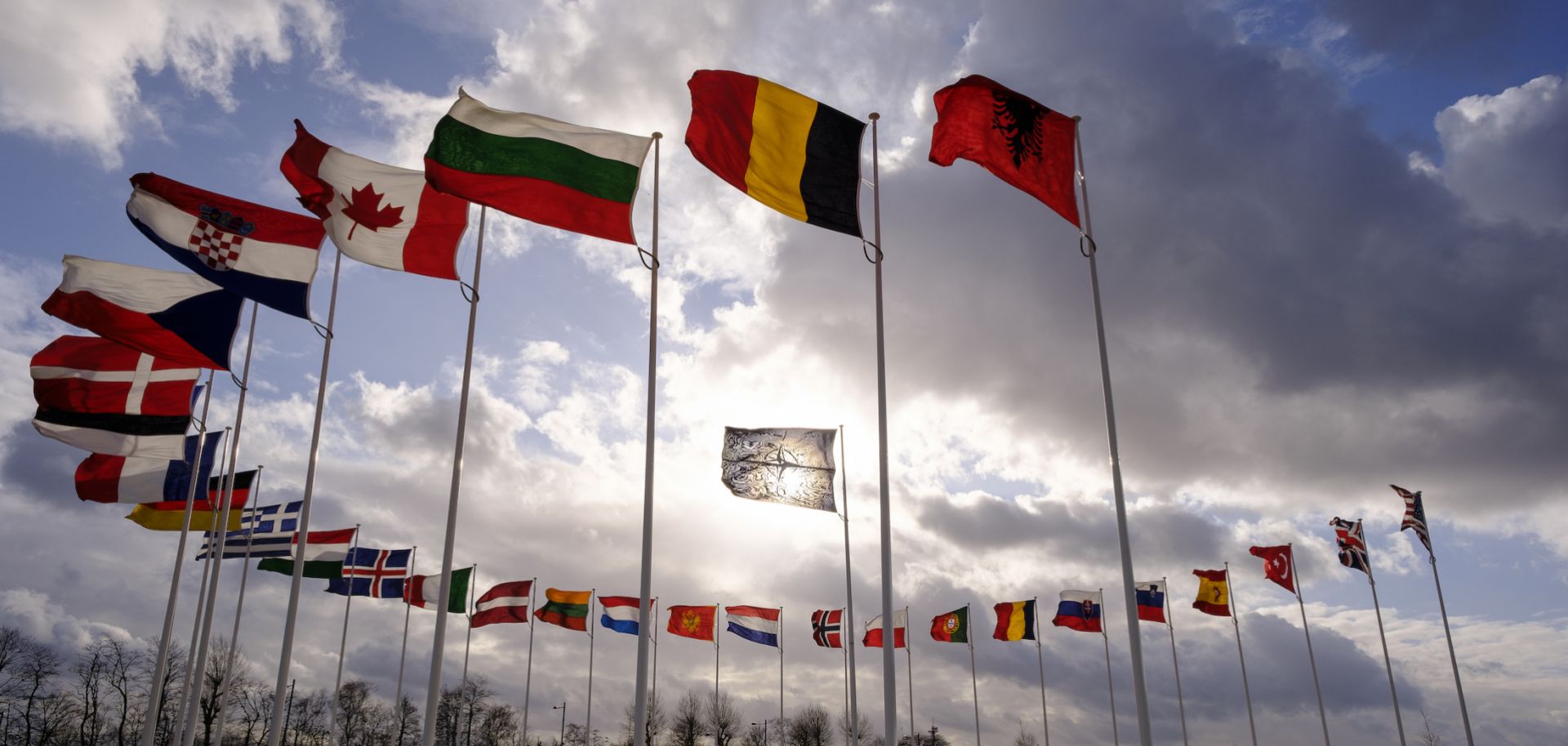
Views of the North Atlantic Treaty Organization headquarters on February 11, 2020, in Brussels, Belgium.
Russia's invasion of Ukraine is frequently characterized as part of a broader struggle between democracy and autocracy, a lens that the West also has used to counter Chinese actions. In a Feb. 24 press briefing, NATO Secretary-General Jens Stoltenberg brought his comments to a close by declaring, "Democracy will always prevail over autocracy. Freedom will always prevail over oppression." Less than a week later, in his first State of the Union address, U.S. President Joe Biden said, "In the battle between democracy and autocracy, democracies are rising to the moment, and the world is clearly choosing the side of peace and security." And more recently, European Commission President Ursula von der Leyen told France24 that "democracy is standing up against autocracy," highlighting the role the European Union and its partners are playing in countering Russian actions in Ukraine.
This ideological lens serves certain political purposes by creating a moral framework that Western leaders can use to encourage a unified and lasting response to the Russian invasion. Western leaders and thinkers have long equated democracy with freedom and human rights while associating autocracy with aggression and repression. This binary evokes the simplicity of former U.S. President Ronald Reagan's epithet for the Soviet Union as the "evil empire" and George W. Bush's labeling of North Korea, Iran and Iraq as an "axis of evil." Such emotional appeals are memorable and simpler than explaining the strategic significance of far-away Eastern Europe for U.S., Australian or South Korean national security. The democracy versus autocracy framework is bite-sized and easy to rally around, and it justifies the economic sacrifices citizens in the United States, Europe or other partner countries must accept in countering Russian actions.
But these simple slogans, if not carefully constrained, can take on a life of their own, complicating strategic options and leading to unachievably broad missions. Many U.S. allies and partners in the Middle East and Indo-Pacific are considered autocracies, such as Vietnam, which is a key rising regional partner for the United States. So framing the Russia-Ukraine war as a struggle between democracies and autocracies risks either constraining U.S. relations with its partners or undermining political unity by leaving room for Russia, China or others to accuse the United States and its partners of hypocrisy. The latter outcome would enable more countries to avoid picking sides in the war, thus undermining Western attempts to unify an economic and political response.
Attempts to reframe events in binary terminology simply run counter to the interests and actions of much of the multipolar world. China is a massive global economic consumer, producer and investor, and Russia remains critical to the supply of key mineral and agricultural commodities and military hardware. Few developing nations want or can afford to choose a side in a new global Cold War, and even key U.S. partners like Japan, South Korea and India retain critical connections to Russia and China. As Chinese and Russian information operations have highlighted several times, much of the world is not actively engaged in the West's current sanctions regime against Russia. This is often due to countries' lack of major economic ties to Russia, as well as to the prioritization of local issues over the far-away war in Eastern Europe.
The democracy versus autocracy framing also makes de-escalation in the Russia-Ukraine war nearly impossible, as a long-term struggle between two political systems will only end when one idea is victorious and the other is defeated. Even if Russia were to withdraw from Ukraine tomorrow, that would not end the assertion that Russia is an autocracy and not a democracy, thus prolonging the wider ideological conflict. The binary, therefore, encourages a Cold War framework of a constant struggle between two competing political systems.
But this time around, the democracies risk being seen as the long-term aggressors. Russia may be invading Ukraine now, but if the West's ultimate goal is not merely the withdrawal of Russian forces but the end of autocracy itself, then Russian and Chinese assertions that the West is trying to force political regime change become more believable. And if the West intends to advance democracies globally, these goals could encourage a revival of extreme Western liberalism, the missionary zeal to drive global political change and assert a single North Atlantic political philosophy as the only legitimate — and inevitable — global philosophy.
An ideological framework can also take on a political life of its own, as social dynamics can play a powerful role in a democracy's political process and policies. Politicians capitalizing on moral fervor may find themselves trapped by their own constituents, encouraged to take actions that may not match strategic necessities but are politically expedient. This can reduce options for working with active or potential partner countries when challenging larger strategic competitors like Russia and China. For example, while the impact of sanctions against Russian energy can be mitigated by expanded energy imports from other producers, social and political fervor can undermine logical efforts to increase imports from places like Iran or Venezuela, as these countries are also "autocracies."
Bifurcating the world into two competing political systems risks creating an ever-widening set of potential targets and fails to identify a clear achievable end goal. If autocracy itself is the target, then, in the simplest terms, the West is seeking to replace autocracy with democracy. But that raises several challenging questions. First, what is the line between democracy and autocracy? Are so-called flawed democracies OK? How does the United States manage relations with NATO allies Turkey or Hungary? Are soft autocracies OK? Should the West create space and incentives for the transition to democracy, or should it actively pursue the democratization of autocracies? Would that entail purely economic and political tools or military tools as well? Like the war against terrorism, which evolved from a focused U.S. response to 9/11 and continued well after the death of al-Qaida leader Osama bin Laden, a battle against autocracy can quickly become vast and ill-defined.
Finally, lumping all countries into one of two categories fails to account for the very different geopolitical positions of each country. China is not Russia, and Taiwan is not Ukraine. Superficial analysis conflates the two and shapes policy that may be inapplicable or even counter-productive. In the Cold War, had the United States recognized the political friction between the Soviet Union and China earlier, it may have been able to exploit the Chinese-Soviet split sooner, perhaps even undercutting the idea of the domino theory and altering U.S. policy toward Vietnam. A democracy versus autocracy framework is a valuable tool that can be used to shape and maintain cohesive action against Russia, but it needs to be carefully applied. Without tailoring policies to the geopolitical context and realities of different countries, the self-averred coalition of democracies risks costly and counterproductive policies.
