
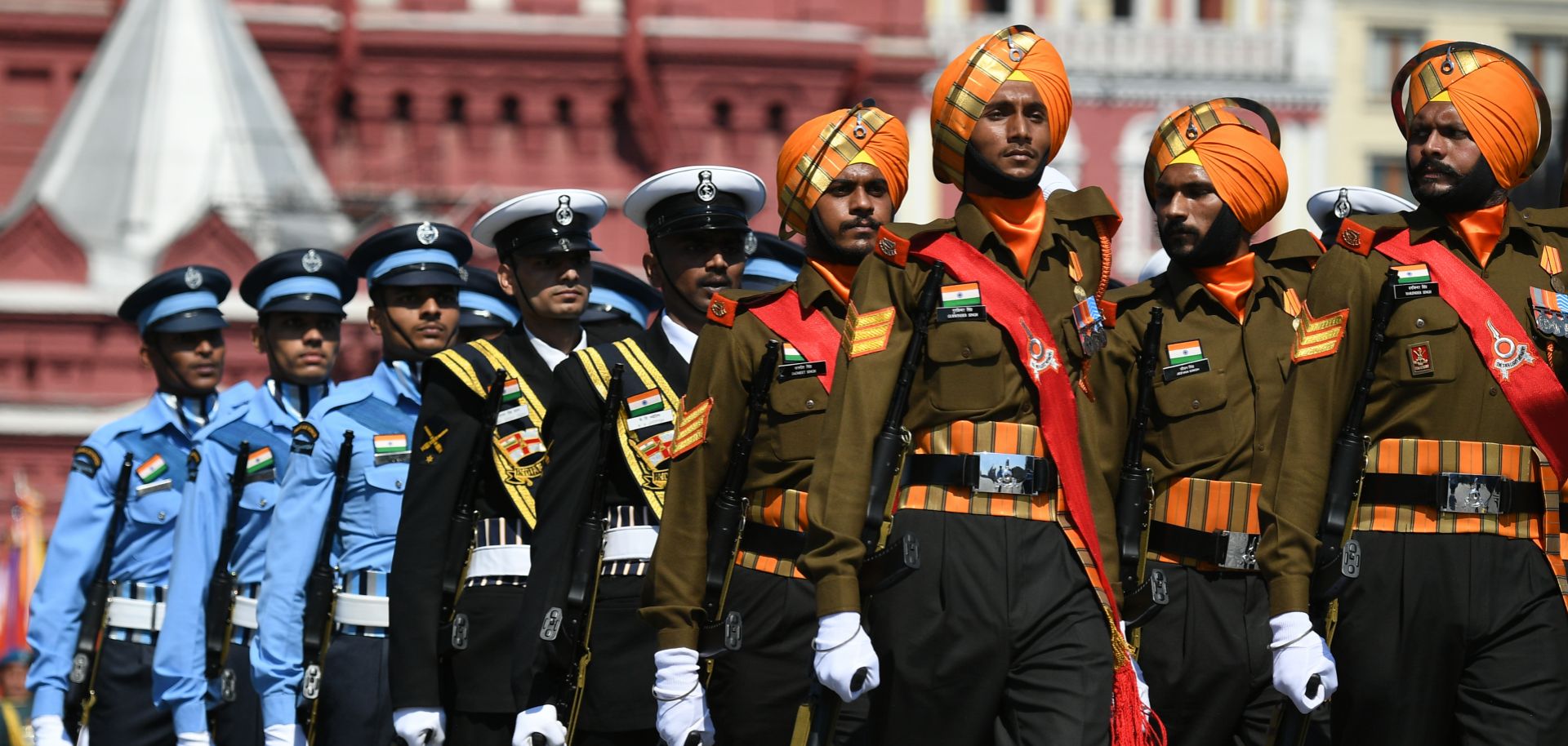
Members of India’s armed forces march in a military parade in Moscow's historic Red Square on June 24, 2020, to commemorate the 75th anniversary of the Soviet Union’s victory in World War II.
India will seek to remain neutral in the Russia-Ukraine conflict to maintain its defense ties with Moscow. But if the war intensifies and further isolates Russia, New Delhi may ultimately be forced to recalibrate its position to protect its alliance with the United States. In his statement at the emergency Feb. 24 meeting of the U.N. Security Council (UNSC) to discuss Russia’s invasion of Ukraine, India’s U.N. ambassador notably made no mention of Ukraine’s territorial integrity or sovereignty and appeared to avoid taking sides on the issue. The following day, India abstained on a U.S.-sponsored UNSC resolution that strongly condemned Russia’s actions in Ukraine. Then on Feb. 27, India again abstained from voting on another draft UNSC resolution to hold an emergency session on the Ukraine crisis in the U.N. General Assembly. Eleven of the UNSC’s 15 member states voted in favor of both the Feb. 24 and Feb. 27 resolutions, with only Russia voting against and India (along with China and the United Arab Emirates) abstaining. Many European and U.S. officials have taken note of India’s diversion from the majority. Some have even expressed anger over New Delhi’s lack of a clear stance on the crisis, despite Western calls for a strong and collective international response.
India’s dependence on Russian military supplies amid tensions with China and Pakistan explain New Delhi’s hesitance to condemn Moscow’s actions in Ukraine. Russia supplies roughly half of India’s total arms imports and 70% of its advanced military equipment, including battle tanks, aircraft carriers, nuclear-powered submarines and fighter aircraft. This reliance on Russian arms is unlikely to decrease in the medium term, as good ties with Moscow and constant defense supplies are all the more relevant at a time when India’s relations with its regional rivals China and Pakistan are tense. In addition, India lacks options to quickly diversify its defense imports and has also already placed a number of orders for Russian weapons that are scheduled to be delivered in the coming months. To retain its access to Russian defense supplies (and, in turn, its ability to deter threats from China and Pakistan), India will continue to try to avoid taking a strong stance on the Russia-Ukraine conflict. In the near term, New Delhi will likely also try to ensure the international sanctions imposed on Russian companies do not affect bilateral arms trade by entering into a rupee-ruble trade arrangement with Russia to bypass the SWIFT system for global financial transactions.
- According to the Stockholm International Peace Research Institute, 49% of India’s total arms imports came from Russia between 2016-2020 (India accounted for 23% of Russia’s total arms exports during the same time period). New Delhi also recently signed a $5 billion deal for the procurement of controversial Russian-made S-400 air defense systems.
- India also purchases arms from the United States, Israel and France. But its imports from these countries are still dwarfed by those it receives from Russia. India’s domestic arms production will also take many years to pick up.
- The ongoing standoff at sectors of India’s northern and eastern border with China and both sides’ enhanced military deployment have led to sustained tensions between New Delhi and Beijing since May 2020. The Taliban’s recent takeover of the India-friendly government in nearby Afghanistan and the subsequent withdrawal of U.S. troops from the country have also increased India’s concerns about regional stability — especially given the Taliban’s historically close ties with New Delhi’s archrival Pakistan.
If the war in Ukraine continues for weeks, India’s neutral position could become unsustainable. On March 2, an Indian student was killed in an attack in eastern Ukraine’s Kharkiv city. Russia has since said it would look into the student’s death and consider ensuring safe passage for other Indian citizens in Ukraine. Moscow’s response to the incident exemplifies the bind India is in by signaling that Russia sees India’s neutral stance as tacit support for Moscow’s actions in Ukraine. New Delhi does not want to take sides, but in doing so, it risks inadvertently being seen as backing Russia in the conflict — making it all the more difficult for New Delhi to respond to the crisis. India also justified its choice to abstain from voting on the UNSC resolution to condemn Russia by vaguely expressing “regret that the path of diplomacy was given up” and highlighting that the global order was based on the U.N. charter, the principles of national sovereignty, and the territorial integrity of U.N. member states. This position will make it increasingly hard for India to remain silent against Russian aggression, particularly if the war rages on without a diplomatic and constructive resolution-building process.
A prolonged conflict in Ukraine could eventually force India to adopt a tougher position on Russia in order to preserve its ties with the United States. India sees Washington’s growing interest on Indo-Pacific issues as a potential strategic counterweight to China’s rise. While India needs Russian arms to deter China in its border disputes, it also needs the West’s support against China’s growing economic ties and military presence in South Asia and the broader Indo-Pacific.
- India’s membership in the Quadrilateral Security Dialogue — which also includes the United States, Australia and Japan — exemplifies its interest in building a strategic alliance against China.
