
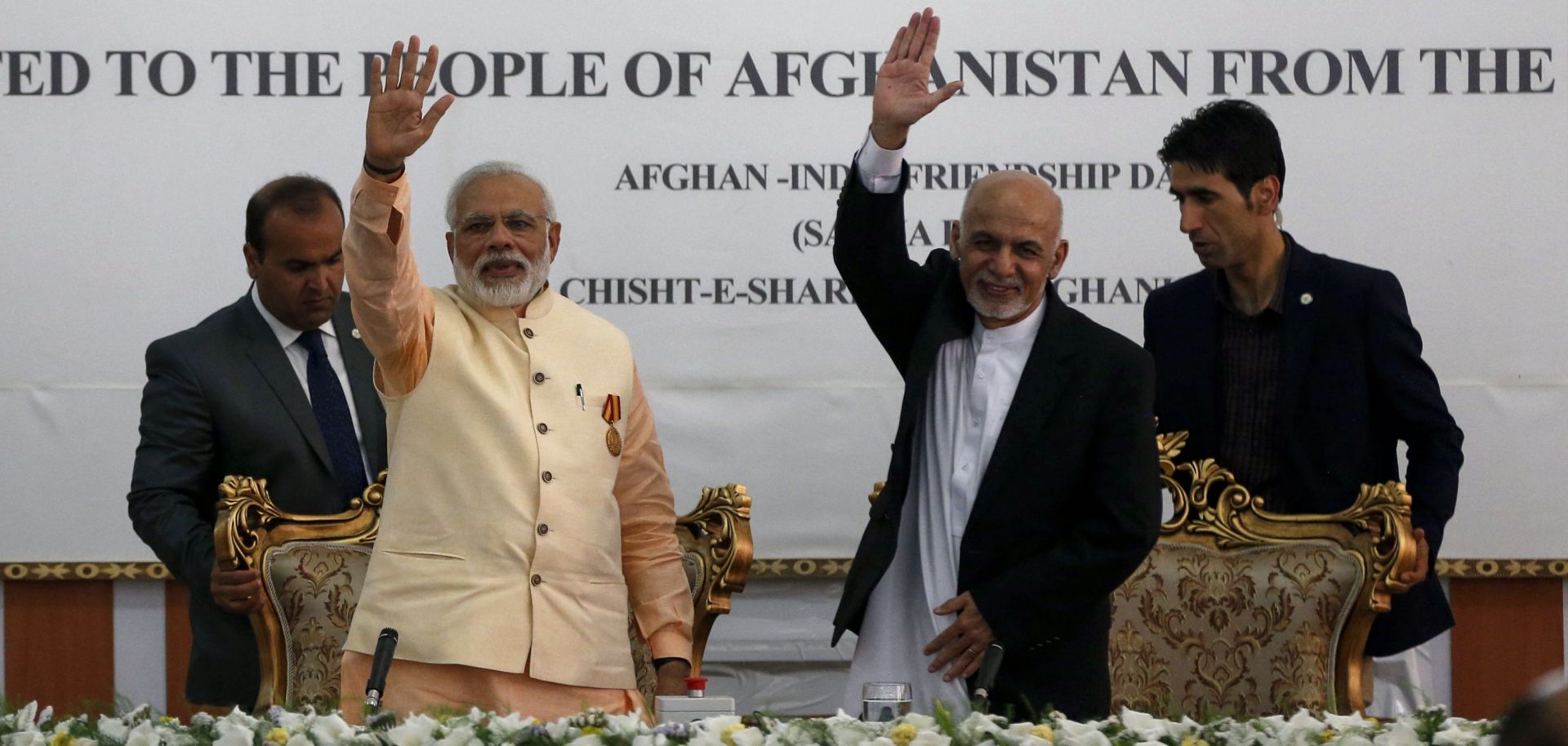
Indian Prime Minister Narendra Modi (left) and then-Afghan President Ashraf Ghani wave during the inauguration of the Afghan-India Friendship Dam in Herat, Afghanistan, on June 4, 2016.
The Taliban’s takeover of Afghanistan has created political, economic and security challenges for India. New Delhi’s strategy will focus on preserving some degree of political engagement with Kabul while reaching out to countries like Russia and Iran to influence regional events and try to mitigate the risk of terrorism. Lodged between regional rivals China and Pakistan, Afghanistan has great strategic value for India. India’s relationship with Afghanistan has also helped India with its national security and economic goals for the region. For New Delhi, influence in Afghanistan by means of a strong engagement with the former democratic government has been helpful in keeping its neighboring nemesis Pakistan in check. Over the past 20 years, India has built up large strategic capital through developmental investment and people-to-people ties in Afghanistan. Economically, Afghanistan has also become an important node for facilitating India’s trade and connectivity with West and Central Asia. But with the Taliban now ruling the country, the soft power New Delhi has spent years building up in Afghanistan now hangs in balance.
- Afghanistan is an important piece of the International North-South Transport Corridor, an approximately 4,500 mile-long multi-mode network of ship, rail and road routes for moving freight between India, Iran, Afghanistan, Azerbaijan and Russia, as well as Central Asia and Europe more broadly. Afghanistan was also envisioned to be a key node for the transport of goods from India to Central Asia.
- Over the past 20 years, India spent roughly $3 billion to bolster the now-deposed U.S.-installed regime in Afghanistan. Since 2001, New Delhi has helped build roads, dams, power lines, clinics and schools across the country, and also trained civil servants and Afghan officers, in addition to providing scholarships to thousands of Afghan students.
- India entered into a strategic partnership with the former Afghan government in 2011, after which New Delhi engaged heavily in economic reconstruction and building up diplomatic relations in Afghanistan.
- India also funded the 135-mile highway connecting the Delaram District in Afghanistan to the border of Iran. The $150-million Zaranj-Delaram highway holds high strategic significance since the road connects India to landlocked Afghanistan via Iran’s Chabahar port bypassing Pakistan.
The Taliban takeover, however, has created geopolitical challenges that will likely erode India’s ties with Afghanistan. The Taliban’s rapid advance in Afghanistan over the summer was as much of a shock to India as it was to the rest of the world. Unlike Russia or China, India never engaged with the Taliban on any level and supported the fragile democracy backed by the United States. Taliban leaders, meanwhile, don’t trust India, given New Delhi’s support to the former Afghan government and ongoing rivalry with the Taliban’s main partner, Pakistan. This will make it hard for India and the new Taliban-led Afghan government to reach even minimal cooperation in the future.
- Despite security assurances from the Taliban during and after the fall of Kabul in mid-August, the Indian government decided to go ahead with evacuating all of its nationals from the embassy in the Afghan capital.
- Indian Prime Minister Narendra Modi condemned the transfer of power to the Taliban for not being inclusive during the Shanghai Cooperation Organization summit held on Sept. 18 in Tajikistan.
Pakistan, India’s historic rival, will likely work with Afghanistan to further reduce New Delhi’s influence in the country in the coming months. India’s engagement in Afghanistan in the recent decades has fueled concerns in Pakistan of being encircled by India to the east and by the pro-Indian government to the west and north. Pakistan’s historical links to the Taliban — which has included providing Taliban fighters safe havens, indirect arms and financing over the years — had also strained Islamabad’s relationship with the former Afghan government. In this regard, the Taliban victory has opened the door to a more friendly government in Kabul, where Pakistan can increase its influence. As a result, Pakistan will likely try to prevent India’s close engagement with the Taliban to maintain its leverage over Kabul, while also working closely with China and Afghanistan’s other immediate neighbors to spearhead regional cooperation. Pakistan can also now leverage its strategic ties with the Taliban to shift assets in event of a military flare-up on its border with India, effectively limiting New Delhi’s reach to any conflict zones.
- The Taliban’s leadership council, known as the "Quetta Shura,” had reportedly been operating from the Pakistani city of Quetta for the majority of the past 20 years leading up to the fall of Kabul in August.
- In 1999, during their first reign in Afghanistan, the Taliban gave the hijackers of an Indian passenger jet safe passage to Pakistan after they landed in the southern Afghan city of Kandahar. New Delhi also remains deeply wary of the Taliban’s close links to Pakistan’s military spy agency, Inter-Services Intelligence.
China’s growing influence in Afghanistan poses another challenge for India, considering New Delhi and Beijing's ongoing strategic disputes. In recent weeks, China has been proactively engaging with the Taliban and appears ready to work with them. Now that there is some degree of stability in the country with the formation of a formal caretaker government, China — facilitated by Pakistan — will likely support Afghanistan through both humanitarian and developmental aid.
- China, along with Pakistan and Russia, kept its embassy open during the Taliban takeover and the chaotic evacuations that followed.
- On Sept. 9, just two days after the Taliban unveiled their internationally controversial caretaker government, China pledged $31 million worth of humanitarian aid to Afghanistan.
- The Taliban have stated that China is one of the most important neighbors for their economic development and have expressed a willingness to join Beijing’s massive Belt and Road Initiative.
The Taliban's takeover of Afghanistan is also creating new security threats for India by raising the risk of cross-border terrorism. Militant groups active in Afghanistan and other nearby countries will likely recruit the thousands of prisoners freed during the Taliban takeover of Kabul. Indeed, there are reports that Jaish-e-Mohammad (JeM), a militant group that operates from Pakistan, has already begun recruiting fighters from Afghanistan. Pakistani armed forces are likely to indirectly facilitate attacks or militant infiltrations into India. Although the Taliban have assured India that no terrorist groups will operate from Afghanistan against India, there is no guarantee the Taliban even have the capability to keep militancy from spreading across Afghanistan. In addition to JeM, regional Islamic State and al Qaeda affiliates also pose a threat to India. The Pakistan-based militant group Lashkar-e-Taiba (LeT), for example, has close ties with al Qaeda, raising the potential for an increased flow of fighters from Afghanistan to India-Pakistan border regions. Despite lacking a stronghold in India, the Islamic State has also been able to recruit individuals from the southern Indian states of Kerala and Karnataka via propaganda and radicalization campaigns on social media.
- The head of JeM visited Afghanistan shortly after the fall of Kabul to congratulate the Taliban and seek their support for JeM’s operations against India in the disputed Kashmir region.
- On Aug. 31, the Indian government’s counter-terrorism task force reported it was closely monitoring 25 Indian nationals suspected to be working with the Islamic State Khorasan Province (ISIS-K) in Afghanistan on online efforts to recruit new Indian fighters.
Given its limited options, India’s immediate strategy in Afghanistan will focus on making timid gestures toward political dialogue while trying to mitigate security threats. India now has little control over the situation in Afghanistan due to Pakistan and China’s influence in the country and close relationships with the Taliban. New Delhi will thus likely remain cautious in approaching Afghanistan in the short term, waiting to see how the new Taliban-led governance structure develops while also monitoring for any new terrorist activity in the country. While it’ll be slow to grant formal recognition to the Taliban government, India will likely attempt to establish relations with Afghanistan’s new leaders in the coming weeks in an effort to keep basic communication channels open. The existing infrastructure developed by India and prospects of regional connectivity projects could be initial avenues of engagement in the country. To deal with the security threat, New Delhi may further increase counterterrorism operations and troop deployments in the Jammu and Kashmir region, as well as other border states like Punjab and Rajasthan. The Indian government has already expressed an urgency to deploy an anti-drone system at the border to effectively deal with threats posed by militants in the region using such technologies to launch attacks on India.
- In June, a Qatari official announced that an informal meeting between Indian diplomats and Taliban representatives had taken place in Qatar.
- On Aug. 31, India’s ambassador to Qatar officially met with Taliban representatives in Doha after Qatar hosted an informal meeting in June between Indian diplomats and Taliban leaders.
In addition, India will work with other regional countries to protect its interests in Afghanistan and influence developments in the region. Following the Taliban takeover in Afghanistan, the Shanghai Cooperation Organization (SCO) — which includes Russia, China, India, Pakistan, Iran and most Central Asian countries — has emerged as the focal group for nearby countries to develop some form of a joint strategy to prevent a wider security crisis in the region. India is likely to use this forum to work with Iran and Russia and, to a lesser extent, Tajikistan on Afghanistan-related issues. If the situation in Afghanistan becomes volatile again and the terrorist threat increases significantly, India may eventually also join Iran and Tajikistan in supporting the Panjshir resistance and/or other anti-Taliban movements that arise in Afghanistan. But this is an unlikely scenario, as such movements are unlikely to fully stamp out the Taliban — resulting in only a severe deterioration of bilateral ties and a worsening of the overall security situation in the region. Supporting resistance forces would also risk triggering a wider civil war in Afghanistan between the Taliban and various local movements, sending more Afghan refugees into nearby countries while exacerbating overall security risks in the region.
- Iran has a mixed complex relationship with the Taliban due to their ideological differences and the Taliban’s discriminatory treatment of Hazaras, a mostly Shiite ethnic group in Sunni-dominant Afghanistan. Russia, meanwhile, is keen to restrict any spread of violence and radical ideologies into Central Asian states, which are in Moscow’s own sphere of influence.
- Tajikistan is the only country in the region that has criticized the Taliban for excluding ethnic Tajiks from the new Afghan government administration and is believed to be secretly supporting the resistance movement in Afghanistan’s Panjshir Valley.
