
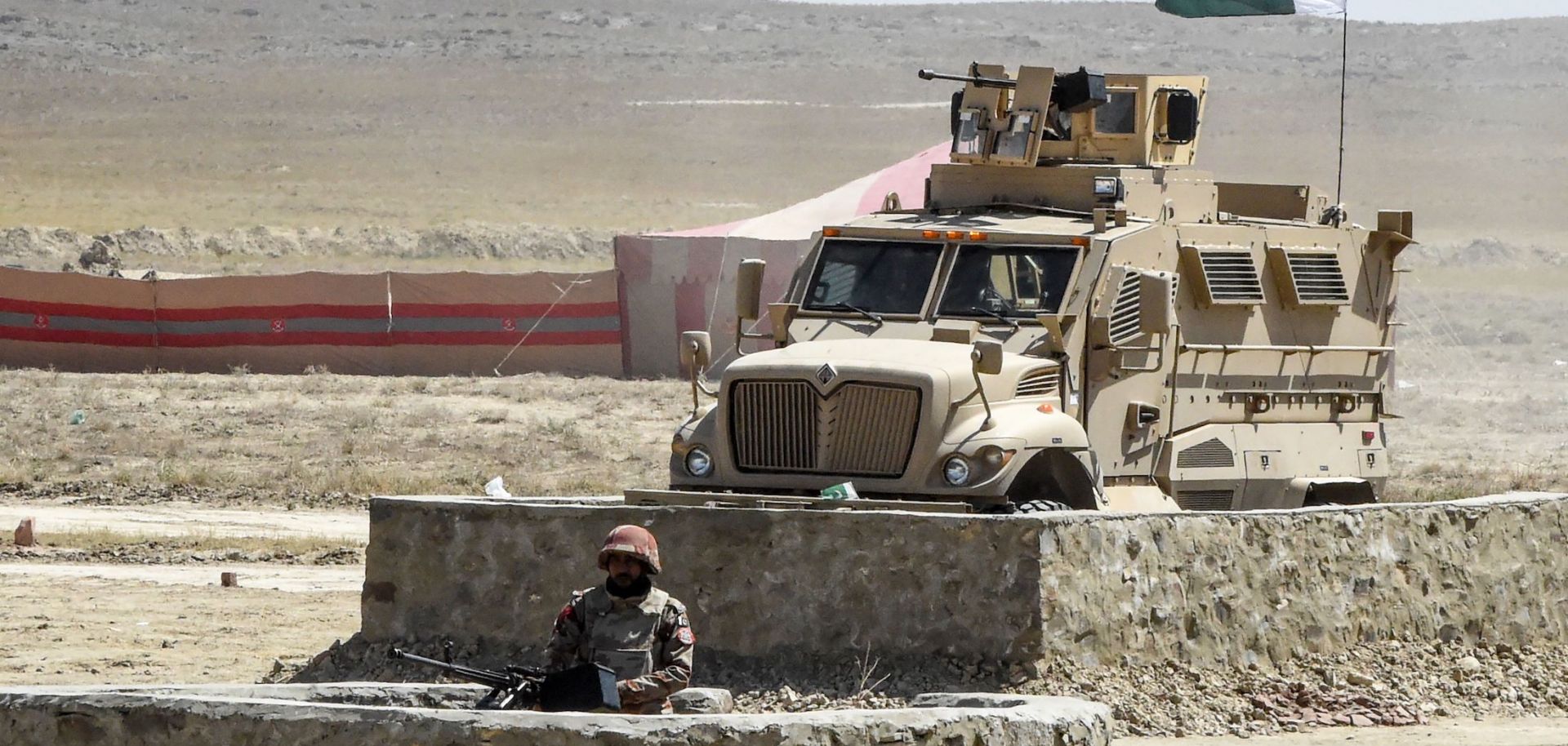
Pakistani paramilitary forces stand guard near the Afghan border in Pakistan's southwestern Balochistan province on Sept. 16, 2020.
As the battle for control of Afghanistan unfolds following the withdrawal of foreign troops, Pakistan will aim to consolidate its influence in the country while dealing with threats of militant activity in its own territory in order to ensure the security of economically vital projects under the China Pakistan Economic Corridor (CPEC). On July 27, the United Nations confirmed that the Pakistan-based terrorist group Tehreek-i-Taliban Pakistan (TTP) has maintained ties with the Afghan Taliban. According to the U.N. report, approximately 6,000 TTP members are currently present in Afghanistan’s eastern district bordering Pakistan, where they’ve been actively providing military support to the Taliban’s ongoing offensive against the Afghan government. Pakistan has historically relied on its good relationship with the Afghan Taliban to keep TTP fighters in check. As it awaits the rise of the ultimate power bearer amid the turmoil in Afghanistan, Islamabad will focus on preventing violence in its western provinces that poses a serious threat to CPEC-related Chinese investments. Pakistan will also seek to maintain its role as the key mediator between the Taliban and Kabul to secure its influence over the next Afghan government, while at the same time limiting the extent of its ties to the Taliban to avoid international scrutiny.
- Since the Taliban began its offensive following the announcement of U.S. withdrawal on April 14, the number of Taliban-controlled districts in Afghanistan has tripled from 73 to 221. The militant group also now controls strategic border crossings.
- Current U.S. estimates suggest that the Afghan government will fall within the next six months.
Pakistan’s future actions in Afghanistan will be guided by its ties to the Taliban, as well as its strained relationship with the current Afghan government. Pakistan’s close ties and influence with the Taliban will enable Islamabad to remain a major player throughout the transitional period in Afghanistan, regardless of what form it takes. Pakistan has historically provided diplomatic support to the Taliban, and has also offered sanctuaries for the group’s leaders and their families. But while this grants Pakistan some leverage with the Taliban, just how much remains unknown. Indeed, despite Islamabad’s demands, the Afghan Taliban has yet to dissuade their Pakistani counterpart, the TTP, from attacking Pakistani government forces. Still, Islamabad has a better shot of influencing the Taliban’s actions compared with the current Afghan government, which remains suspicious of Pakistan’s mediatory role — increasing difficulties and tensions in any intra-Afghan peace negotiations.
- Pakistan supported the Taliban government following the Soviet withdrawal and civil war after 1992. In the early 1990s, Pakistan provided shelter to the Rehbari Shura, the Taliban’s leadership council, which remains based in Pakistan. Families of many Talibani leaders and fighters also still live in Pakistan’s western provinces.
- Pakistan played an important role in convincing the Taliban to participate in talks with the Afghan government in 2020. The United States has acknowledged Pakistan’s role in the process.
- Many Afghan officials have publicly denounced Pakistan’s role in strengthening the Taliban’s capabilities by providing funds, arms and a safe haven to Taliban fighters and leaders.
- On July 14, Taliban fighters in Afghanistan seized control of the Spin Boldak border crossing with Pakistan. Afghan officials claimed Pakistani forces threatened to launch missiles at Afghan forces if they tried to recapture the major crossing, which Pakistan’s foreign ministry has since denied.
- In a July 17 speech, Afghan President Ashraf Ghani condemned Pakistan for sheltering terrorists. He also said more than 10,000 Taliban fighters had entered Afghanistan from Pakistan after the United States began withdrawing troops.
- Afghanistan and Pakistan have also long sparred over the governance of their shared 2,430-kilometer (1,510-mile) border, known as the Durand Line, which stretches through the Pashtun tribal heartland from Peshawar to Kabul.
Pakistan’s strategy will remain focused on consolidating its regional influence and preventing spillover violence by leveraging its influence with the Taliban. As Taliban fighters continue to gain ground amid the withdrawal of international forces in Afghanistan, there are three main ways the conflict could unfold:
- An all-out civil war. The Taliban’s gains could push Afghanistan into a larger civil conflict, with various ethnic groups and local militias fighting for local territories as the Afghan government scrambles to defend provincial capitals and cities. This would likely result in sizable clashes in northern Afghanistan where ethnic Tajiks and Uzbeks defend their regions. In this scenario, the volatile security situation in the north would pose more of a direct security threat to Afghanistan’s northern Central Asian neighbors compared with Pakistan. Islamabad would thus likely let the fighting in Afghanistan play out without intervention and tacitly support the Taliban, while still increasing security along its western borders to keep any potential militants from entering Pakistan.
- A successful Taliban offensive. The Taliban currently claims to control 85% of territories in Afghanistan). Should the group surround the provincial capitals and wait for the fall of the Afghan government, Pakistan would also likely let the fighting play out. However, if the Taliban seeks to establish solo rule, Pakistan would be constrained in its extent of tacit support for the Taliban due to the threat of international isolation. Islamabad would face additional pressure from the United States to break all ties with the Taliban and dismantle the sanctuaries within Pakistan. The subsequent rise of militant extremist groups within Pakistan would also create a significant security crisis that Islamabad would then need to focus resources on to contain.
- A political solution. This outcome, while unlikely, would entail the Taliban and the current Afghan government reaching a power-sharing agreement. Pakistan would likely seek to work together with the newly formed government to control the growth of terrorist groups in border regions, thus limiting the near-term security threat. The long-term survival chances for a Taliban-led Afghan government are slim, based on historical precedent. But in the offchance such a government is able to retain credibility and control over the country for an extended period, Pakistan could also facilitate an economic relationship between China and Afghanistan, increasing the potential for economic growth in the wider region.
With prolonged conflict in Afghanistan the most likely scenario, Islamabad will focus on mitigating or containing the resurgence of the Pakistani Taliban, which poses a security risk to Chinese projects under the strategic CPEC. Emboldened by the Afghan Taliban’s territorial gains, TTP fighters have recently begun regrouping along border regions in Afghanistan. With the recent consolidation of numerous splinter groups including al Qaeda affiliates, the group is poised to intensify its activities in Pakistan’s urban centers where such militants have had strong networks in the past. This poses a serious threat to Chinese investments and nationals in Pakistan, as both separatist insurgents and Islamist terrorists view China as being in league with a Pakistani state that they despise. The importance of CPEC and China cannot be overstated for Pakistan. Extending the CPEC would facilitate infrastructure development in Pakistan, particularly for energy transport from the Middle East. Besides strategic alignment against India, China is also Pakistan’s most important defense and economic partner. Loss of Chinese projects or future investments would thus greatly hurt Pakistan’s economy and development in the long run.
- The TTP recently reaffirmed its commitment to a protracted struggle against the Pakistani state and is trying to broaden its support base to include the disaffected Pashtun and Baluch ethnic groups.
- According to the aforementioned July 27 U.N. report, five splinter groups have formally pledged allegiance to the TTP in July-August 2020 under an initiative pushed by the TTP’s new chief, who has reportedly also been successful in winning over the support of groups associated with al Qaeda and the Punjabi Taliban.
- In April 2021, TTP detonated a bomb in a luxury hotel in Quetta targeting the Chinese ambassador. More recently, an alleged bomb blast on a bus killed nine Chinese workers working for a hydropower plant in Pakistan’s Khyber Pakhtunkhwa province.
- Baloch insurgents in the west can also take advantage of volatility across the border regions to regroup and organize against the Pakistan government, further destabilizing the region’s security and economy.
