
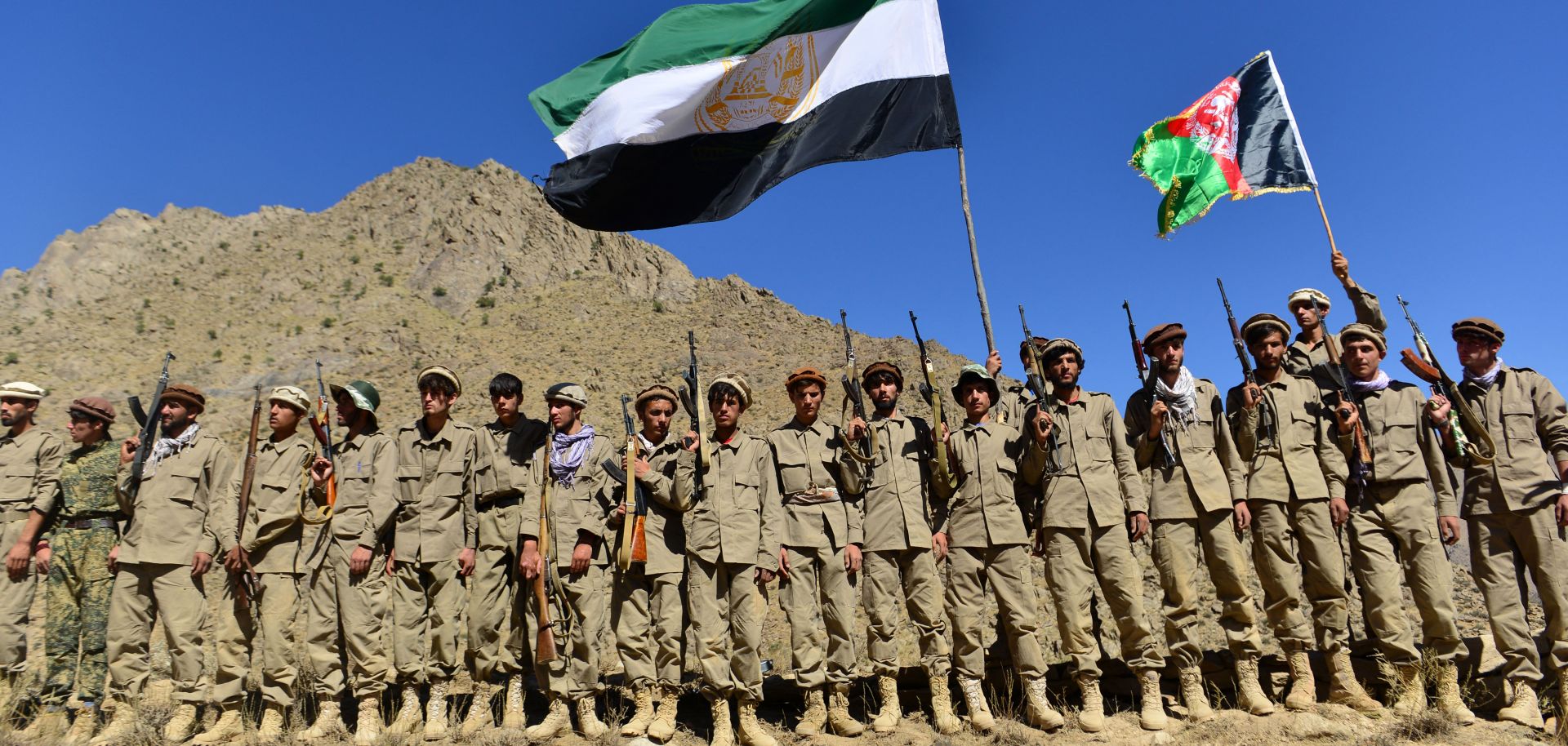
Anti-Taliban resistance forces take part in a military training exercise in Afghanistan’s Panjshir province on Sept. 2, 2021.
The capture of Afghanistan’s Panjshir Valley is a political and propaganda victory for the Taliban; several additional factors will determine the future of the National Resistance Front. The Taliban announced they had taken control of the resistance holdout on Sept. 6, a day before announcing the makeup of their new interim government. Elements of the National Resistance Front (NRF) admitted the Taliban had taken the government offices in the Panjshir Valley, but claimed that the resistance forces had shifted from conventional warfare to guerrilla warfare, taking refuge in the mountains. While reliable information remains scarce, we are monitoring several key questions to assess the direction of future resistance to Taliban rule.
While a shift to guerrilla tactics makes sense, it may also reflect the NRF’s inability to form a cohesive fighting force.
- Even as the NRF was forming, several reports indicated that the resistance had difficulty forming a cohesive fighting unit, and the Taliban chose to assault the valley quickly — preventing the NRF from overcoming internal differences, unifying tactics and fighting styles.
- Shifting away from conventional warfare may also highlight the inherent weakness of large, poorly organized massed forces in a constrained area. While the Panjshir Valley provided shelter and a historically symbolic location to host the resistance forces, it also left these forces vulnerable to the Taliban blockade and artillery attack.
- Breaking up into smaller units and shifting to guerrilla operations — whether as a result of poor cohesion or as an intentional strategy — disperses the resistance and may limit the Taliban’s ability to squeeze their supplies and recruitment.
The NRF’s calls for a national uprising have stirred only limited responses, raising questions of internal support and fear of Taliban reprisals.
- One challenge for a more dispersed guerrilla movement will be ensuring receptive areas for rest, resupply and training. There have been limited responses to NRF head Ahmad Massoud’s call for a national uprising, but it is still early days, and the active presence of small bands of guerrillas may resonate more than a call from a distant valley.
- If past patterns are any indication, the NRF may find greater support in the ethnic Tajik and Uzbek areas of Afghanistan. This would keep the resistance forces away from Kabul and the Pashtun areas of the south, concentrating fighting in the north.
- The growing size and importance of cities in Afghanistan raise questions of whether the NRF will be able to raise small resistance units in the cities, or if the Taliban will maintain tighter control over urban areas, leaving the resistance in rural spaces. In addition to Kabul and traditional Northern Alliance-sympathetic areas like Mazar-e-Sharif and Kunduz, key border cities will be important to monitor, particularly along the Iranian frontier.
The NRF called for external resupply prior to losing control of the central Panjshir Valley, but it remains to be seen how foreign support will manifest, and if Afghanistan could devolve into a regional proxy war.
- Despite some early reports of helicopter resupply from Tajikistan, it does not appear that any significant foreign assistance entered the Panjshir Valley, potentially because of the very short time between the concentration of resistance forces in the valley and the Taliban assault. With the resistance forces shifting to the mountains, they likely left behind much of their heavy equipment and may be limited in ammunition. While some may be captured from Taliban forces in combat, the NRF will need to establish new supply lines to ensure it is able to continue fighting.
- Afghanistan has relatively porous borders, and arms smuggling is common. Basic supplies will thus be relatively easy to access over time, but any major improvements in NRF arms, or supplies for any major assault, may require intentional outside support. Tajikistan is one likely avenue, with possible tacit Russian backing. Iran may also be another source of support. Concerned about the impact of Taliban control on its own border regions and possible Pakistani influence with the Taliban, Tehran may see the NRF or other militants as a proxy to protect its interests and counter Islamabad.
Finally, the question remains whether the NRF will be able to find bases of operations inside Afghanistan, or if it seeks to move its core training and leadership operations to neighboring Tajikistan.
- Over the last two weeks, there have been multiple rumors, each time denied, that key leaders of the resistance have left Afghanistan for Tajikistan. Should the NRF fail to hold together, it is more likely that its leadership sets up core operations across the border — with or without the Tajik government’s direct support and approval.
- There is a long history of guerrilla forces setting up operations in neighboring countries; and in Central and South Asia, it is often a norm. While this would provide the Taliban with a political and rhetorical win, it would also limit Taliban responses, unless they wanted to begin a border war with a neighbor while still trying to manage internal instability.
