
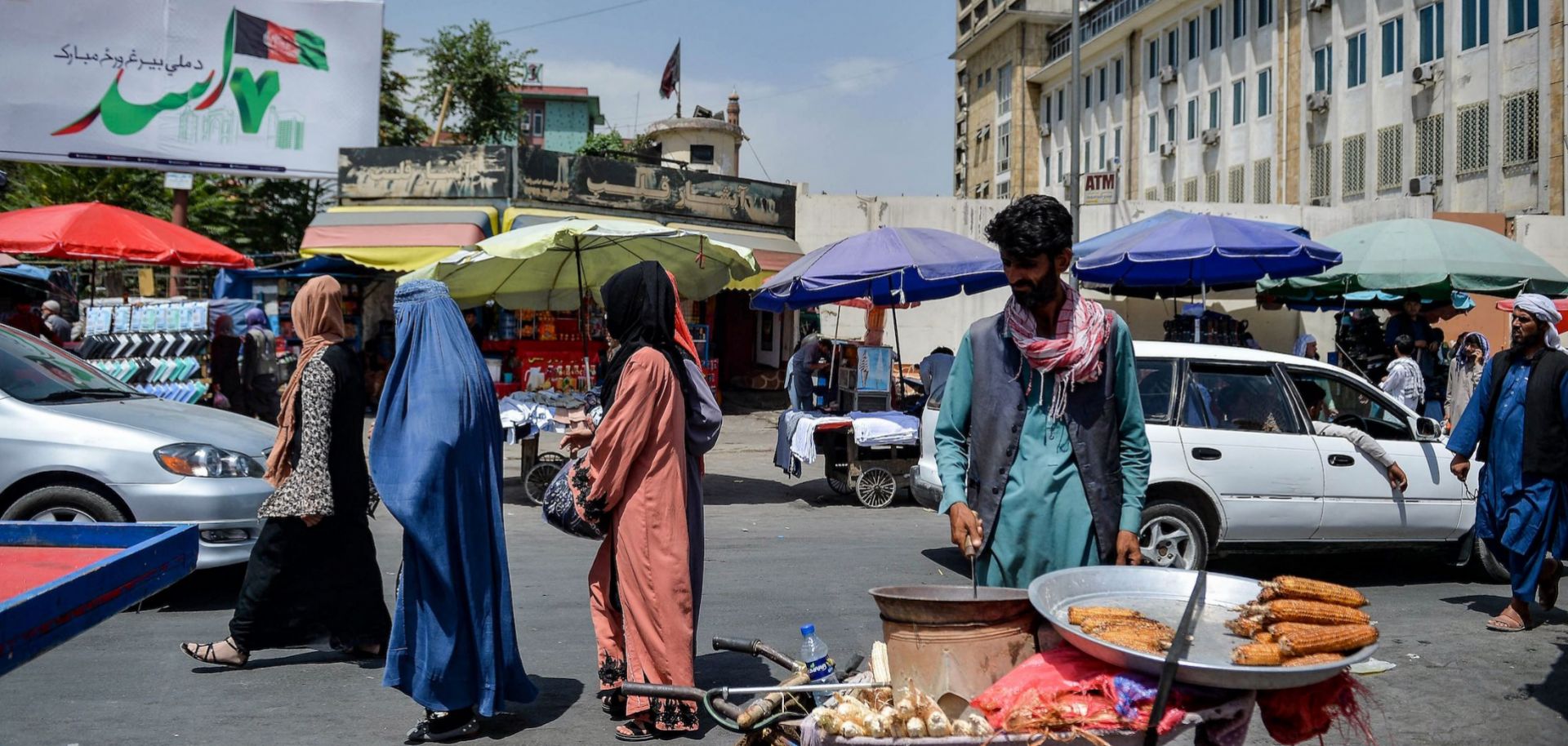
Afghan women shop at a market area in Kabul on Aug. 23, 2021, following the Taliban's takeover of the country.
The Taliban will struggle to provide core government services, maintain infrastructure and generate public investment to support growth in Afghanistan’s largely aid-dependent economy, which will create room for internal dissent and unrest by leaving subsistence agriculture and illegal activities as the main sources of revenue in the war-torn country. The Taliban takeover will exacerbate Afghanistan’s pre-existing economic challenges, while the combined effects of COVID-19 and a severe drought will create new ones.
- According to a February 2021 report released by the U.S. government’s Afghan Study Group, the poverty rate in Afghanistan is now estimated to be as high as 72%, up from 55% in 2017 — driven largely by the ongoing COVID-19 crisis.
- In 2020, the U.N. Development Program ranked Afghanistan 170 out of 189 countries and territories in terms of human development and also estimated that more than one million Afghans were internally displaced.
- According to a recent appeal from the Food and Agriculture Organization of the United Nations (FAO), some 7 million Afghan farmers and herders are currently at risk due to increased drought conditions, and the current harvest is expected to be 20% lower than in 2020.
The Taliban’s most immediate goal will be to secure the provision of basic services, as well as the availability of food and medicine for the Afghan population. In doing so, Taliban leaders will seek to stabilize the country internally and provide a relatively safe environment for foreign non-governmental organizations (NGOs). Afghanistan has changed since the Taliban’s previous rule between 1996-2001, as more urban Afghans have higher expectations of basic services including electricity, water and sewers. This will require trained labor who receive regular salaries and supplies to keep basic services operational. Without these services, basic city functions would break down, creating greater discontent against the Taliban that could increase resistance to their control of urban areas. But isolation from international finance and the freezing of Afghanistan’s international assets after the Taliban takeover have left the country’s import-dependent formal economy on the brink of collapse with few sources of foreign exchange as it struggles to resume output and pay for imports.
- Nearly all of Afghanistan’s foreign exchange resources are frozen, including up to $9.5 billion in central bank reserves held almost entirely in U.S. banks.
- The International Monetary Fund (IMF) has also suspended lending to Afghanistan, which included $200 million already disbursed of $600 million in commitments. Afghanistan has been barred from accessing an additional $440 million under the IMF’s recent allocation of Special Drawing Rights as well due to a lack of international recognition of the Taliban.
- Assistance from multilateral development banks and bilateral donors that exceeded $550 million in 2020 has also been suspended.
- The Afghan economy is mostly cash-dependent, with domestic credit in 2020 equivalent to only 3% of GDP and only 10% of the population holding bank accounts.
Dependency on economic support from Western countries will likely force the Taliban to constrain or even attack other groups inside Afghanistan to show their commitment to keeping the country from becoming a transnational terror hub. The Taliban will be reliant on foreign governments and NGOs for both aid, as well as help to distribute that aid. This will require the Taliban to ensure some degree of security for foreign workers and demonstrate at least some effective logistics capability for distribution (corruption is already endemic). The Taliban will also have to demonstrate more “moderate” social control to avoid a politically instigated shutdown of aid flows. As a result, the Taliban will face both the need to counter the National Resistance Front of Afghanistan (NRF) and other opposition forces (including ISIS-K), and may at the same time lose the support of its erstwhile allies. The Taliban’s desire to show a more moderate face may drive splits within their ranks and create new internal challenges for the government.
- According to the World Bank, only 22% of Afghanistan’s $11 billion in annual expenditures were provided domestically, which shows the country’s dependence on foreign financing and assistance.
- Prices of food were reported to be up by as much as 35% in the week after the Taliban takeover, according to Kabul residents cited by Bloomberg. People on the ground quoted in other reports have also said prices of cooking oil and gas up have risen as much as 50%.
- Banks in Afghanistan were shut down and ATMs quickly ran out of cash in the wake of the Taliban’s capture of Kabul on Aug. 15. On Aug. 21, Western Union and MoneyGram also halted cash transfers — preventing the Afghan diaspora from sending money back home, which accounted for 4% of Afghanistan’s GDP in 2020.
- The Taliban have promised banks would reopen “in the near future” and government employees would be paid. But without access to foreign currency, the Afghan currency is virtually worthless and there are anecdotal reports of shortages developing as people hoard non-perishable commodities.
Even if the security situation improves in the coming months, it is unlikely to substantially help the formal economy and reduce the role of illegal activities. Millions of Afghans will continue to depend on subsistence agriculture and will see a further deterioration of their living standards. The IMF estimates that security expenditures accounted for only one-third of government spending in 2020, which means that a more stable security situation would only have a modest impact on government spending. In the meantime, the United Nations estimates that the Taliban annually generates between $300 million and $1.6 billion in criminal activities, including opium production, drug trafficking, extortion, kidnapping for ransom, and illegal mineral exploitation. Considering the dire state of the Afghan economy, these illegal activities are likely to continue. The current situation in the country will also severely reduce the Taliban’s ability to take advantage of Afghanistan’s rich, untapped mineral resources, which includes major copper deposits, along with lithium, iron ore and some rare earth mineral reserves. As a result, Afghanistan will be dependent upon a small number of potential investing countries (such as China), which will constrain its own political options.
- In June, the International Rescue Committee estimated that 80% of Afghans relied upon rain-fed agriculture and cattle grazing for income. In some provinces, more than 80% of community members were also leaving to find access to food and water.
- Afghanistan’s ability to pay for imports, including food, is compromised in the absence of export earnings and access to international reserves, unless sympathetic countries donate food.
- Before the latest Taliban takeover, Afghanistan already had an external financing requirement of $5 billion for 2021 and was projected to import $7.4 billion this year, financed almost entirely by official external grants. The IMF projected 2021 exports at less than $1.6 billion, with imports nearly 4.5 times that amount. Foreign direct investment in Afghanistan was also virtually non-existent, even under the previous government.
