
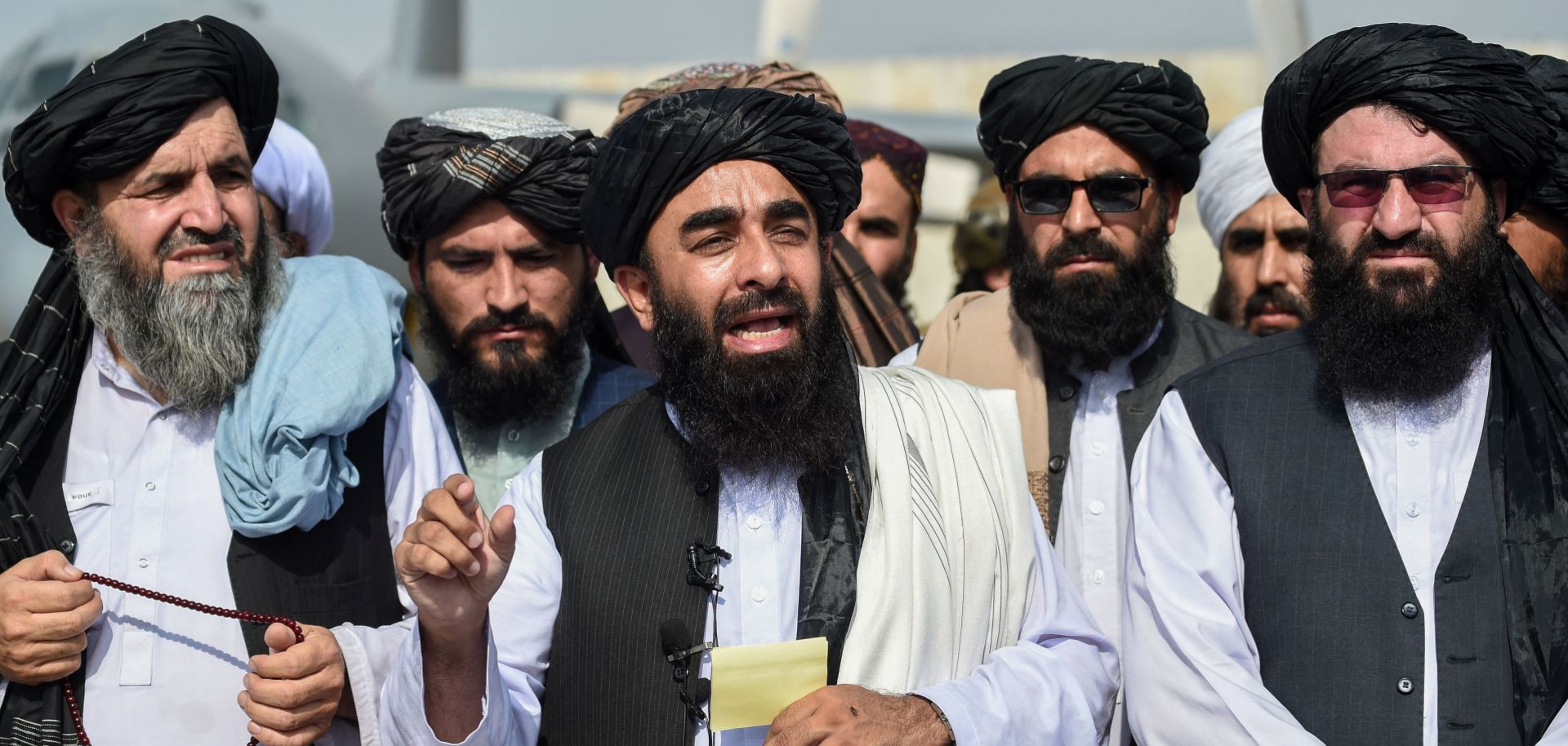
Taliban spokesman Zabihullah Mujahid addresses media at the Kabul airport on Aug. 31, 2021.
Taliban comments that China is their main partner appear more aspirational than a confirmation of significant Chinese advances in Afghanistan. In an interview in the Italian paper la Repubblica published Sept. 1, Taliban spokesman Zabiullah Mujahid called China the Taliban government’s “main partner,” expressed confidence in future Chinese investments in infrastructure and mining, and linked Afghanistan to world markets through China’s Belt and Road Initiative (BRI). The comments have stirred international attention, appearing to confirm assessments that China has “won” Afghanistan after the U.S. withdrawal. Beijing, however, is taking a more cautious approach to Afghanistan, and any significant infrastructure development or economic activity will still require the Taliban to provide a more stable environment — something far from certain.
There has been little commitment from the Chinese side, even as the Taliban promised safety inside the country and the stoppage of any outflows of terrorism into China. The readout from a Sept. 2 phone call between Chinese Assistant Foreign Minister Wu Jianghao and the deputy head of the Taliban's political office in Qatar, Mawlawi Abdul Salam Hanafi, highlights the gap between the Taliban’s ambitions and Beijing’s caution. Hanafi emphasized the importance of BRI to Afghan development and economic growth, and promised to provide a safe environment for Chinese workers and institutions in Afghanistan. Wu, however, merely highlighted thousands of years of friendship, and said China respected Afghan independence and hoped Afghanistan would rebuild soon.
For the Taliban, China offers a potential opportunity to insulate Afghanistan from Western pressure by accessing foreign aid and development that isn’t tied to democracy or women’s rights. China’s permanent membership on the U.N. Security Council would add another shield for the Taliban government. While China shares a border with Afghanistan, it is small. There are also few territorial or strong ethnic issues along Afghanistan’s border with China, unlike its borders with Tajikistan, Uzbekistan, Iran and Pakistan. China’s BRI initiatives and the China-Pakistan Economic Corridor (CPEC) flank Afghanistan and provide potential avenues for economic connections. Beijing’s perceived higher risk tolerance could help the Taliban access vast Afghan mineral deposits, providing a ready source of revenue, even if China is only the consumer. For the Taliban, cozying up to China also plays on Beijing’s international rhetoric, highlighting how China can be a responsible big power, in contrast to U.S. interventionism and attempts to change societies.
Beijing will take a much more cautious approach, as Chinese leadership remains uncertain about the Taliban’s ability to deliver on their promises of stabilizing Afghanistan and stemming outbound terrorism. Beijing sees potential future opportunities to access minerals close to home, and Afghanistan’s location could provide a valuable north-south link in regional transportation infrastructure. Much has been made of China’s concern about ethnic Uyghur militants potentially striking from Afghanistan into Xinjiang. But Beijing’s main concern is the potential for militancy to spread into Central and South Asia, threatening its BRI and CPEC projects. Several militant groups working with the Taliban are either based or have ambitions in neighboring countries. And with the United States out of Afghanistan, these groups may refocus their attention back to their original goals.
Beijing is also reticent to get pulled into Afghanistan, given the history of other great powers. Afghan mineral resources are not vital enough, nor are the transit routes necessary enough, for China to risk either getting caught up in a civil war or being seen as the new foreign invader. On the international front, while Beijing has exploited the U.S. withdrawal to try and score some rhetorical political points, China’s leaders do not want to be seen as responsible for the Taliban and potentially blamed for their failure to quell transnational terrorism. China is unwilling to use military force inside Afghanistan, and thus has minimal real influence beyond promises of aid and investment. After decrying Afghan terrorism and the U.S. intervention for years, Beijing has also had a difficult time convincing its own population that the Taliban are suddenly a reliable partner and that China should take a strong interest in Afghanistan.
In the end, China is more likely to provide aid to help stabilize Afghanistan, while potentially exploring some additional investment or development work — but only if the Taliban can ensure the security of Chinese workers, which may be difficult for some time. For Beijing, and many other regional countries, an unstable Afghanistan is the worst-case scenario, creating pockets of ungoverned space for militants to exploit, while triggering refugee flows and potential cross-border fighting. But while China wants to see a stable Afghanistan, it will avoid any significant entanglements for fear of being held responsible for the Taliban’s actions, as well as becoming the latest in a long line of powers that have found themselves stuck and ultimately defeated in the “graveyard of empires.”
