
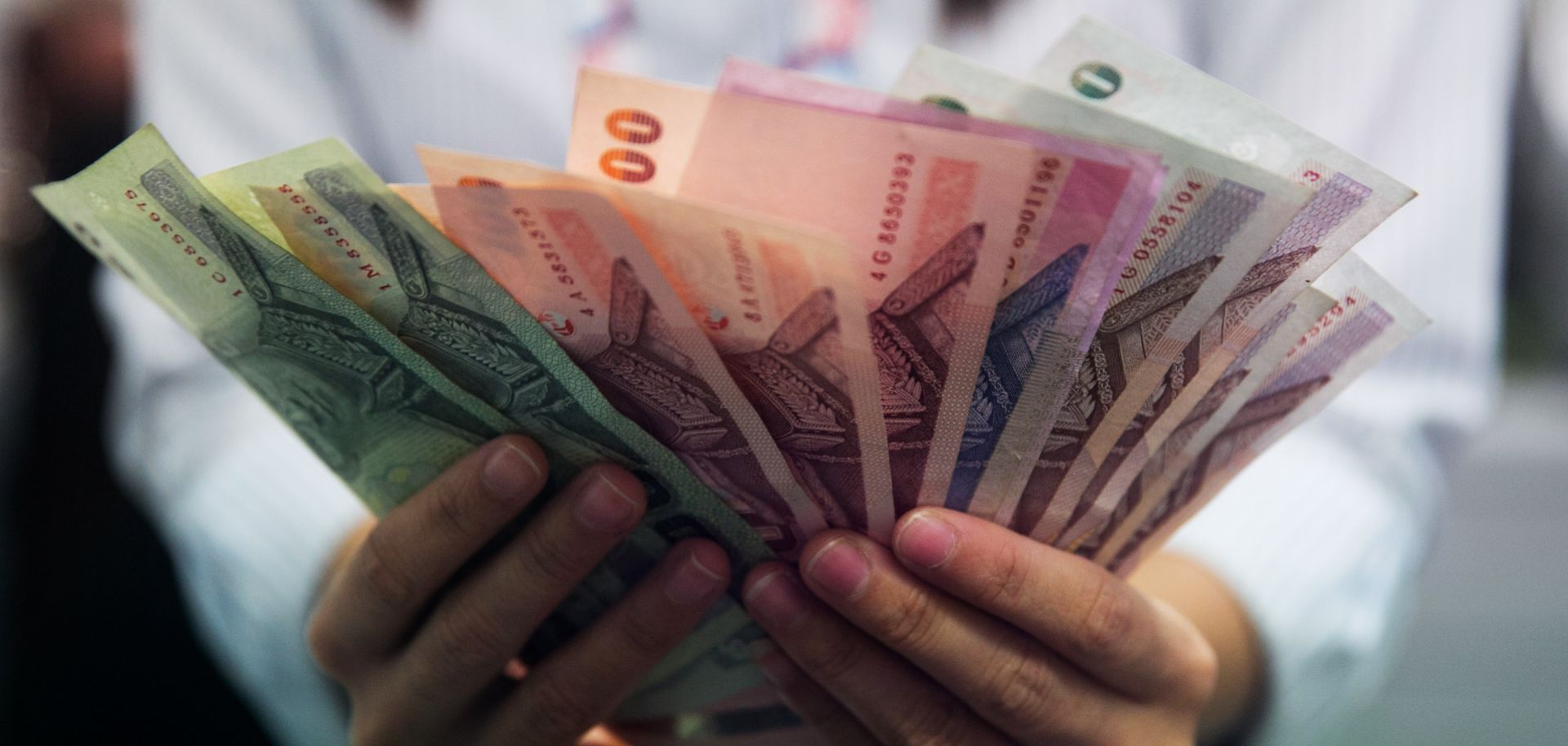
A bank teller in Bangkok counts out Thai bhat, which was Asia's strongest currency in 2019. The baht's strength has hurt Thailand's economic growth over the past year by making its exports less competitive.
Less than a year into its transition out of direct military rule, Thailand has found itself steeped in mounting economic and political risks. The coronavirus outbreak in China has already taken a toll on the country's vital tourism sector, and the' extent of the damage from the epidemic to Chinese economic growth will risk cutting even deeper into Thai exports. But even before the outbreak, Thailand's strong baht was hindering its growth by deterring tourism and making its exports less competitive. Meanwhile, the country's unwieldy military-aligned ruling coalition is fending off an increasingly desperate opposition seeking to make inroads wherever it can, which will limit Bangkok's ability to implement the big-ticket infrastructure projects needed to spur growth and ultimately weather the storm.
The New Coronavirus Threat
It is still unclear how long China's coronavirus outbreak will last. But the disease has already dampened the 2020 outlook for Thailand's crucial tourism industry, which comprises roughly 14% of the country's GDP. Chinese tourists account for nearly 30% of Thai tourist arrivals with a value of $17.5 billion in spending in 2019. The outbreak of the virus has already damaged Chinese outbound travel for China's Lunar New Year celebrations. Amid the virus outbreak, Thailand is one of the few regional countries that has not imposed sweeping restrictions on Chinese arrivals — a testament to the economic importance of Chinese tourists.
But the Tourism Authority of Thailand already projects a dropoff of 2 million Chinese tourists in 2020, with estimates putting losses for the first quarter at around $3 billion. To make matters worse, the Chinese government has also suspended bookings for group tourism to control the spread of the virus, a serious restriction, given that around 44% of Chinese tourists travel as part of package tours. Meanwhile, there are growing fears that the confirmed coronavirus cases in Thailand may deter tourists from elsewhere in the world as well, especially if the disease continues to spread inside the country.
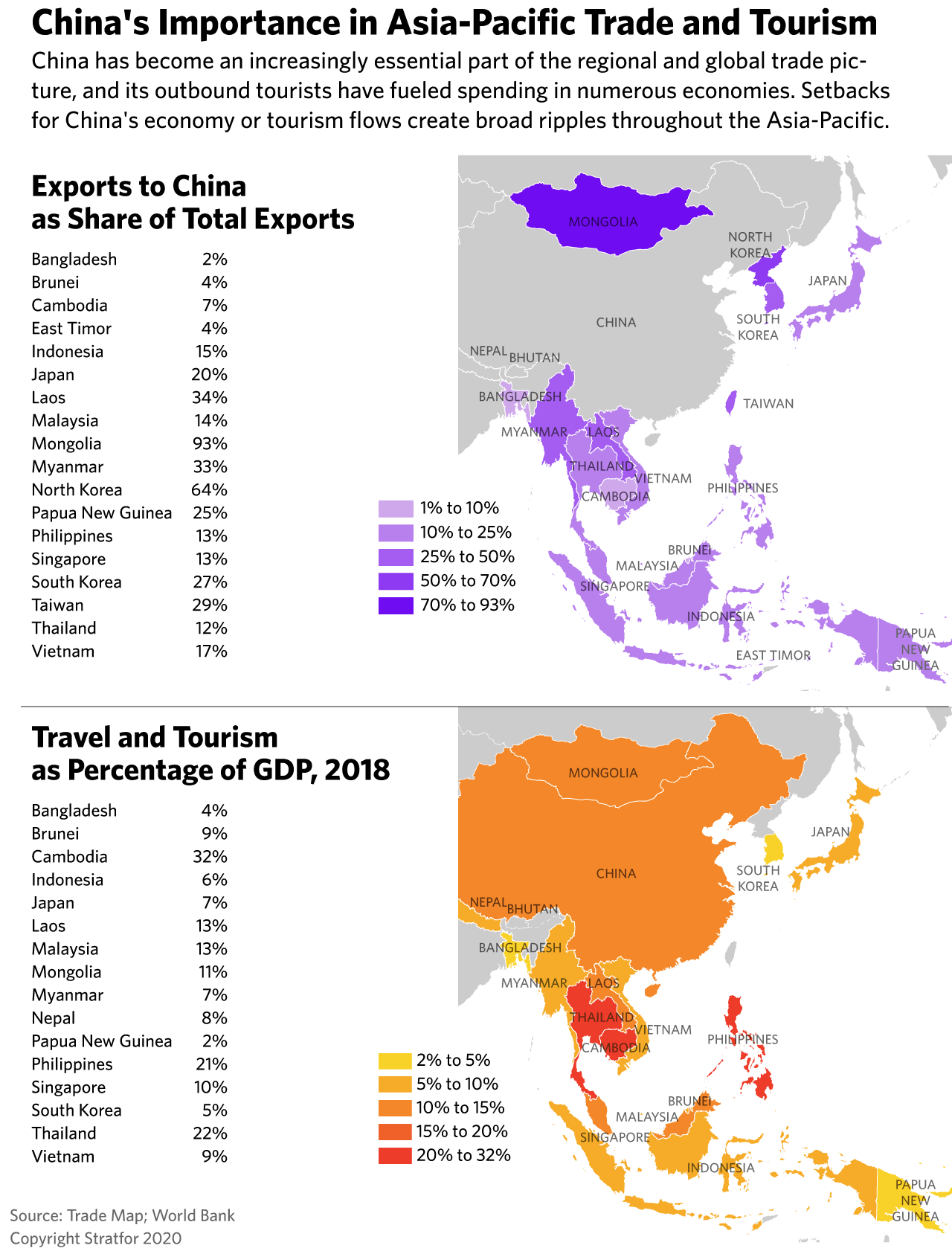
On top of this is the potential blow the virus may have on Chinese economic growth and overall demand in 2020, which could dampen Chinese demand for Thai rubber, agricultural goods, machinery and automotive exports. Chinese 2020 growth will slip in the first quarter of 2020, with hits to overall annual growth and further ripple effects in global GDP growth. Additional hits to the Thai economy due to this darkening picture could spur the country's central bank to further cut interest rates in a bid to boost liquidity, as well as ease consumer and business debt. The bank's room to do this, however, will be limited given that it's already made three cuts since 2019 to a record low of 1%.
The government will need to proceed with any monetary intervention with caution, lest be labeled as a currency manipulator by the United States — a moniker it has so far avoided. Thailand's trade surplus with the United States and large current account surplus already meets two of Washington's three criteria for currency manipulation. At 41% of GDP, the country's relatively low level of public debt will also enable it to expand the $10 billion in stimulus spending Bangkok already had planned for 2020.
An Already Gloomy Outlook
Prior to the coronavirus outbreak, Thailand was already in something of an economic bind. In 2019, Thai exports dropped a total of 2.7% amid the unfavorable global trade picture, with outbound shipments down every month from July to December. This is particularly troubling for Thailand, given that its export sectors account for nearly 67% of GDP. It also largely failed to capitalize on the manufacturing capacity relocating from China amid the U.S.-China trade war.
With a rise of only 4.2%, Thailand's tourism numbers were also lackluster in 2019, as political uncertainty, competition from nearby Vietnam and a strong Thai baht deterred travelers. Weak external demand dampened private consumption and domestic investment growth as well, which both softened in the second half of 2019. And to top it all off, a severe drought over the summer took a sizable toll on Thailand's agricultural output. Especially hard hit have been the country's rice growers, who are already facing steeper competition from nearby countries worsened by the strong baht. As a result, Thailand's economy grew only 2.5% in 2019 — marking the slowest growth since the 2014 military coup.
Political Problems
The World Bank estimates that Thai GDP growth will recover to 2.7% in 2020. But this slightly sunnier economic picture hinges on massive infrastructure spending, which the country's internal political turmoil may put in jeopardy. Issues in forming a coalition government has put the country's $103 billion budget for the 2020 fiscal year on hold. It had initially been slated to be passed in October 2019. The parliament voted to pass the budget in January, but the Supreme Court ruled that a second budget vote was necessary. With spending likely not beginning until May 2020, this means that ongoing infrastructure projects will have to continue relying on 2019 funds. New infrastructure spending, meanwhile, may require Thailand to borrow to meet the requirement at the risk of further complicating the country's already difficult economic situation.
A troubled economic picture due to these preexisting issues, exacerbated by the effects of the recent coronavirus outbreak, could jeopardize Thailand's fragile political balance by giving further ammunition to opposition forces. Thailand's nationwide elections in March marked a transition out of five years of direct military rule and into a civilian-led government — one in which military-backed parties still managed to secure a dominant hold. Already, however, the Thai opposition under the mantle of the new Future Forward Party and the long-familiar Pheu Thai Party have been agitating against the military's role in politics. Thailand's Supreme Court may rule in a case to disband Future Forward, which has spurred some of the largest protests the country has seen since the 2014 coup. Local elections likely due sometime this year will provide another opportunity for the opposition to agitate against the military-aligned government, whose bid for sustained political power depends on delivering consistent economic growth and development.
Indeed, Thailand's political stability in 2020 will largely hinge on whether the government can manage to navigate the tricky economic headwinds facing the country, while still maintaining unity within the ruling coalition. The country's vulnerability to events beyond its control, however — namely, the coronavirus outbreak in China and disruptions to overall global trade — will make this no easy feat. And desperate to gain political ground, Thailand's opposition will no doubt be working at every step to try to wrestle power from the pro-military government in hopes of either defeating it at the polls in 2023 — or better yet, assuming the mantle before then.
