
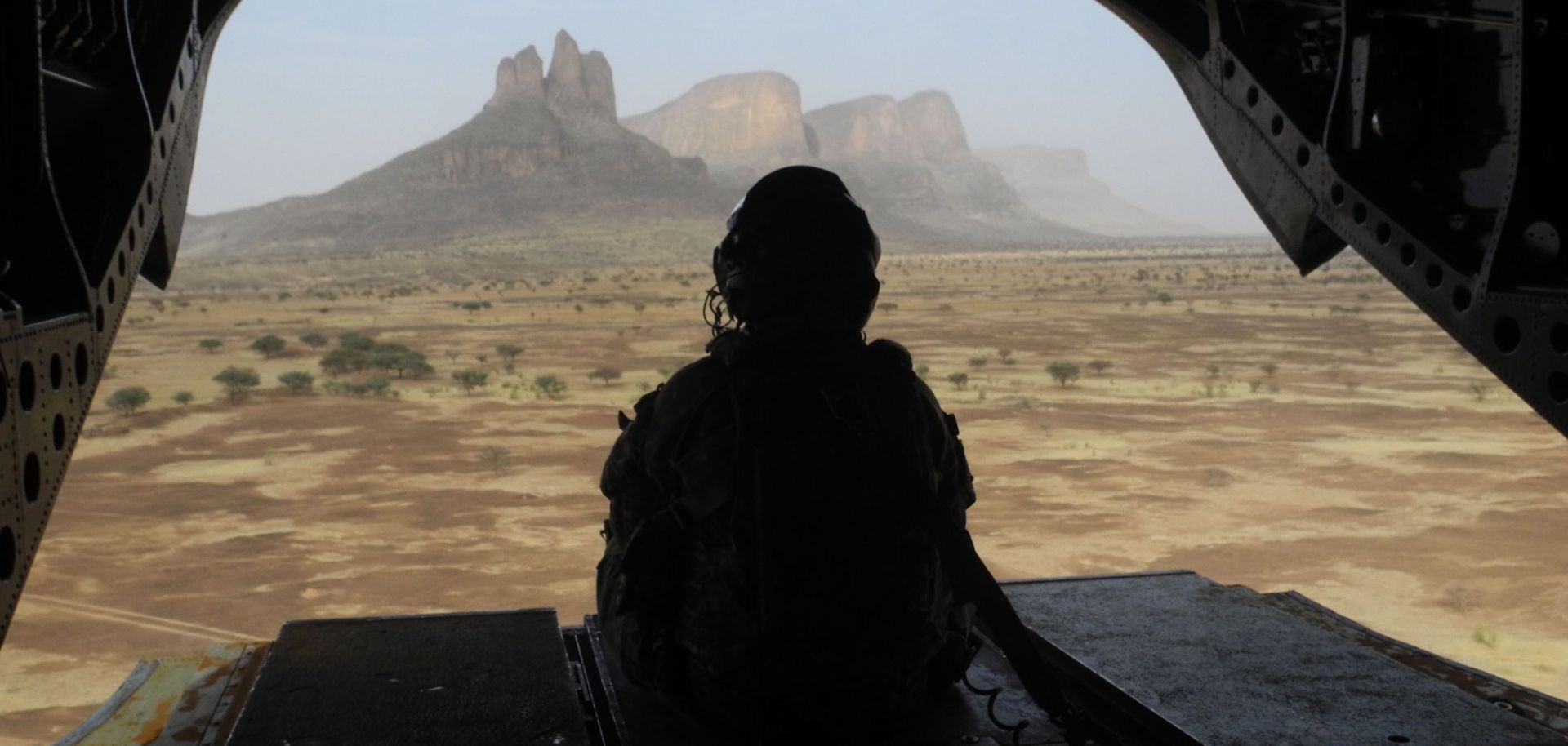
A British soldier leaves the Hombori area aboard a Chinook helicopter on March 28, 2019, during the start of the French Barkhane Force operation in Mali's Gourma region.
By Charles Thorson
Coming so close to the 20th anniversary of the 9/11 attacks on the United States, the Taliban takeover of Afghanistan raises important questions regarding the future of jihadist terrorism. The current global jihadist landscape is largely bifurcated, with al Qaeda affiliated groups competing with and in some instances outright fighting Islamic State affiliates. And aside from these two primary competitors for global jihadist leadership, a range of smaller, more locally focused groups remains a persistent threat, particularly as both al Qaeda and the Islamic State seek to co-opt them to join their global networks.
In the short term, the Taliban victory will provide a significant propaganda victory for global jihadist groups, with al Qaeda and its affiliates having an advantage given their historic and ongoing links to the Taliban. As a practical matter, al Qaeda central will likely use the opportunity to rebuild various components of its infrastructure that serve as inputs for its violent capabilities; these include recruitment, communications and training. Likewise, there will be a heightened threat in the West from individuals and small cells inspired by al Qaeda affiliates in Somalia, Yemen and the Sahel given the greater reach of their propaganda efforts. In the West and in countries with more proficient security forces, attacks will likely be limited in scope, typically involving cars, knives or firearms, but attacks involving improvised explosives remain a latent threat. Meanwhile, in countries where security forces are less capable and/or stretched thin, more sophisticated and lethal attacks are likely, particularly in places where jihadist groups have a significant presence.
The long-term outlook for global jihadism is much less certain, but if the Taliban continues to emphasize its ideological credibility and does not make a clean break with al Qaeda, the group will likely be able to reconstitute its capabilities, drawing on the large number of foreign fighters in Afghanistan with combat experience to refill its ranks. This will reinvigorate the threat it poses to regimes in the region around Afghanistan and farther afield. By contrast, a Taliban crackdown on jihadist groups would likely be a recruiting boon for the local Islamic State branch and other Islamic State-affiliated groups to attract new members, and at the very least pose a significant internal threat to the Taliban and the wider region.
Al Qaeda in and Near Afghanistan
Al Qaeda's General Command issued an Aug. 31 statement praising the Taliban victory, notably after several of its affiliates — including Yemen-based al Qaeda in the Arabian Peninsula (AQAP), Somalia-based al Shabaab and North Africa-based al Qaeda in the Islamic Maghreb — had already done so to derive propaganda value from the Taliban win. Al Qaeda central's release came as its global affiliates have generally come to eclipse the group's Afghan operations. Fewer than 1,000 members are estimated to remain in Afghanistan, though this includes the group's top leadership, according to a July 21, 2021, report by a monitoring group for the U.N. Security Council. An estimated 8,000-10,000 other foreign fighters are in Afghanistan, but these individuals fight for various groups including the Taliban, al Qaeda and the Islamic State Khorasan Province (ISKP), the group's Afghan branch.
By contrast, al Qaeda’s largest affiliates, AQAP and al Shabaab, have approximately 6,000 and 8,000 members, respectively, while other affiliates such as Jaamat' Nusra al-Islam wa al-Muslimin (JNIM) in West Africa have had more meaningful victories in recent years than the Afghanistan-based leadership.
Al Qaeda prime faces significant challenges and opportunities in the Afghanistan-Pakistan region following the Taliban takeover in Afghanistan. As part of the negotiations that led to the U.S. withdrawal, the Taliban repeatedly pledged not to allow Afghanistan to become a haven for international terrorist groups, and Afghanistan's dependence on foreign aid may force the Taliban to make good on those promises to stabilize the country and govern effectively. But the Taliban faces a dilemma in this regard, as many of its more militant members — both in leadership roles and among the rank and file — sympathize with the global jihadist cause, and the Taliban is therefore likely reticent to take overly aggressive action against al Qaeda, as this could cause the jihadist group’s members to defect to more radical groups such as ISKP. The Taliban's recent choice of hard-line ideological leaders, such as naming Sirajuddin Haqqani to serve as the interim interior minister — indicates that the group will prioritize maintaining its ideological cohesion, and suggests that at least in the near term, al Qaeda will likely be safe from a major crackdown. While any tolerance for al Qaeda could cost Kabul foreign aid, reports from earlier this year indicate that the Taliban continues to receive financial support from al Qaeda, which may help offset any foreign aid shortfall.
This would give al Qaeda space to regenerate its capabilities in Afghanistan. If the large number of foreign fighters in Afghanistan are unable or unwilling to return to their home countries and fighting in Afghanistan dies down, the fighters could become a pool of fresh recruits for al Qaeda. The group could deploy these fighters to participate in the Indo-Pakistan conflict over Kashmir, where al Qaeda has had a close relationship with the militant group Lashkar-e-Taiba, which has become more active of late.
Opportunities in Afghanistan aside, al Qaeda will face a significant challenge from its rival, ISKP, for recruits and funding. And of course, should a terrorist attack issue from Afghanistan, particularly one against Western targets that produces a high casualty count, would presumably lead to renewed counterterrorism activities against al Qaeda, potentially costing it its haven in Afghanistan should the Taliban come under major pressure to crack down on it.
Al Qaeda Farther Afield
Al Shabaab, AQAP and JNIM currently represent the most developed and capable al Qaeda affiliates, with the U.S. Director of National Intelligence publicly stating Sept. 13 that the terrorist threat to the United States from conflict zones such as Yemen, Somalia, Iraq and Syria presently eclipses the threat from Afghanistan. Al Shabaab relies on minimally governed areas of Somalia to establish and maintain a base of operations; AQAP has successfully taken advantage of the war in Yemen to maintain and grow its capabilities; and JNIM continues to exploit insecurity in northern Mali, Burkina Faso and Niger. All three affiliates have substantial social media propaganda and recruitment operations, which AQAP and al Shabaab have previously used to inspire attacks on targets abroad. While JNIM has not shown an intent or capability to inspire attacks far outside of its primary area of operations, its substantial freedom of action across countries in the Sahel makes it a threat to numerous local governments that could one day grow to threaten those farther away.
While al Shabaab is presently focused on a protracted insurgency against the Somali government, the group continues to launch terrorist attacks, such as the Aug. 19 suicide bombing that targeted a cafe popular with local intelligence personnel. There are also indications that al Shabaab's propaganda efforts played a significant role in radicalizing the lone attacker responsible for the Aug. 25 shooting attack outside the French Embassy in Dar es Salaam, Tanzania, demonstrating its ability to inspire attackers elsewhere. While al Shabaab faces significant pressure from Somali military operations and outside forces, including the African Union Mission in Somalia and periodic U.S. drone strikes, the group also has significant growth opportunities if it can continue to exploit continued political instability in Somalia, and it has shown persistent staying power despite years of counterterrorism pressure.
AQAP, meanwhile, has kept a lower profile as the Yemeni civil war — primarily between Iranian-backed Houthi rebels and a Saudi-led coalition supportive of the former internationally recognized government — has pushed AQAP into the role of a supporting actor in that conflict. The group has also suffered significant losses, including the arrest of its senior leader in early 2021. Still, the group remains a quite capable terrorist threat, as reflected by an April 2021 attack on Emirati-backed Yemeni forces in Shabwah. Moreover, AQAP has inspired attacks abroad in recent years, including two lone-actor attacks in Saudi Arabia and Florida in 2019, and there are no indications that the group has given up on extraterritorial operations. As one of al Qaeda's historically most powerful affiliates, AQAP has faced unrelenting pressure from U.S. drone strikes, as well as efforts by Saudi- and UAE-backed forces against the group, limiting its capabilities.
JNIM meanwhile is well-positioned to take advantage of the Taliban takeover in Afghanistan to drive recruitment and propaganda, as pressure on the group has at least temporarily decreased amid France's reevaluation of its regional counterterrorism mission. The group has increased the frequency of its attacks in the Sahel, such as an Aug. 18 attack in Burkina Faso near the border with Mali. The group is also beset by a high degree of factionalism, and least for the moment, JNIM's attacks pose little threat to the West as the group prioritizes local conflicts and targets.
The Islamic State
Unlike al Qaeda, which has a close alliance with the Taliban, the Islamic State, and particularly ISKP, is an adversary and ideological competitor of both the Taliban and al Qaeda. Disaffected members of the Taliban played an important role in founding ISKP, and the group continues to routinely call on Taliban members to defect. ISKP's Aug. 26 attack at Kabul International Airport killed large numbers of Afghan civilians, Taliban militants and U.S. military personnel, indicating the group maintains the intent and capability of launching attacks across Afghanistan and possibly even staging a prolonged insurgency against the Taliban. ISKP's largest opportunity for recruits would come in the event the Taliban substantially moderated and took substantive action to counter al Qaeda and other jihadist groups in Afghanistan, which would push more radical members to defect to ISKP.
For the Islamic State globally, including its core in Syria and Iraq and affiliates in the Greater Sahara and Central Africa, the Taliban victory in Afghanistan is unlikely to have much value in the immediate term beyond propaganda. The Islamic State has already heavily criticized the Taliban in its propaganda, questioning its religious credentials and accusing it of being a tool for the Americans. But such messages will likely only marginally improve Islamic State recruitment, especially in view of the immense counterterrorism pressure on the group in various theaters and its own failure to sustain a supposed caliphate. That said, a failure of the Taliban's emirate project would heavily play in the Islamic State’s favor and would likely drive new waves of recruits from disaffected Taliban fighters in Afghanistan as well as disgruntled al Qaeda members. And even absent such a development, the Islamic State has the capacity to continue to sustain guerrilla insurgencies in places like Iraq and Egypt, as well as inspire global supporters to commit attacks on their own, such as the Sept. 3 in Auckland, New Zealand.
U.S. Counterterrorism Capabilities After the Afghan Withdrawal
The U.S. withdrawal from Afghanistan significantly inhibits its ability to gather on-the-ground intelligence on terrorist threats coming from the country and concurrently limits its ability to effectively interdict such threats. In terms of intelligence gathering, in the absence of personnel on the ground, the United States will become reliant on drone surveillance and signals interception, since Afghanistan has become a nonpermissive environment for human intelligence collection. While drone surveillance has been quite effective in monitoring known militant hideouts, it has been less effective in instances where the target has not been positively identified through other means. According to recent media reports, this may include the Aug. 29 instance where U.S. drone operators allegedly mistook the daily routine of a civilian nongovermental organization worker for that of an ISKP suicide bomber when they launched a strike on a vehicle in Kabul that appears to have killed approximately a dozen people.
Moreover, while signals collection can help build out extremists' connections and identify threats, it struggles without human intelligence to put it in context, especially in places like Afghanistan where mobile communications are less widespread and culture favors face-to-face contact, making human sources vital. While the United States may receive sporadic human intelligence from foreign partners, the countries likely with the best access — including China, Pakistan and Russia — can be expected to share any intelligence they might have. Moreover, media reports that the United States and the Taliban shared intelligence during the U.S. withdrawal that potentially exposed sources to compromise mean Afghans who may previously have been willing to collaborate with the United States and Western countries could refrain from doing so amid concerns for their personal safety.
The withdrawal of ground forces effectively leaves drone strikes, airstrikes and working through third parties as the main methods left to go after key militants and terrorist infrastructure. Although they can be effective in certain instances, drone and airstrikes cannot make up for more responsive on-the-ground personnel intimately familiar with the operating environment. The absence of on-the-ground confirmation from a human source can lead to attacks on the wrong target and/or produce excessive collateral damage, both outcomes that offer extremist groups propaganda and recruiting advantages. The difficulty of post-strike assessments can lead to a false impression of their effectiveness and an inability to collect intelligence from the targets that could otherwise be gleaned from an on-the-ground arrest operation.
Working through third parties — such as local militia groups and/or foreign countries whose security forces have a footprint in the country — will remain theoretically possible, but leads to greater odds of compromised operational security due to local partners' poor tradecraft, militant infiltration or foreign competitors' duplicity. Working with local militias and/or certain foreign countries also raises significant human rights concerns, particularly if such groups and/or countries are indiscriminate in how they deal with terrorist targets or are particularly corrupt.
