
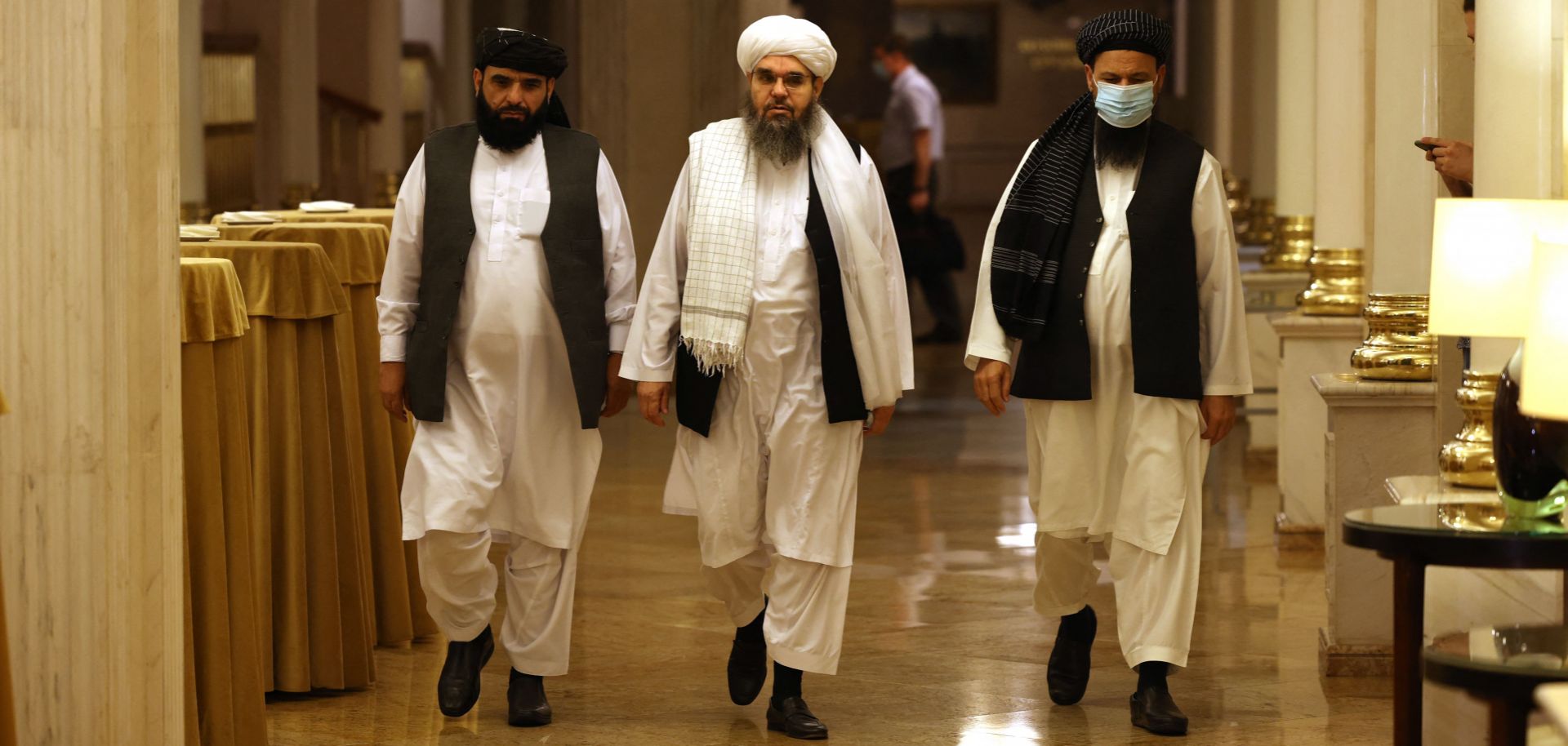
Leaders of the Taliban walk to attend a press conference in Moscow, Russia, on July 9, 2021.
After gaining control of Kabul, the Taliban’s desire for international legitimacy will be shaped by their willingness and capability to constrain transnational militants from using Afghanistan as a base of operations. As the Taliban enter final negotiations with representatives of the Afghan government, the group has already engaged in outreach to countries around the region, most notably China and Russia. Both Beijing and Moscow have already set very specific terms for recognition — the Taliban must demonstrate its willingness and capability to limit transnational attacks from its territory. In the case of Chinese Uyghurs, this may be a relatively simple task, both politically and militarily. But that task grows more challenging when considering groups like al Qaeda in the Indian Subcontinent (AQIS), which will feel empowered to set their sights back on other regional targets amid the withdrawal of U.S. forces from Afghanistan.
- Taliban officials have promised that they will not allow Afghan soil to be used for operations against other countries, so long as those countries are not engaged in military action against the Taliban.
- Moscow and Beijing have said they are willing to engage with the Taliban, but both also noted that they will withhold formal diplomatic recognition until the Taliban demonstrate a capability to constrain foreign militancy in Afghanistan.
The Taliban's Willingness to Contain Militancy
The Taliban’s willingness to contain militants will be dependent on the balance of two opposing drivers: the need to gain international legitimacy and the need to maintain the loyalty of like-minded transnational groups. The Taliban in the past gave shelter to transnational militants (most notably al Qaeda), despite Western condemnation and airstrikes. That support contributed to the U.S. overthrow of the Taliban after the 9/11 attacks in 2001. Currently, several foreign fighters and groups operate alongside the Taliban, from al Qaeda and AQIS to Tehrik-e-Taliban Pakistan (TTP) and the Haqqani Network. While most have been fighting against U.S. and Western forces in Afghanistan, or against the Afghan government and military, AQIS and TTP have directed activities against Pakistan. And despite competing against Islamic State-Khorasan Province (ISKP), the Taliban have also retained relatively close cooperation with more like-minded foreign militants.
The Taliban may be focused on Afghanistan, but they have clear sympathies with many of these other militant movements. An agreement to constrain or control them would, at least on the surface, appear to contradict the Taliban’s ideology and its existing relationships. The Taliban may be willing to constrain specific smaller groups, like the ethnic Uyghur militants that concern China. Managing these other groups, however, will take stronger political will and clearer benefits from constraining rather than shielding. At least on a limited basis, Moscow and Beijing may provide the incentive.
The Taliban will seek international legitimacy to gain access to trade, as well as selective infrastructure and development assistance. Such legitimacy, which was denied to the Taliban in the 1990s, would also reduce potential external support for anti-Taliban movements inside Afghanistan. Russia is a particular concern, given its continuing relations in Central Asia and the history of ethnic conflict in Afghanistan. Recognition from China or Russia would also help shield a Taliban-ruled Afghanistan from U.N. Security Council actions. If these benefits outweigh the perceived benefits of allowing attack planning and training from inside Afghanistan, the Taliban may well be willing to selectively constrain the operations of its current partners, at least over the next year or two.
The Taliban's Capacity to Contain Militancy
The Taliban clearly have interests in gaining international or at least regional legitimacy for its takeover of Afghanistan. But with inherent constraints, it will be difficult for the group to control militant activities both within and beyond its borders, regardless of intent. Political cohesion within the Taliban will be the first and most significant test. Taliban fighters hail from numerous individuals and groups, some with competing ideas about just what the Taliban should be, where they should focus, and whether they should take on a more internationalist role. Whether Taliban leaders are able to retain centralized loyalty and ensure commitment to central goals, rather than local or personal interests, during a transition from an insurgency to status-quo power will offer the first indication of the Taliban’s ability to control transnational militants, as local leaders who have close relations with transnational militants may be more sympathetic to their fighting partners than to a governing body in Kabul. The second test will then be whether the Taliban can exert control over all of Afghanistan, lest risk creating negative space that other groups could occupy outside of Taliban control. And the third and final test will be whether the Taliban can enforce control over groups that have fought on their territory, but now have shifting priorities.
Fighting against a common foreign enemy inside Afghanistan has strengthened ties between the Taliban and their transnational militant partners, but with that enemy gone, the core interests of those individual groups move back to the fore. The Taliban share some common goals and intent with these groups, but they do not align across the board. AQIS and TPP clearly have a foreign focus, and will look at the Taliban victory as a cue to accelerate their attacks in Pakistan and Bangladesh. This risks undermining relations with not only Pakistan but also China, which sees the China-Pakistan Economic Corridor (CPEC) as a critical economic link. The Taliban may be able to refocus some groups to the consolidation phase that is still necessary to control Afghanistan, as it has with Jamaat Ansarullah, the so-called Tajik Taliban. But this may be short-lived as they focus on their broader goals in Tajikistan.
The Taliban may be willing to use force or expel troublesome leaders or groups from Afghanistan, but their military capacity to do so remains in question. The Taliban did turn their forces against ISKP, as there were clear ideological differences and competition over power. It is possible similar patterns may emerge with the TTP or Jamaat Ansarullah, which have geographically and often ethnically constrained goals. Smaller groups like the remnants of the East Turkistan Islamic Movement (ETIM) may also be relatively easy targets, assuming the Taliban can locate them. But it is difficult to see the Taliban, likely faced with ongoing insurgency and resistance, having the political or military will and capacity to shift their sights against al Qaeda. A split with the Haqqani Network would also trigger a civil war between Taliban fighters.
