
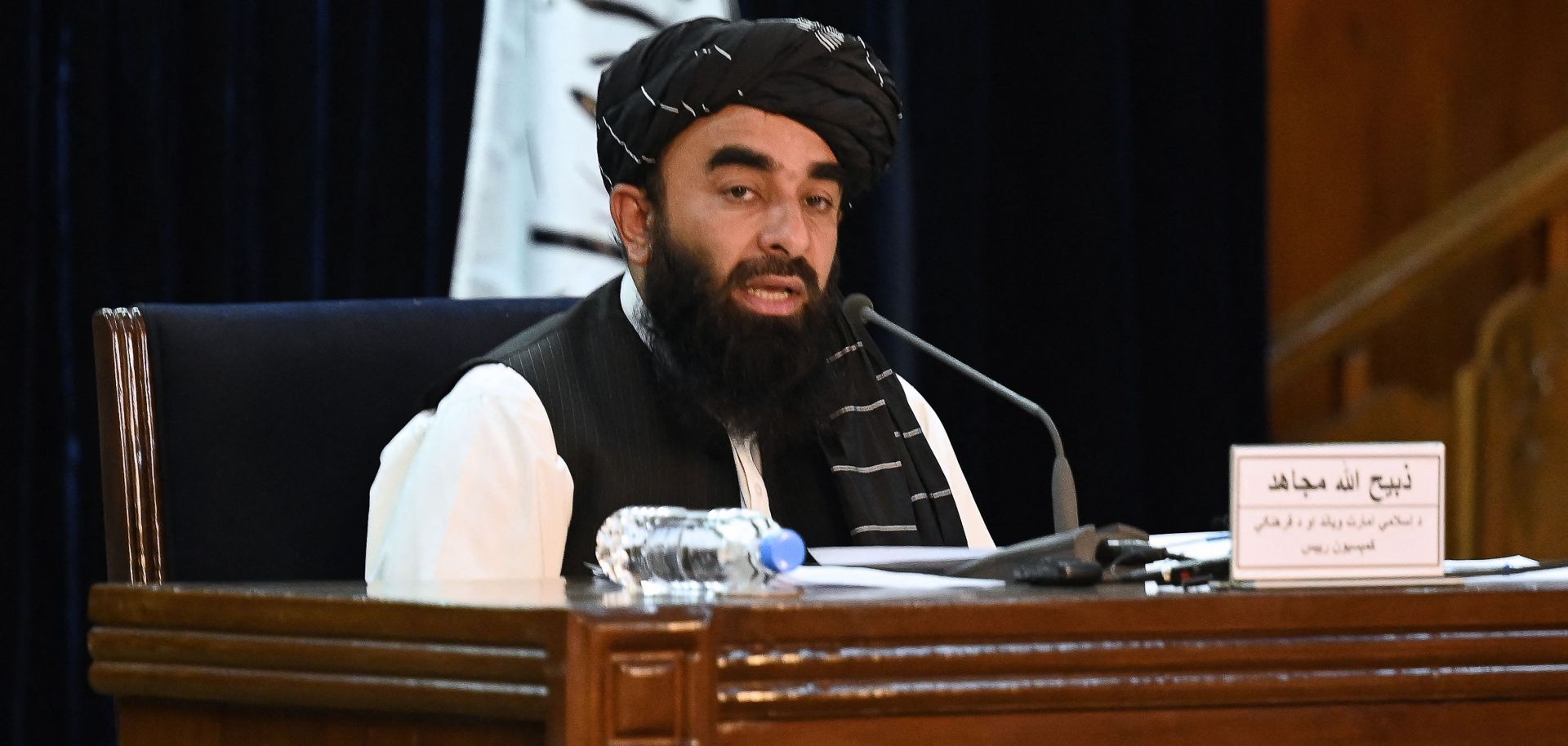
Taliban spokesman Zabiullah Mujahid speaks during a press conference in Kabul on September 7, 2021.
The Taliban’s newly unveiled caretaker government is unlikely to gain widespread formal international recognition due to its lack of diversity and former Afghan officials. But the re-establishment of a formal cabinet will still likely see the immediate resumption of crucial trade and diplomatic ties with Afghanistan’s neighbors, as well as limited — even if unofficial — engagement with farther-flung countries. On Sept. 7, the Taliban announced an interim government composed of leaders from old ranks despite initial promises of an ethnically inclusive and representative government. The announcement follows weeks of consultations between Taliban leaders and officials members from the deposed Afghan government, fueling speculation that the new system would include at least some former political officials. But the list of 33 ministers released by the Taliban doesn’t include anyone from the exiled President Ashraf Ghani’s administration. In addition, only two of the new ministers are ethnic Uzbek and only one is Tajik, with the remaining 30 all hailing from Afghanistan's dominant Pashtun ethnic group. The absence of women from the new government, while less of a shock, has also exacerbated fears in Western countries about the future of women’s rights in the country. The Taliban have stated that a permanent system would be announced in the future, which could give them time and room to deal with internal political conflicts. But the exclusions of various groups and former officials from power in the meantime will nonetheless raise the risk for more unrest and instability.
- Mohammad Hassan Akhund, the longtime head of the Taliban’s powerful leadership council, was appointed to acting prime minister. Akhund served as foreign minister and then deputy prime minister during the Taliban’s last reign in Afghanistan between 1996-2001.
- Abdul Ghani Baradar, one of the Taliban’s founding members, was appointed deputy prime minister. Baradar helped lead negotiations with the administration of former President Donald Trump that culminated in the agreement formalizing the U.S. troop withdrawal.
- The caretaker government also includes members of the powerful Haqqani Network. Several senior members of the new government had been detained at Guantanamo Bay before being released as part of a prisoner swap deal in 2014.
Afghanistan’s important neighbors will still likely work with the new government to help ensure the flow of aid and key supplies into the landlocked, war-torn country. Nearby countries like Pakistan and Tajikistan are attempting to build a cohesive strategy to deal with the developments in Afghanistan and direct aid to the country. Tajikistan initially expressed reservations over the lack of ethnic minorities in the caretaker government. But there seems to be an overall understanding among Afghanistan’s neighbors on the need to still work with the new Taliban leaders in order to supply the country with much-needed humanitarian aid and bilateral trade.
- A day after the Taliban’s provisional government was revealed, Pakistan hosted a virtual meeting on Sept. 8 that was attended by Iran, China, Tajikistan, Uzbekistan and Turkmenistan. During the meeting, China pledged $31 million in emergency humanitarian assistance to Afghanistan. Pakistan also proposed including representatives from the Taliban-led caretaker government in future meetings on the Afghan situation.
- In an interview in the Italian paper la Repubblica published Sept. 1, Taliban spokesman Zabiullah Mujahid called China the new Afghan government’s “main partner,” and also expressed a desire to be part of the infrastructure projects under China’s massive Belt and Road Initiative (BRI) and the China-Pakistan Economic Corridor (CPEC).
- Without direct access to maritime shipping lanes, Afghanistan depends on cooperation with its immediate neighbors for trade.
Countries elsewhere around the world, however, are unlikely to formally recognize the new Afghan government in the short term due to its controversial makeup. But just having a formal system in place will enable the Taliban to at least establish diplomatic, if informal, channels with the outside world, which could eventually open access to frozen aid and funds. The Taliban have called on the international community to recognize the new government and help reconstruct Afghanistan’s post-war economy, though the latter is a much more urgent need compared with the former at this time. The Taliban have also said they want good relations with all countries (with the reported exception of Israel) and have allegedly been meeting with representatives of foreign nations in September in Qatar. Several countries and international political bodies have maintained some contact with the Taliban following the Aug. 15 takeover of Kabul, though most have been careful to clarify that such communications do not imply recognition of governmental status. The European Union and the United States, for example, have both been coordinating with the Taliban to secure the Kabul airport amid the final evacuation of foreigners and Afghans. Brussels and Washington, along with the United Nations, have also pledged to continue sending humanitarian aid to Afghanistan.
- The United Nations recently warned that Afghanistan may run out of food reserves by the end of the month amid the country’s ongoing drought and liquidity crisis, with nearly all of the country’s foreign exchange resources now frozen.
- The United States voiced concern over the makeup of the Afghan caretaker government, but said its judgment would remain focused on the new Taliban leaders’ actions, including letting Afghans leave freely. Future U.S. cooperation with Afghanistan, however, will be complicated by Washington’s move to designate Haqqani Network leaders as terrorists, given that one of those leaders was appointed to serve as acting minister of refugees and repatriation in the new government.
- The European Union also stated that the new provisional government is neither inclusive nor representative, and would be judged on its conduct.
- China has openly expressed interest in engaging with the Taliban-led government and, along with Russia, has kept its embassy in Kabul open.
