
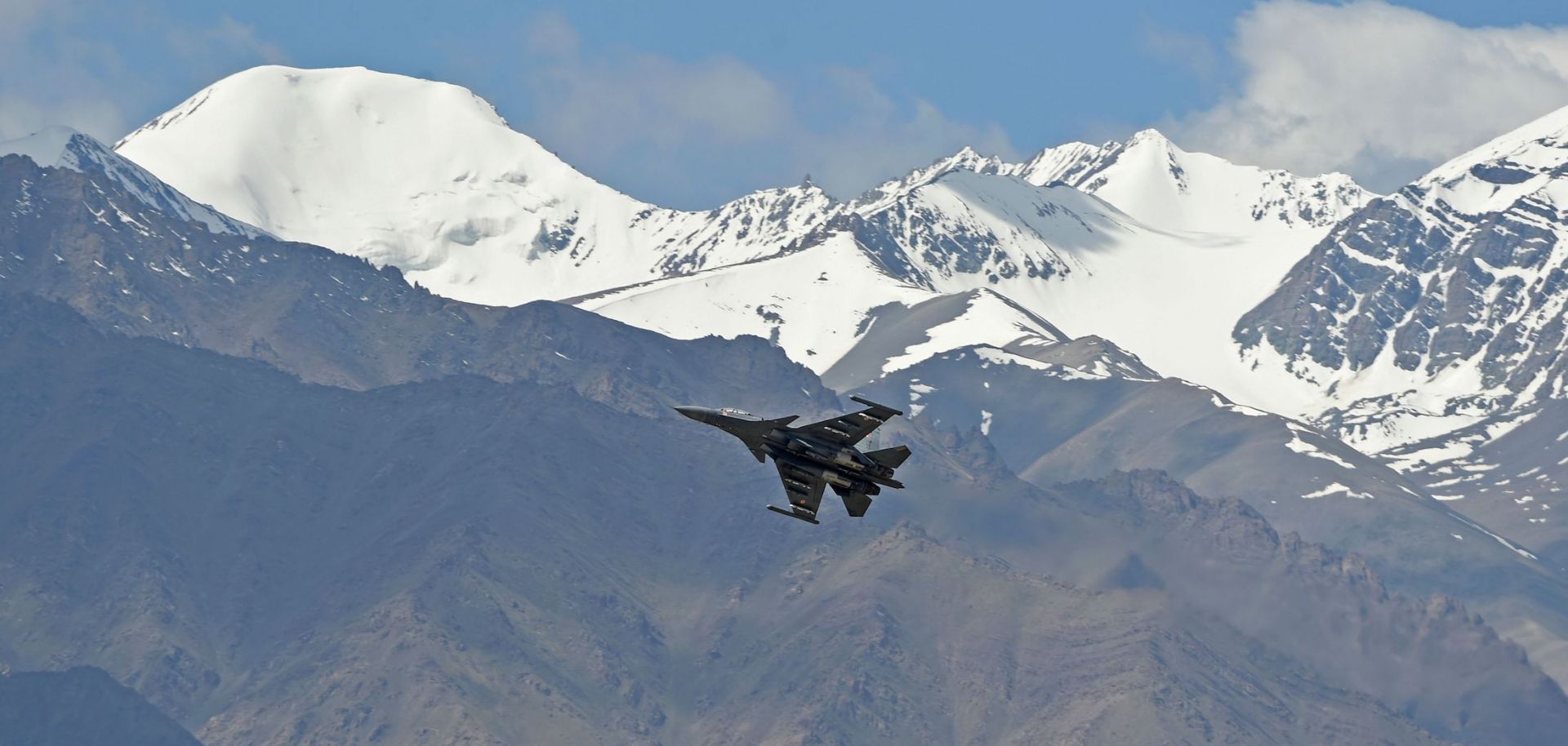
An Indian fighter jet flies over Leh, the joint capital of the union territory of Ladakh, on June 26, 2020.
China’s recent reassertion of its 1959 border line with India has left little room for a compromise in the two countries’ territorial dispute in Ladakh ahead of the approaching harsh winter, which will enable Beijing to both reinforce its claims in the Himalayan region come spring, as well as test Indian resolve with actions at other areas along the border. In late September, the Chinese Foreign Ministry sent a statement to the Hindustan Times confirming it still recognizes its unilateral 1959 line along the Indian border as the Line of Actual Control (LAC), which was drawn before the two countries’ war in 1962. Military officials from the two sides are set to meet Oct. 12 for the seventh round of Corps Commander talks aimed at resolving the border standoff in the eastern section of Ladakh, but China’s reassertion of the 1959 line makes any resolution difficult before the winter season sets in a month.
- Though China has hinted at the 1959 line in recent years, this marks one of the clearest assertions of Beijing’s claim.
- India asserts it has never recognized China’s 1959 unilateral border claim, and efforts in recent years to exchange maps to reassess claims have fallen through.
The most likely path in the near term is limited disengagement along the frontier, but there will not be a major withdrawal by Chinese or Indian forces. In addition to reinforcing their frontline forces in the western section, both countries continued infrastructure construction in the area, and there are reports Chinese forces have also moved in equipment to provide shelter and medical care for their forces through the winter. India has demanded that Chinese forces withdraw from newly-occupied territory, to which China has retorted by demanding that Indian forces first leave the high ground they have taken up in response to Chinese forward forces.
- In a five-point joint statement between their foreign ministers, who met in Moscow in early September, India and China agreed that they did not want to see tensions escalate further and agreed that their forces should disengage along the disputed border.
- While there is room for further de-escalation, there appears little trust or interest by either side to make any major withdrawal, for fear the other side moves first in the spring to occupy disputed territory.
With a dozen areas along the LAC in dispute, China is likely to press its sovereignty claims in different sectors come the new year. China has increased attention to its claims of national territory, whether at sea or on land, and is unlikely to back down along the Indian frontier. Even as China has pulled some forces back from their furthest extensions this year, it has maintained and reinforced positions in formerly unoccupied territory just a little ways back from its furthest forward positions. There are 12 main areas of dispute along the LAC, but only half of them have seen flare-ups in recent years. If China follows its pattern from the South China Sea, it will de-escalate in one area, only to step up pressure along another front.
- In 2017, the two sides clashed further south and east, at the Doklam Plateau near Bhutan. There are concerns that the next confrontations may take place even further east, near Arunachal Pradesh.
- With Arunachal Pradesh in the east administered by India but claimed by China, and Aksai Chin in the east administered by China but claimed by India, there is the possibility that China will later offer some concessions in the east in return for its forward claims in the west, though any significant territorial adjustments will be politically untenable in India.
