
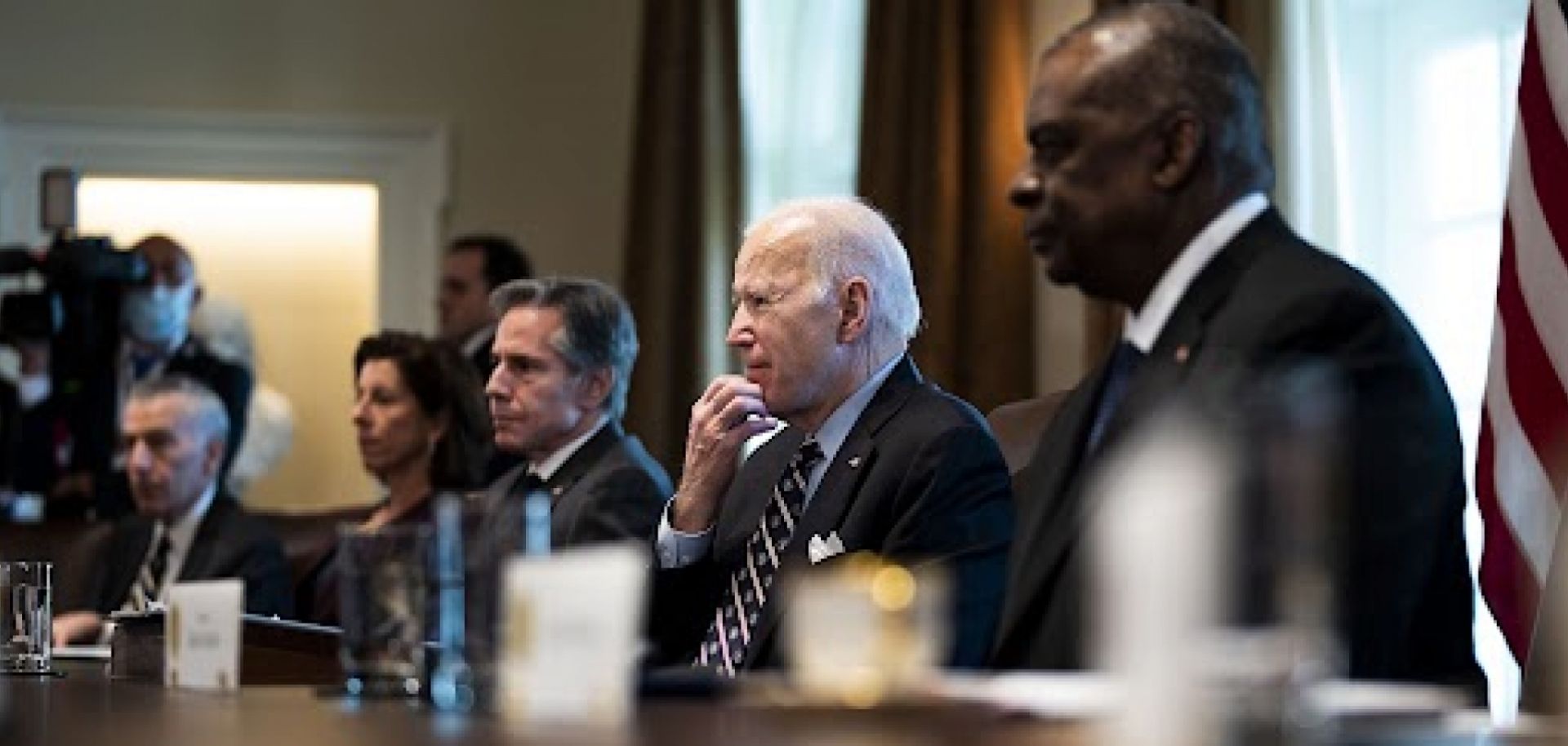
(From left to right) U.S. Secretary of State Antony Blinkin, U.S. President Joe Biden and U.S. Defense Secretary Lloyd Austin meet with Colombian President Ivan Duque at the White House on March 10, 2022, following a recent meeting between U.S. and Venezuelan officials where the possibility of easing oil sanctions was discussed.
While a full removal of sanctions is unlikely, the United States' new outreach to Venezuela may yield a narrow agreement allowing new exemptions for some Venezuelan oil exports, as Washington seeks to mitigate the oil shortages and subsequent price increases created by Russia's invasion of Ukraine. The U.S. State Department on March 9 announced the release of two Americans held in Venezuela, including Gustavo Cardenas, a former oil executive detained in Venezuela since 2017. On March 5, senior U.S. officials traveled to Venezuela to directly meet with officials from the administration of President Nicolas Maduro. The two sides reportedly discussed easing U.S. sanctions on Venezuela's oil and gas exports in exchange for small political concessions from Caracas, which could include releasing political prisoners or ending discriminatory practices against members of opposition parties. Little progress was made toward reaching such an agreement, though negotiators agreed to continue holding talks. Separately, U.S. officials reportedly stipulated that Venezuela supply at least a portion of its oil exports to the United States as part of any deal on sanctions relief.
- In 2017, Cardenas and five other executives at the Houston-based oil company Citgo — a subsidiary of Venezuela's state-owned oil company PDVSA — were arrested in Venezuela during a business meeting over alleged embezzlement charges. The other members of the so-called ''Citgo 6'' group remain imprisoned in the South American country.
The negotiations indicate the United States may be easing its formerly hard-line approach of demanding regime change in Venezuela to selectively engage with the Maduro administration. This calculation is likely part of a broader push by the administration of U.S. President Joe Biden to increase the oil and gas supply in the United States in an effort to mitigate the rising oil prices, which have spiked to record highs in response to the sweeping sanctions imposed on Russian energy exports following the invasion of Ukraine. It also indicates an admission by the White House that the U.S. strategy of maintaining strict sanctions on Venezuela's oil and gas exports has so far failed to achieve the ultimate goal of unseating Maduro's authoritarian regime.
- To help temper markets amid the loss of Russian exports, the United States has been working closely with its allies to aggressively release oil supplies from their strategic stockpiles. The Biden administration has also discussed potentially removing restrictions on oil and gas exports with Saudi Arabia, as well as with Iran as part of Washington's ongoing nuclear negotiations with Tehran.
- In 2019, the U.S. Treasury introduced a series of sanctions targeting Venezuela's oil and gas sector with the goal of pressuring Maduro to step down after he was elected for an illegitimate second term.
- In October, the U.S. government released a review of the effectiveness of its sanctions policy. The report highlighted the challenges posed by new payments systems and technology that enables cargoes to escape detection, both of which have helped Venezuela evade strict U.S. sanctions.
A less hawkish U.S. approach to Venezuela will likely give the Maduro government some economic breathing room, preserving his regime. Negotiations could lead to progress toward smaller items such as exchanging oil cargoes to settle the debts of state-owned oil company PDVSA. Sanctions on oil shipments destined for the United States may also be eased or removed, enabling limited circulation of Venezuelan oil without Maduro having to make major political concessions (such as free and transparent elections) that would threaten his government. While Venezuela would likely export a small amount of oil that would have a marginal impact on the overall price of oil, even small imports of Venezuelan oil could alleviate pressure on Gulf Coast refiners that have relied on Russian oil imports in recent years. While unlikely to boost popular support for Maduro's regime, any additional revenue from a limited relaxation in oil and gas sanctions could help him keep his inner circle paid off and increase funding to the military in exchange for their continued support.
- Venezuela produces under 800,000 barrels of oil per day (compared with Russia's 11 million bpd) and has little ability to scale up production without significant additional investment, which foreign oil companies are likely unwilling and unable to provide. However, the majority of Venezuela's oil is heavy crude, which refiners in Texas are uniquely positioned to process.
- The West's recent move to block Russian banks from accessing the SWIFT global payments system has also barred the Venezuelan government from accessing funds held in Russian banks. This added financial distress likely made the Maduro regime more open and eager to hold talks with the United States in the hopes of securing sanctions relief.
But the United States will likely still make substantial sanctions relief contingent on equally substantial pro-democracy concessions from the Maduro administration, making an all-encompassing bilateral deal unlikely for the foreseeable future. On March 7, Maduro announced his regime planned to restart talks in Mexico City with members of the Venezuelan opposition. The announcement followed months of the United States' pressuring Caracas to return to the negotiating table with the delegation representing Venezuela's interim President Juan Guaido, likely as a mechanism to continue talks on broader sanctions relief. Oil and gas sanctions, however, are the biggest piece of leverage the United States (and, in turn, the opposition delegation) has against Caracas. Washington will thus be reluctant to lift more substantial sanctions for anything less than a credible commitment to holding free and fair elections in 2024. But Maduro is also highly unlikely to concede points that could seriously threaten his grip on power and may either agree to hold a democratic vote only to later backtrack on election transparency, or sabotage the negotiation process with the United States entirely before discussions of substantial sanctions relief begin. Still, even a timid rapprochement between Caracas and Washington would represent a political defeat for the Venezuelan opposition, whose strategy counts on continued U.S. pressure to progressively weaken the regime and open the door to a change of government.
- Delegations representing opposition leader Guaido and authoritarian leader Maduro held several meetings in Mexico City between August through October, marking their fifth round of talks since the South American country's political crisis in 2019.
