
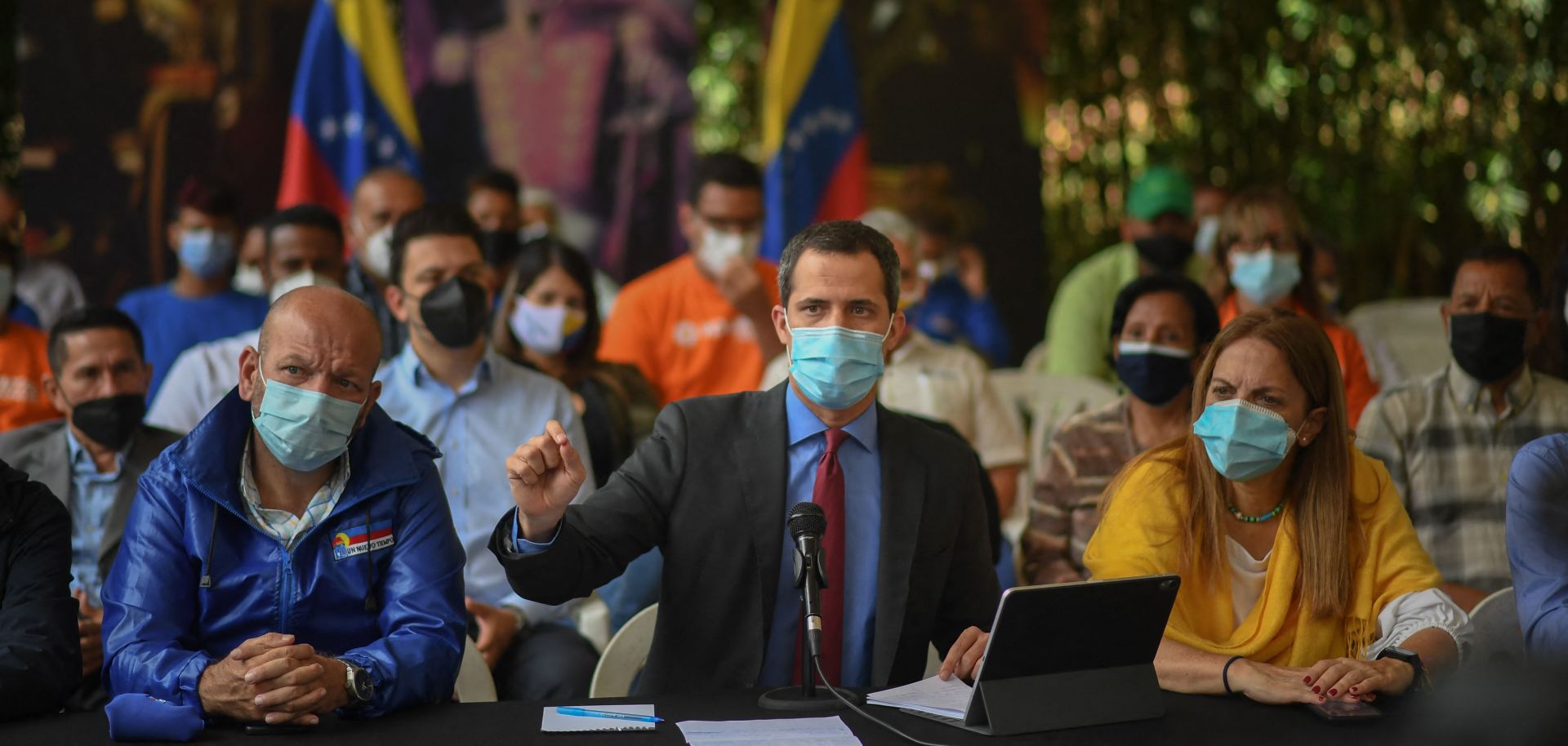
Venezuelan opposition leader Juan Guaido (center) speaks during a press conference at a park in Caracas on June 30, 2021.
Negotiations between the Venezuelan opposition and Nicolas Maduro’s authoritarian regime will likely yield small compromises, but ultimately fail to result in significant progress on elections or sanctions relief. Delegations representing interim President Juan Guaido and authoritarian leader Maduro will meet in Mexico City on Aug. 13 for what will be their fifth round of talks on the South American country’s political crisis since 2019. National Assembly leader Jorge Rodriguez and Miranda state Governor Hector Rodriguez will negotiate on Maduro’s behalf, while former legislator and mayor of Baruta Gerardo Blyde will represent the opposition. The delegates are expected to sign a memorandum of understanding for more detailed talks in September.
- On May 11, Guaido proposed an agreement where Caracas would hold free and fair elections in exchange for the United States agreeing to lift sanctions.
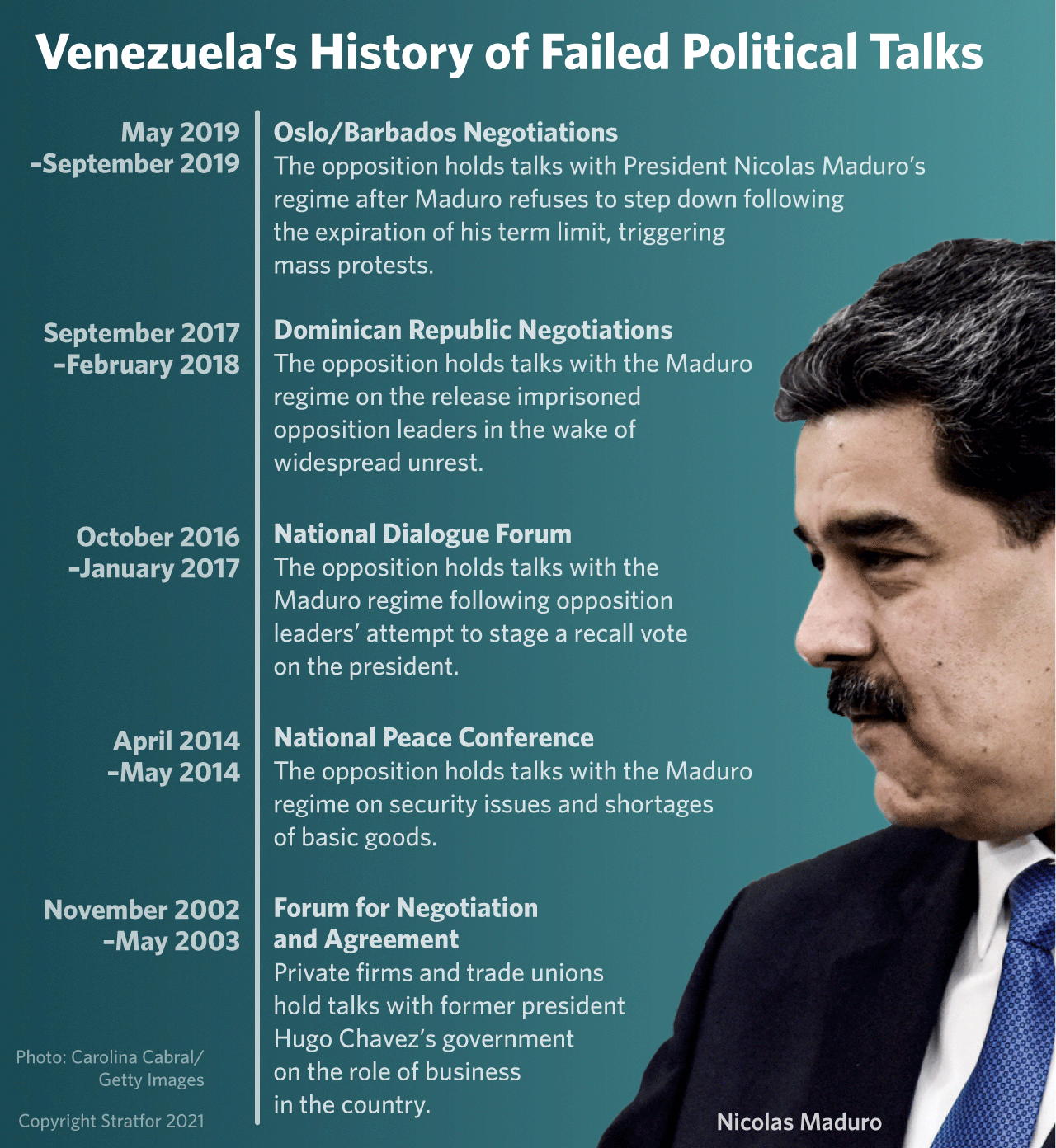
- The current U.S.-backed opposition movement led by Guaido first held talks with the Maduro regime in 2019 after violent anti-government demonstrations in Venezuela forced Caracas to the negotiating table.
Internal divisions, along with the fact that sanctions relief is ultimately in the United States’ hands, will limit the opposition’s negotiating power and, in turn, the concessions it can extract from Maduro’s regime. Though internationally-backed Guaido leads the opposition, there are several factions within the anti-Maduro camp that have opposing views on how to conduct the upcoming negotiations. Guaido has lost the majority of his support in Venezuela and has little leverage to hold over the government. The opposition’s main leverage is also the promise of sanctions relief, which the United States has the final say on. As a result, the opposition will enter the negotiations with a relatively weak position compared with previous negotiation attempts.
- Guaido and the United States have signaled that they plan on taking a hard-line stance in this next round of talks with the Maduro regime, promising Caracas serious sanctions relief in exchange for holding truly free and fair elections. But other factions of the Venezuelan opposition, such as Foro Civico, propose giving small concessions on sanctions in exchange for small concessions on the part of Maduro's government, such as the release of political prisoners.
Maduro, by contrast, will enter negotiations in a relatively comfortable position due to his government’s strong financial income streams, popular recognition and the support of the armed forces. Maduro does not face immediate pressure to make significant concessions to the opposition, though he is driven by the incentive of sanctions relief on key industries. His government receives sufficient financial revenue from legal oil trade and illicit trade of gold, copper and rare earth minerals carried out by Colombian militant groups. Although Maduro has low public approval, a majority of Venezuelans — including significant parts of the military — accept that he is the leader of the country. And while his regime would welcome the removal of sanctions on the country’s oil and gas sector, Maduro's political survival is not dependent on it. This secure position will grant Caracas the power to walk away from the negotiation process at any point should it see fit.
Negotiations are thus ultimately likely to center around Maduro’s government making concessions on small political issues in exchange for the phasing out of some U.S. sanctions in the oil and gas sector. Maduro is most likely to make concessions on issues that will not directly threaten his presidency, such as releasing political prisoners, returning exiled politicians or allowing aid organizations into the country. There’s a chance Caracas could also promise to reinstate opposition party cards, which enable Venezuelan voters to claim allegiance to dissident parties. In return, the United States — via the Guaido delegation — would probably offer limited sanctions relief, such as permitting oil-for-aid swaps or permanently allowing the sale of liquefied petroleum gas (more commonly known as propane) to Venezuela. However, sanctions relief will likely occur incrementally in order to ensure the Maduro government complies initially with the negotiated terms. As sanctions on the oil and gas sector are the biggest tool the United States — and thus, the opposition delegation — has, they will likely be unwilling to lift more substantial sanctions for anything less than a credible commitment to holding free and fair elections, which the Maduro delegation is unlikely to offer.
- As a measure of goodwill toward negotiations, the U.S. government recently authorized a limited resumption of propane exports to Venezuela through July 2022, temporarily easing a Trump-era ban on shipments of the key cooking fuel. Since the ban was imposed in 2019, propane shortages in Venezuela have created a dual humanitarian and environmental crisis by forcing people to cook on charcoal or wood grills.
With the Maduro government unwilling to give up power, the negotiations are likely to fizzle out before substantial progress is made on free and fair elections or the lifting of sanctions. Free and fair elections — the United States’ main goal in negotiations — would threaten Maduro’s grip on power. Maduro’s team will likely either agree to this stipulation only to later backtrack on election transparency, or sabotage the negotiation process entirely before discussions of substantial sanctions relief begin. While this will not be a problem during initial talks for smaller concessions, the negotiations process is likely to be stalled by the inherently opposing interests of the government and opposition parties.
- According to a July poll conducted by the market research and consulting firm Ipsos, Maduro has a 6% approval rate, indicating that he would lose any free and fair election.
