
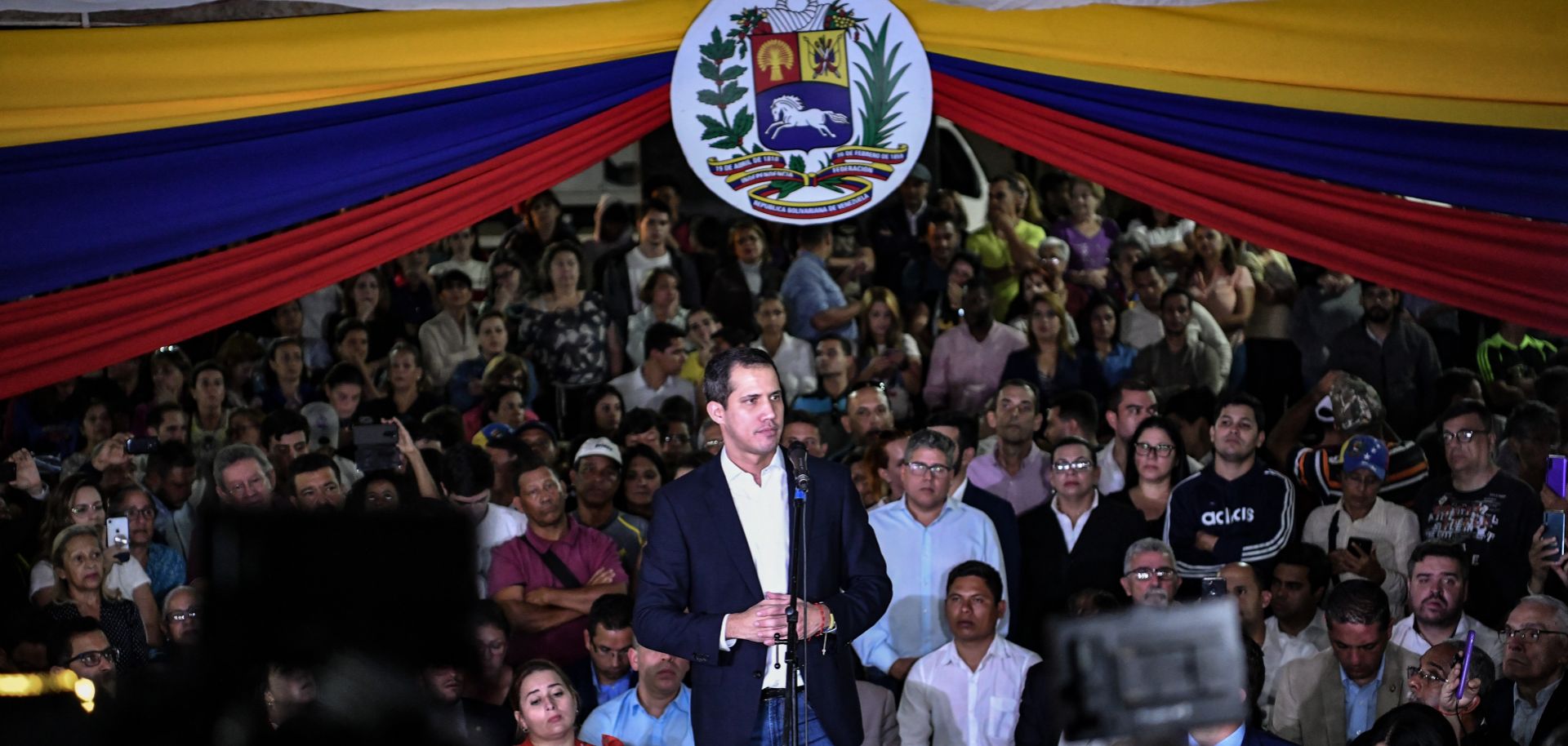
Opposition leader Juan Guaido speaks at an event in Caracas, Venezuela, on Feb. 11, 2020.
Disputes within Venezuela’s opposition over whether to boycott the country’s Dec. 6 legislative elections will likely enable President Nicolas Maduro to remain in power through at least the first half of 2021 by further weakening the legitimacy and influence of both Juan Guiado and his interim government. Guaido, who assumed an interim presidency in 2019, has proposed boycotting the upcoming elections for the National Assembly, citing concerns that the vote will be rigged by the Maduro regime. But prominent members of Venezuela’s opposition coalition, which Guiado currently heads, have since come out against his position.
- On Aug. 29, a meeting between Guaido and the leader of the opposition Vente Venezuela party, Maria Corina Machado, ended with no agreement on a common electoral strategy, as Machado demanded a specific action plan beyond only boycotting.
- On Sept. 2, two-time presidential candidate Henrique Capriles also broke with Guaido, saying that all parties should participate in the Dec. 6 elections instead of boycotting it.
The divisions within the coalition have deepened enough to precipitate a final split of opposition groups during the run-up to the Dec. 6 elections. Guaido has tried to consolidate his position as interim president by maximizing international recognition, expanding sanctions against Maduro, and trying to offer alternative governance in a country in a deep economic crisis. Capriles, however, has expressed that the opposition cannot serve as an interim government and present a robust resistance to Maduro’s regime at the same time. Capriles has also advocated for full participation in every election, as well as focusing on galvanizing internal support rather than seeking the endorsement of foreign governments. Machado’s Vente Venezuela party, meanwhile, seems to have lost patience for Guaido’s more gradual approach as well, believing that only external material support — including some limited military intervention — will dislodge Maduro from power.
These disagreements are likely to impact international support and weaken the opposition coalition, resulting in Maduro being able to stay in power for several more months without a clear alternative to oppose him. The current trajectory will result in two groups claiming to be the legitimate National Assembly following the election: the members of the coalition in the National Assembly who agree with Guaido’s approach, and the group that emerges from the Maduro’s organized Dec. 6 ballot.
- As the leader of the opposition-dominated National Assembly, Guaido obtained recognition as interim president from dozens of countries in January 2019. Several of these nations, including the United States and Colombia, have agreed on an implicit extension of the current National Assembly mandate after its term ends on Jan. 5, echoing Guaido’s position that fair elections are not possible under Venezuela’s current circumstances.
- But other nations who recognize the legitimacy of the current National Assembly, such as Argentina and Mexico, will likely switch their recognition to the newly elected legislature — especially if an important contingent of the opposition (like the one led by Capriles) ends up participating in the Dec. 6 vote.
