
Wheat grows in a farm field about 25 kilometers (15.5 miles) from the front line of a battle between Russian and Ukrainian troops near Sloviansk, Ukraine.
Even if talks on ending Russia’s naval blockade of Ukraine to allow grain exports via the Black Sea continue, major obstacles to an agreement and its implementation mean that Ukraine’s grain exports will remain strained, maintaining pressure on global food prices and fueling war fatigue in the West and around the world. On June 8, Russian Foreign Minister Sergei Lavrov and Turkish Foreign Minister Mevlut Cavusoglu met in Ankara where, among other topics, they discussed measures to create a sea lane to resume Ukraine's grain exports via the Black Sea as a part of a U.N.-backed effort to address the global food crisis. According to reports, Turkey is open to an agreement that would involve Turkish warships demining Ukrainian ports and creating a safe passage for ships carrying wheat and other products from Ukrainian waters. While the two foreign ministers expressed optimism that the plan was feasible, no agreement was struck. And as long as the talks take place without the participation of Ukraine and its demands are not addressed, a deal will likely remain elusive.
- Prior to the war, Ukraine exported around 95% of its cereals and oilseed via the Black Sea, averaging as much as 6 million tons per month. But exports amounted to only around 800,000 tons in May. Ukraine’s rail operator has said it expects rail exports to rise to up to 1.5 million tons a month in the coming weeks, but even under this optimistic scenario, Ukrainian grain exports will remain below a third their pre-war levels and at a much higher cost. Ukrainian farmers still managed to plant nearly 70% of their spring 2022 crops, but the inability to sell their goods amid the ongoing storage and export bottlenecks could prevent Ukrainian farmers from planting crops in the fall of 2022 and the spring of 2023.
- Turkey’s cooperation with Russia to advance the Ukrainian grain export issue is in part motivated by Ankara’s domestic economic instability and desire to mitigate the added pain of global food price shocks. But it’s also motivated by Turkey’s desire to remain a central player in cease-fire talks between Russia and Ukraine, as well as an overall constructive partner for Moscow as Turkey eyes another possible offensive in Russia-protected parts of Syria.
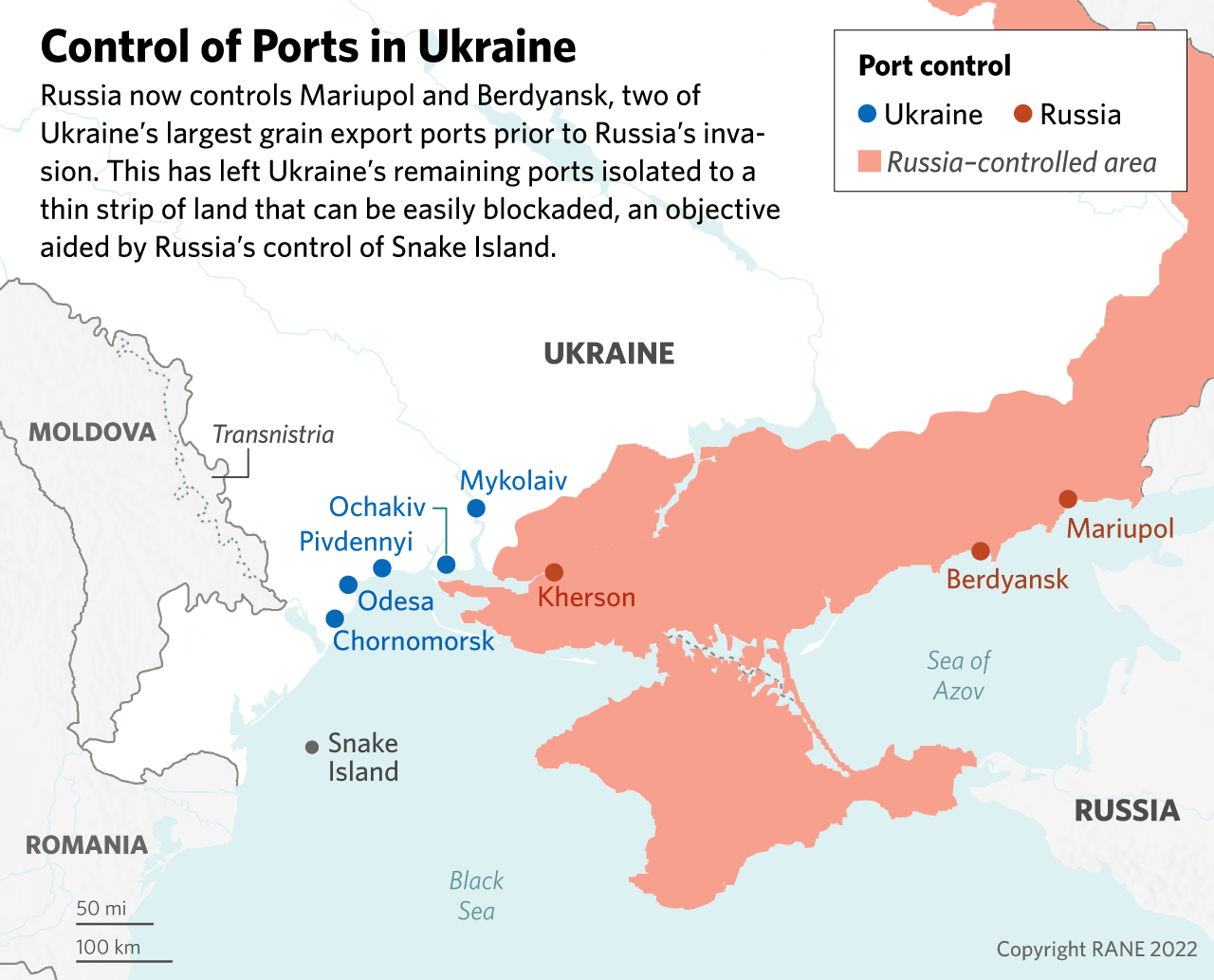
Kyiv will insist that the most sustainable way to end the naval blockade and resume grain exports is for the West to supply Ukraine with weapons to end the blockade and protect its coastline. In a statement following the Turkey-Russia meeting, Ukraine’s Ministry of Foreign Affairs indicated that while Kyiv "appreciates Turkey's efforts to unblock Ukrainian ports," it would reject any agreements that do not take Ukraine’s interests into account. Negotiations to which Ukraine is not a party and that do not involve providing Ukraine with a military deterrent against Russia breaking the deal are therefore unlikely to materialize. Ukraine has numerous concerns about resuming grain exports, including the possibility that demining its ports and coastal waters could prompt Russia to swiftly move in with its own naval mines or use the cleared areas to conduct offensive strikes on Ukraine.
- The Ukrainian statement specifically pointed to a Russian missile strike that destroyed warehouses at Mykolaiv’s commercial port on June 7 as evidence that Russia was not serious about allowing Ukraine to resume food exports.
- Ukraine will keep open the possibility of a deal as long as third countries, presumably NATO countries including Turkey and Romania, guarantee all aspects of the deal, including the minesweeping process and patrol and escort duties for the area of the Black Sea in question.
A deal could take months to implement, and Moscow has little reason to expedite the resumption of grain exports because food inflation could fuel Western war fatigue. Representatives of the International Maritime Organization have said that even if Ukraine wanted to reopen its ports, it would take several months to completely remove sea mines in the necessary areas. Furthermore, Moscow likely believes that the continued limitation of Ukraine’s grain exports to road, rail and river transport (effectively capping the volume it can export) will contribute to war fatigue in Europe and across the globe by contributing to rising food prices amid already immense pre-existing inflationary pressures on fuel and other commodities. Moscow likely hopes that such fatigue would push the West to pressure Kyiv to accept Russian terms for a ceasefire later this year.
- Commercial ships stopped operating in the northwest of the Black Sea near Ukraine, and freight and insurance costs spiked after several merchant ships were hit in the early days of Russia’s invasion, prompting some shipping companies to avoid the Black Sea altogether. Three mines were detected free-floating in March, two of which were located off the coast of Turkey and the other of which was found near Romania.
