
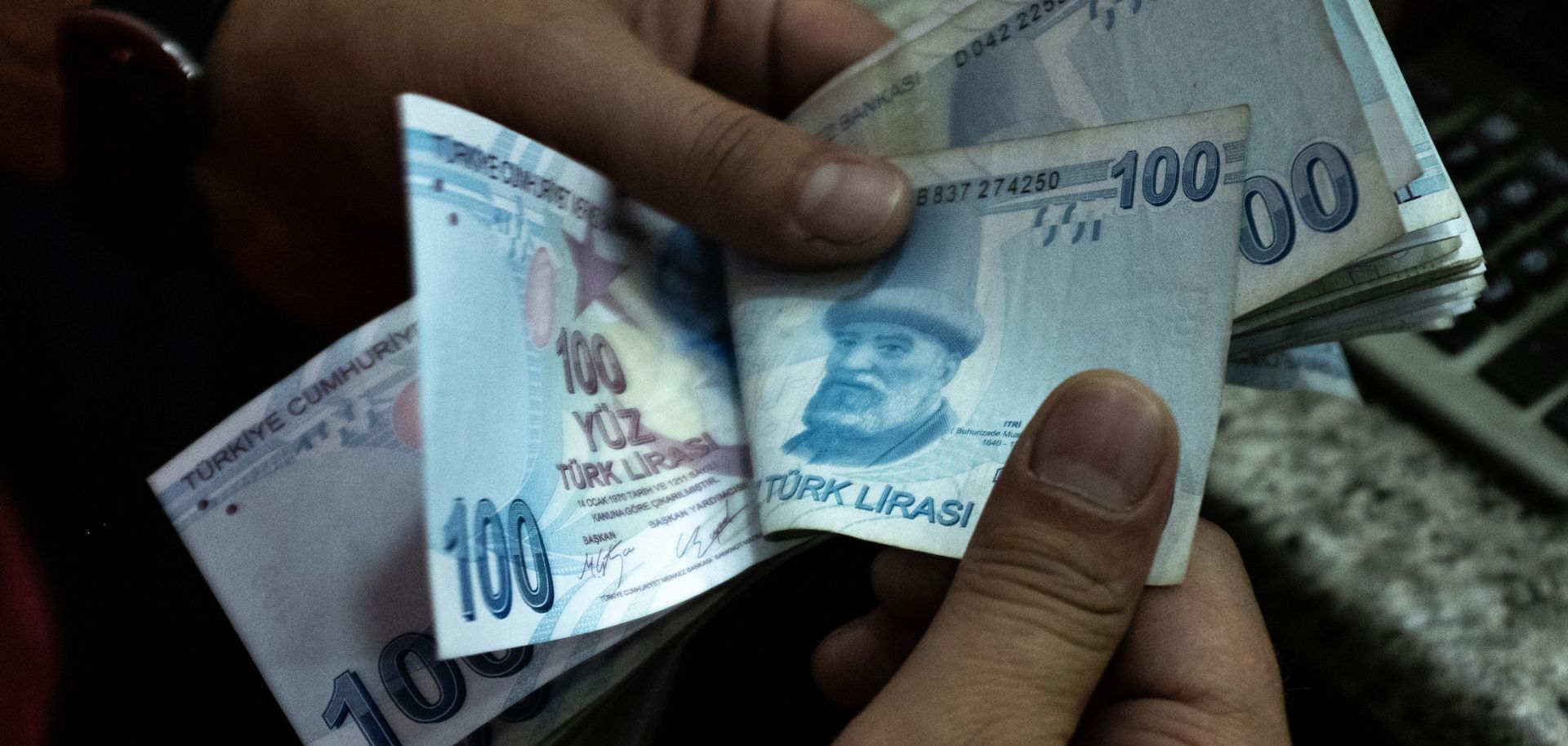
A man counts Turkish lira at a currency exchange office July 29, 2020, in Istanbul.
High inflation in Turkey threatens to eject the longtime-ruling Justice and Development Party (AKP) from power in Turkey's 2023 presidential election, meaning the government will be tempted to seek ways — such as manipulating the election process and trying to exploit a foreign crisis — to tip the political scales in its favor. On May 5, the government-run Turkish Statistical Institute reported that annual consumer inflation reached 70%, the highest rate since the AKP first took power in 2002. The Central Bank of the Republic of Turkey blamed spikes in energy and food prices because of the war in Ukraine and pandemic-related supply chain problems. The bank has not, however, raised interest rates to combat inflation, as have many other central banks. Though central bank Gov. Sahap Kavcioglu forecast that inflation would begin to decline in June, various indicators suggest this will not be the case. Meanwhile, Turkey’s Producer Price Index (PPI) soared to 122% from 115%, a price increase they can be expected to pass on to consumers. Meanwhile, private Turkish polling institute MetroPoll suggests opposition figures, including Ankara Mayor Mansur Yavas, Istanbul Mayor Ekram Imamoglu and Republican People's Party (CHP) head Kemal Kilicdaroglu, were all within striking distance of defeating President Recep Tayyip Erdogan in the June 2023 presidential election.
- Kavcioglu, a former AKP lawmaker, has kept interest rates at 14%, but the real interest rate is now net negative because of increasing annual inflation.
- Turkey's inflation has rapidly increased since Q4 2021, when it was at an already high of 36% in December 2021; commodity shocks, wage increases, and supply chain problems continue to accelerate the price increases. To soothe public anger over inflation, Turkey raised its minimum wage by 50% in December 2021.
While an interest rate hike could tame inflation, it might not offset the erosion in public support for Erdogan and the AKP. Erdogan has long been wary of interest rate hikes, but has tolerated them at times, notably to help stabilize the lira amid the currency crisis of 2018. The political pressure caused by inflation might convince the president to permit further rate hikes by the bank, over which he holds significant influence. But inflation is only one of Turkey's economic problems. High energy and food prices remain likely worldwide in the wake of the war in Ukraine. Central banks including the U.S. Federal Reserve have begun raising interest rates, driving up the cost of borrowing for Turkish companies and increasing the cost of the country's sizable corporate debt, much of which is held in dollars. But regardless of how Erdogan proceeds, Turks' confidence in the AKP government may have suffered irreparable damage — especially younger voters, who have grown up with him as president for most of their lives. For such voters, even an economic recovery might not be enough to persuade them to support the AKP.
- A generational split exists regarding voter perceptions of AKP management of the economy. Many Turks born after 2000 do not remember the more volatile economy of the 1990s, when inflation was even higher and the currency deeply unstable. Older Turks, however, are more willing to support the party through tumultuous times because they remember that the pre-AKP governments had worse economic records. This group's support, however, may no longer be enough to guarantee a majority at the polls as the number of younger voters grows.
- Erdogan has long opposed higher interest rates, seeing them as un-Islamic and a form of usury.
Given the country's economic weakness, the AKP's political strategy will hinge more on manipulating the electoral system against the opposition. Already, the AKP has lowered the electoral threshold to enter parliament to 7% from 10% to help ensure its ally, the ultranationalist Nationalist Movement Party, can still win despite its diminished support. It may also ban the Kurdish People's Democratic Party (HDP) via its control of the judiciary to weaken the opposition, and use its influence over the media to create unfavorable narratives for popular presidential candidates, like Yavas, Imamoglu or Kilicdaroglu, ahead of the election.
- The AKP attempted to manipulate the Istanbul mayoral vote in 2019 by holding the election again after its candidate lost, but the CHP won the second election.
The AKP will also exploit certain foreign crises to win over nationalists while reaching out to former rivals for investment and trade ties. Turkey remains militarily involved in Libya, Syria the Caucasus and increasingly in Ukraine; it might increase such involvement to demonstrate Turkey's strength to nationalists at home and showcase Erdogan's leadership skills. Turkey probably will not start confrontations with rivals overseas, but would escalate should a rival threaten its interests. Ankara will also try to convince Saudi Arabia and the United Arab Emirates to rebuild economic ties with Turkey via personal diplomacy between those countries' leaders and Erdogan and via offers to sell them arms, like the Bayraktar TB2 drone. But such efforts might not suffice to help the AKP's electoral chances, and could even backfire on the AKP should deepening involvement in conflict abroad not develop in Turkey's interests.
- The United Arab Emirates has provided currency swaps to stabilize the lira, but neither it nor Saudi Arabia has the financial weight or the interest in completely bailing out Turkey.
- Turkey's intervention in Libya in 2020 initially provided the AKP with a polling boost, but this effect faded as the public returned its attention to domestic economic problems.
