
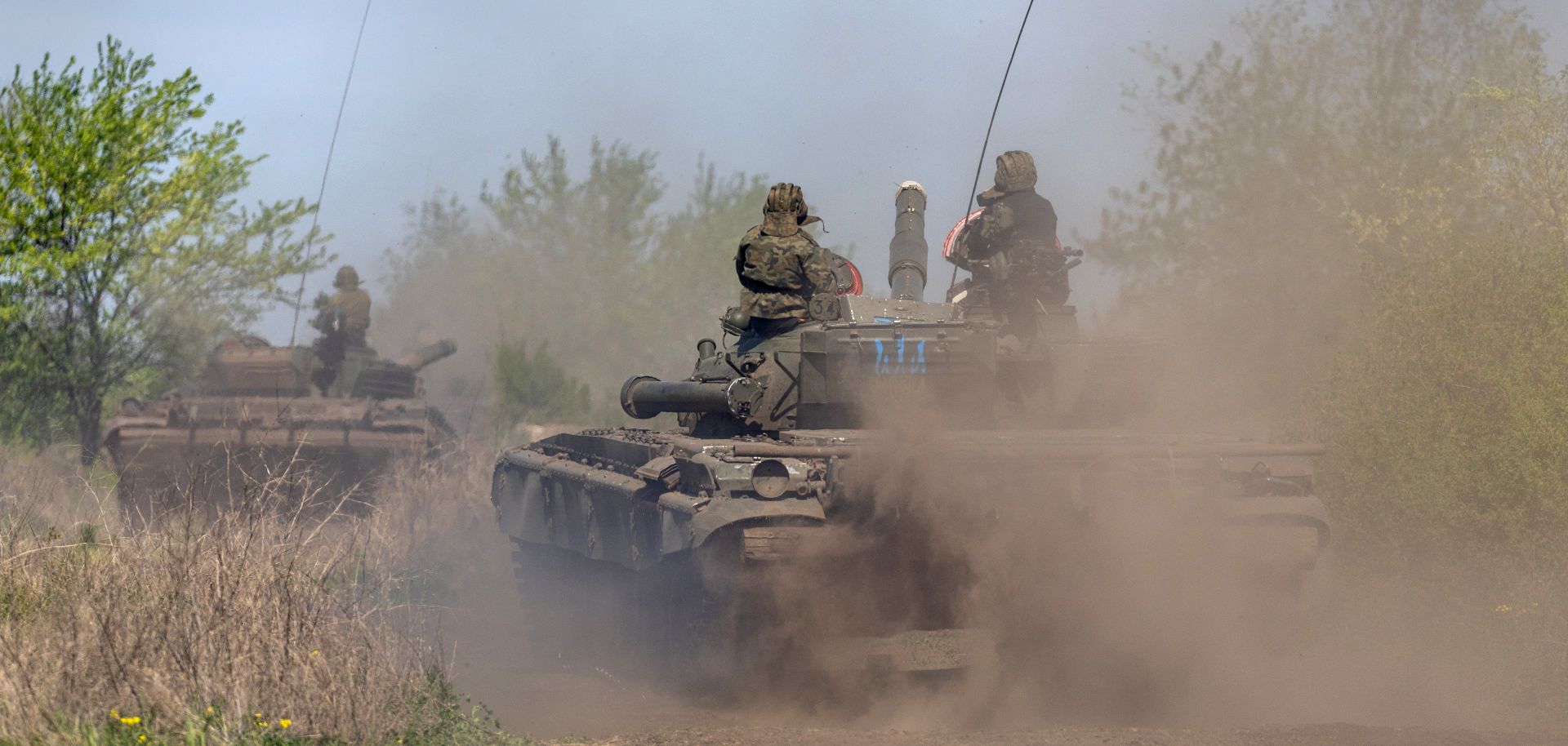
Ukrainian soldiers on tanks participate in a training exercise about 70 kilometers outside of Kherson in southern Ukraine on May 9, 2022.
While Ukraine likely missed its opportunity for a swift counterattack in Kherson, its pressure on Russian forces near the southern city, combined with its continued foothold in the eastern Donbas region, could force Russia to delay annexing Ukrainian territories. But Russia still retains the overall military advantage and desire to seize areas of Ukraine, leaving the door open to eventual annexations. In recent weeks, Western and Ukrainian officials and analysts have spoken of an attempted Ukrainian campaign to retake the strategic city of Kherson and surrounding territory on the western (right) bank of the mouth of the Dnieper River. Recent strikes by Ukrainian forces in Russian-occupied Crimea, as well as on the few bridges linking Kherson and the western bank of the Dnieper River to Russia's ''land corridor'' to Crimea on the eastern (left) bank, have only strengthened speculation regarding a Ukrainian counterattack toward Kherson. However, a large-scale Russian redeployment at the beginning of August brought reinforcements to the Kherson region, and the western bank of the Dnieper River in particular, which will likely limit the prospects of a potential Ukrainian counteroffensive in the coming several weeks and possibly beyond. This will deny Ukraine a potentially major victory that would have demonstrated to Western publics just how big a difference their military support can make, while raising hard questions in Moscow and across Russia about the war being worth its cost. For Russia, reinforcing its bridgehead on the western bank is crucial to retain its ability to threaten a future offensive and buffer against Ukraine's ability to strike east of the river.
- Russian forces, which had been concentrated in the Donbas for most of May, June and July, have now redeployed to spread across a broader front, with several battalion tactical groups (BTGs) moving near the frontline in the Kherson region. In late July, there were only believed to be 13-15 BTGs (or no more than 15,000 Russian troops) in the entire Kherson region, whereas now 25-30 BTGs are believed to be there, with at least 15-20 BTGs on the right bank of the Dnieper River alone.
- On Aug. 10, a series of explosions were reported at Russia's Saki military airfield on the southwestern coast of Crimea, in an apparent attack by Ukrainian forces that resulted in the destruction of numerous Russian aircraft. On Aug. 16, Russia acknowledged a second strike that targeted an ammunition dump and damaged electricity infrastructure, this time attributing the attack to Ukrainian forces. The recent strikes, which provided a significant boost to Ukrainian morale, were conducted well behind the frontline — fueling widespread speculation that they were part of a systematic campaign to degrade Russian military hardware, logistics and communications as part of (or prior to) a Ukrainian counteroffensive.
Ukraine lacks the forces to retake the area occupied by Russia on the western bank of the Dnieper River in the near term, but the mere threat of a counterattack in the region offers Kyiv strategic benefits. Ukraine began launching probing attacks near Kherson nearly two months ago, but has had little success. A major Ukrainian counterattack is unlikely to quickly gain ground in the Kherson region for several other reasons, beyond the recent Russian troop reinforcement of the area. Firstly, Ukraine has essentially no experience conducting major offensive operations. Secondly, the best-trained Ukrainian units have taken heavy casualties and largely remain in the Donbas area. And thirdly, Russian forces maintain an advantage in artillery and ammunition to suppress Ukrainian forces. However, Russia's logistical capabilities to supply the left bank are and will remain in jeopardy. This is because Ukrainian attacks have seriously damaged the only two road vehicle crossing points in the Kherson region: the Antonovsky bridge and the Nova Kakhovka hydroelectric dam bridge. Russia has, in turn, been forced to rely increasingly on pontoon ferries to supply its large troop contingent on the right bank. This logistical bottleneck across the Dnieper River is a severe constraint on the feasibility of a renewed Russian offensive in the area. And for that reason, a steady Ukrainian effort to degrade Russian forces in the Kherson region through the implicit threat of a counterattack toward the city still comes with significant military benefits for Ukraine. Namely, it has forced Russian forces to concentrate in an area where they are vulnerable to Ukrainian firepower, and where their supply lines are also under constant threat — thereby reducing the offensive potency of these Russian troops compared to if they were at another location along the front.
- The Ukrainian high command may calculate that Russia's concentration of additional forces in the area around Kherson offers some positive tradeoffs, including the fact that the Kherson front is the easiest for Kyiv to supply its own forces.
- Russia's redeployment of troops toward the southwest near Kherson has dispersed the Russian forces that were once concentrated roughly 600 kilometers (or 370 miles) away in Ukraine's eastern Donbas region. Seizing control of the Donbas remains Moscow's primary military objective. Russia's reduced military presence there has, in turn, freed Ukraine to move more forces toward the eastern region. It could also enable Kyiv to even divert its troops southward for an attack from the Zaporizhzhya area, which now has the lowest density of Russian combat units on the front.
The Russian troops that remain in the Donbas will probably continue to launch attacks and slowly gain ground in the region, though they are unlikely to capture the rest of the eastern region in the coming weeks. This will decrease the likelihood of Russia annexing the Donetsk province, as well as other areas of Ukraine in September. A significant source of uncertainty in the trajectory of the war is how quickly Russia acts on its annexation plans. Recent reports suggest Moscow has targeted occupied Ukrainian territories for annexation as soon as next month, with proposed dates of Sept. 11 or Sept. 15. However, this appears increasingly unlikely amid Russia's troop redeployments to Kherson and Ukraine's continuous strikes on Russian-controlled territory, which risk denying Moscow the minimal semblance of security and territorial integrity needed to give the annexation referendums a veneer of legitimacy. Russia will thus likely need more time to prepare for such referendums, including by continuing resistance suppression measures and the ''passportization'' of residents to Russian documents in seized areas.
- On Aug. 11, the head of the self-proclaimed self-declared Donetsk People's Republic said that a vote on whether to join Russia could not be held — and that a date for such a referendum wouldn't even be announced — until the region was fully under Russian control. Russia currently controls only about 60% percent of the Donetsk administrative region.
However, it's only a matter of time before Russia eventually tries to annex the Donbas or other parts of Ukraine. Polling shows that Russians do not consider the invasion worth the cost without annexing Ukrainian territory. Russian officials, including President Vladimir Putin himself, have also repeatedly stated that the purpose of Moscow's so-called ''special military operation'' in Ukraine is capturing the Donbas region. This domestic political imperative means Russia is all but certain to still follow through with annexation at some point in the future, with seizing the war-torn Donbas area likely its first priority. However, any attempt to annex Ukrainian territory — whether in the Donbas or in the Kherson and Zaporizhzhya areas — would probably all but end the near-term possibilities of negotiations between Moscow and Kyiv, as Ukrainian President Volodymyr Zelenskyy reiterated as recently as Aug. 7 that if Russia proceeded with referendums in occupied areas on joining Russia, there would be no further talks with Ukraine or its international allies.
Russian forces' currently dispersed posture also grants them flexibility and could be part of preparations for a renewed offensive campaign. Bottlenecks on both the West's ability to provide Ukraine artillery rounds and precision munitions, as well as Ukraine's ability to move those weapons and other equipment to the front, will impede Kyiv's ability to launch counterattacks in the coming months. This will grant Russia its own window to not only prepare its defense, but also potentially conduct a renewed offensive across a broad front. Some analysts have speculated that Russia has changed its force posture not merely to deter Ukraine's possible Kherson counterattack, but also to retain flexibility prior to its own renewed strategic offensive in the coming weeks. Such an offensive could be partially aimed at preparing for annexation referendums by overcoming current challenges in the Donetsk region to simultaneously create new breakthroughs and push the frontline deeper into Ukraine. For Russia, this would secure both more of the regions it seeks to annex and provide additional buffer space, which Moscow believes will contribute to both the security and veneer of legitimacy of referendums by tying down the Ukrainian army's resources. Russia may believe that successfully conducting an offensive would make resisting the annexations appear hopeless and compel Kyiv and the West to come to the negotiating table. Such a Russian offensive could be paired with renewed missile and rocket attacks from Belarus to degrade Ukrainian morale and to more credibly threaten the destruction of decision-making centers in Kyiv, which Moscow has repeatedly threatened to do in response to Ukrainian attacks on Russia. In an annexation scenario, Moscow would claim this supposed right and imperative to retaliate applies to Ukrainian attacks on the newly captured territories in an effort to deter attacks on them.
- Russia has been accumulating rockets and missiles in southern Belarus in recent weeks, leading to speculation that they could be part of a new offensive or intended to strike Kyiv — possibly as soon as Ukraine's Independence Day on Aug. 24.
