
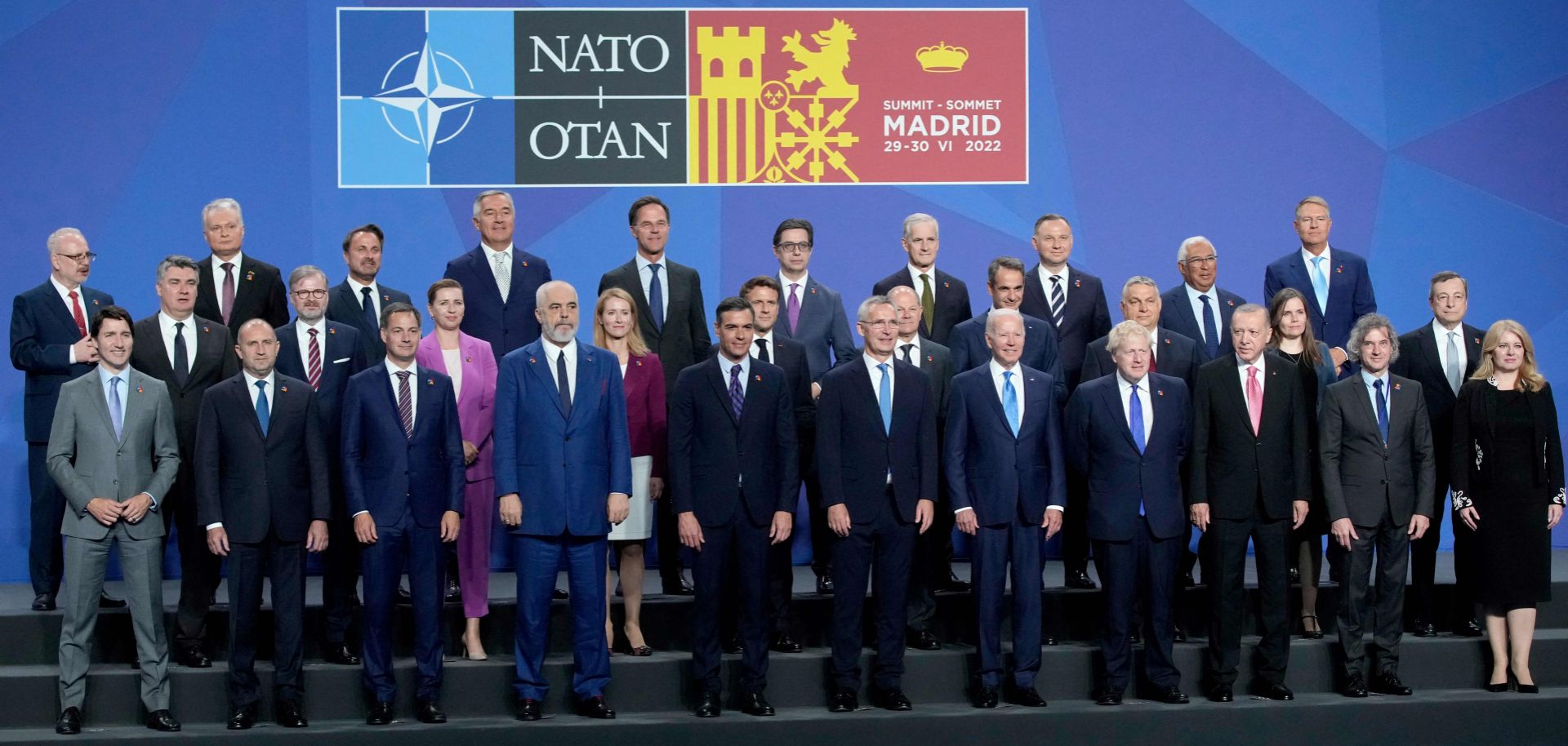
Heads of state pose for a group photo at the NATO summit in Madrid, Spain, on June 29, 2022.
NATO’s first update to its Strategic Concept in 12 years underscores the foundational shifts in the Western security alliance’s priorities and threat perceptions as the Russia-Ukraine war rages on, China expands its reach in Asia, and temperatures rise across the world. On June 29, the North Atlantic Treaty Organization (NATO) unveiled its new Strategic Concept outlining the alliance’s guiding principles, purpose and goals. The document, which was last updated in 2010, identifies Russia as “the most significant and direct threat” to NATO members’ peace and security amid Moscow’s ongoing aggression in Ukraine. NATO lists China as a strategic “challenge” for the first time as well, citing Beijing’s “coercive policies.”
- The updated Strategic Concept was announced during the June 29-30 NATO summit in Madrid. The Madrid summit was the first held since the alliance’s March 24 extraordinary meeting to coordinate a response to Russia’s Feb. 24 invasion of Ukraine.
In response to these changing priorities and threat perceptions, NATO also announced changes in its force posture, including the expansion of its rapid reaction force and new U.S. deployments on Russia’s borders. NATO plans to increase the size of its rapid reaction force nearly eightfold by next year, from 40,000 to 300,000 troops, following Russia’s invasion of Ukraine. The United States, in particular, plans to significantly expand its military presence in Europe. On June 29, President Joe Biden announced Washington will establish a permanent headquarters in Poland for the U.S. 5th Army Corps, send 5,000 additional troops to Romania, and increase rotational deployments in the Baltic states (namely, Estonia, Latvia and Lithuania). The United States will also send two additional squadrons of F-35 fighter aircraft to the United Kingdom, station additional air defense systems at bases in Italy and Germany, and increase the number of naval destroyers in Rota, Spain, from four to six.
- NATO’s so-called Response Force includes land, sea and air assets that are designed to be deployed quickly and wherever necessary in the event of an attack. The force numbered just 13,000 troops prior to Russia’s initial aggression against Ukraine in 2014.
Despite identifying Russia as a “direct threat,” NATO declined even stronger action to deter and defend against Moscow. The updated Strategic Concept describes Russia as “the most significant and direct threat” to security and stability in the entire Euro-Atlantic area, as Moscow seeks to “establish spheres of influence and direct control through coercion, subversion, aggression and annexation,” using “conventional, cyber and hybrid means against NATO and [NATO’s] partners.” The only other “direct threat” identified in the document is terrorism. This harsh language represents a fundamental reversal from the document’s previous iteration in 2010, when NATO said it sought “a true strategic partnership” with Russia and would “act accordingly, with the expectation of reciprocity from Russia.” The updated Strategic Concept also removes any mention of the 1998 Russia-NATO Founding Act governing relations between the alliance and Russia, which the 2010 version reaffirmed. But in the 2022 document, NATO says it is willing to “keep open channels of communication with Moscow to manage and mitigate risks, prevent escalation and increase transparency,” which indicates a desire to maintain the spirit of and compliance with the 24-year-old pact. The new NATO troops that will soon be deployed to Poland and the Baltic states will also continue to rotate throughout the alliance’s Eastern European members to avoid running afoul of the Founding Act, in which NATO pledged not to permanently station combat troops on the Russian border.
- On June 29, U.S. Assistant Secretary of Defense Celeste Wallander said the U.S. 5th Army Corps’ permanent stationing in Poland will be staffed by headquarters officials, not combat troops, and would thus not violate the U.S. understanding of the NATO-Russia Founding Act. Officials in countries such as France and Germany have said the Founding Act should be preserved, while some, particularly in Eastern Europe and the United States, had called for the alliance to consider formally disavowing or suspending the agreement to remove restraints on NATO force posture.
But the new strategy will still fuel Russia’s concerns about NATO’s expansion and prompt Moscow to increase its military presence in the Baltic region. NATO's impending troop movements do not contradict the alliance’s stated desire to maintain the possibility of dialogue with Moscow. They do, however, contradict Russia’s desire for a decreased NATO presence on its periphery, which Moscow expressed prior to invading Ukraine in February. Increased NATO forces in Poland and the Baltic states — not to mention Sweden and Finland’s impending admission to the alliance — will thus still push Russia to increase its nuclear and nuclear-capable weapons systems in the Baltic area and eventually base many more conventional forces there as well. The 2022 Strategic Concept also reaffirms the decision of the 2008 Bucharest Summit that said Ukraine and Georgia will one day be NATO members, adding that “decisions on membership are taken by NATO allies and no third party has a say in this process” in a clear jab at Russia. While this does not portend any concrete or imminent action regarding Georgia and Ukraine’s membership aspirations, it will still increase tensions with Russia, which could use the reaffirmation of the policy to help justify an escalation of the war in Ukraine and/or destabilization measures in Georgia or Moldova.
China’s first-ever mention as a strategic “challenge” also reflects NATO’s new concerns with Beijing’s growing influence in Asia. The 2010 Strategic Concept did not once mention China nor the Indo-Pacific region, but the 2022 document devotes significant space to China, whose “stated ambitions and coercive policies challenge NATO interests, security and values”, and says “the Indo-Pacific is important for NATO, given that developments in that region can directly affect Euro-Atlantic security.” This represents a long-awaited change of tone toward China. The alliance’s statement in the 2022 document that it will “strengthen cooperation with new and existing partners in the Indo-Pacific to tackle cross-regional challenges and shared security interests” will likely raise eyebrows in Beijing. However, the updated Strategic Concept also makes clear that it “remains open to constructive engagement to build reciprocal transparency” with China.
The 2022 Strategic Concept highlights new cybersecurity, climate change, authoritarian governance and other non-military threats as well. Climate change was mentioned only once in the 2010 Strategic Concept. But in the 2022 version, it is mentioned 11 times, including the ambitious statement that NATO should “become the leading international organization when it comes to understanding and adapting to the impact of climate change on security.” Additional attention is also given to cyberattacks. The alliance reaffirmed its longstanding policy that a “single or cumulative set of malicious cyber activities; or hostile operations to, from, or within space” could prompt NATO to trigger its Article 5 mutual defense clause — another measure directed first and foremost toward Russia and China and intended to deter cyberattacks causing physical damage, as otherwise the alliance would be skeptical of triggering Article 5 because of a cyberattack. Finally, the 2022 Strategic Concept on several occasions notes the challenge to the alliance’s interests and values posed by advancing authoritarianism — a threat not acknowledged directly in 2010.
- NATO’s updated Strategic Concept acknowledges non-military threats such as identifying and mitigating strategic vulnerabilities and dependencies, including with respect to critical infrastructure, supply chains and health systems. These new threats underscore the increasing importance of reliable partners in geographies outside the NATO alliance such as in Asia, from where the alliance must ensure the stability and security of supplies of critical components and resources.
