
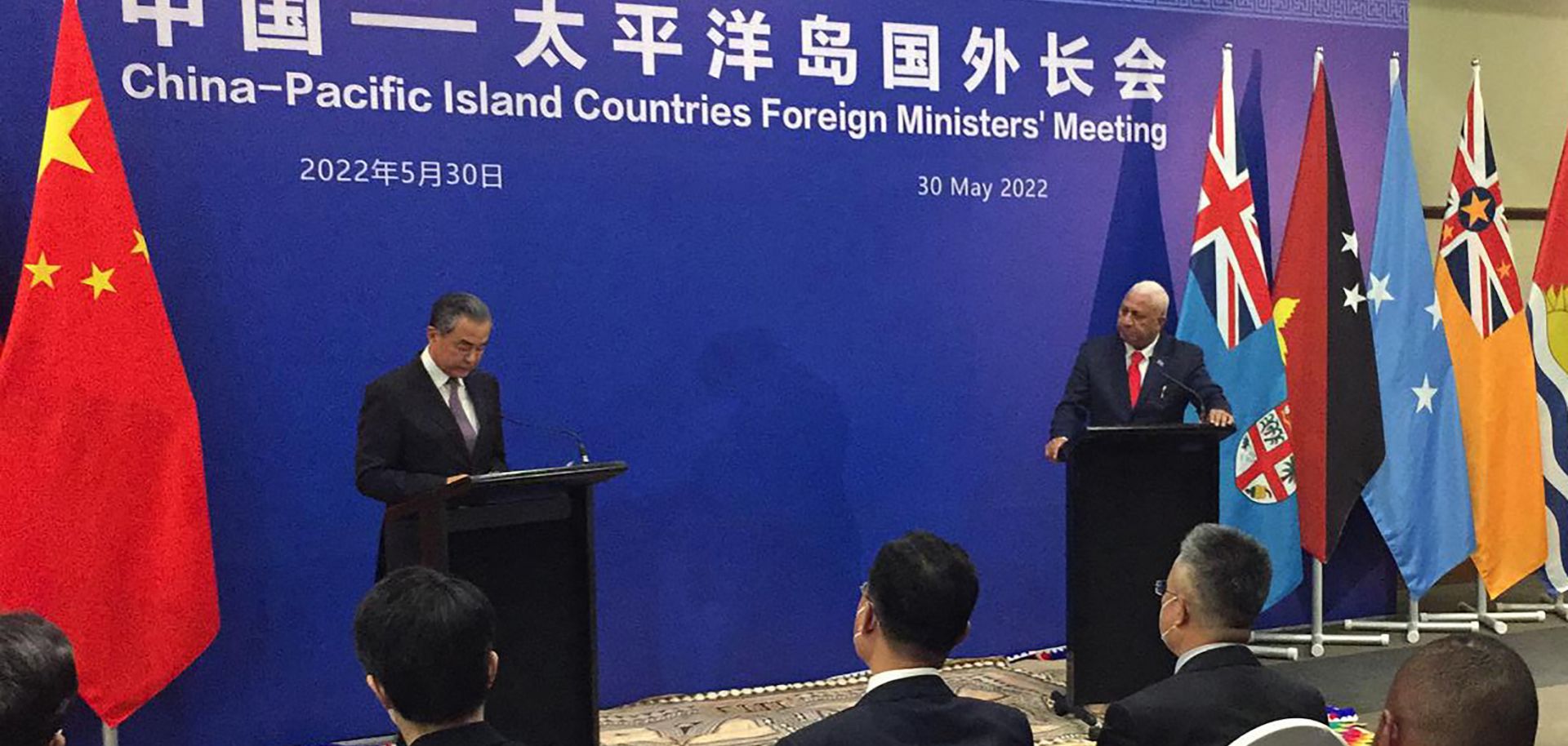
Visiting Chinese Foreign Minister Wang Yi (left) and Fiji's prime minister Frank Bainimarama attend a joint press conference in Fiji's capital of Suva on May 30, 2022.
China's troubled agreement with Pacific Island nations highlights the growing competition with the United States and Australia for regional influence, which will grant bargaining power to the often-overlooked island countries. On May 30, China failed to reach an agreement with Fiji and nine other Pacific Island nations on a joint communique that laid out a five-year plan for trade and security cooperation with the region. Despite Foreign Minister Wang Yi's assurances of the deal's mutually beneficial nature, the prime minister of Fiji — where the deal was supposed to be announced — claimed that the region could not yet agree to a deal as it prized consensus. Other leaders pushed to delay or amend the deal, though few details are available on their specific concerns. This comes after the president of Federated States of Micronesia (FSM) urged his fellow Pacific Island nations on May 25 not to subject the region to great power competition by signing the deal. China's failed pitch also follows U.S. President Joe Biden's May 20-24 visit to South Korea and Japan, where he launched the Indo-Pacific Economic Framework with 13 founding member countries (though Fiji became the 14th on May 28). Biden attended a meeting of the Quadrilateral Security Dialogue on May 24 as well, which saw the United States, Australia, India and Japan launch a regional initiative to combat illegal fishing — a practice for which China is the primary culprit.
- The Pacific Islands is a critical strategic space for all three powers. China is interested in projecting power beyond the Second Island Chain and thus buffering U.S. efforts to project military power and surveillance capabilities from the Pacific Islands into China's near seas and provide strategic depth for U.S. troops in Guam and Hawaii. Australia, for its part, sees the Pacific Islands as its strategic ''backyard'' and thus is highly motivated to maximize its own military access to the region while minimizing the ability of rival countries like China to project naval and economic power in the region.
- The United States and China have high political stakes in 2022. President Biden is heading into the November midterm elections at a time of bipartisan hawkishness on China, while Chinese President Xi Jinping is aiming to secure an unprecedented third term in late 2022. Both leaders are also navigating the domestic economic hangover from the COVID-19 pandemic.
- Australia is also deeply invested in the region, with newly elected Prime Minister Anthony Albanese attempting to quell domestic concerns that he may ease up on his predecessor Scott Morrison's efforts to protect the Pacific Islands — or what Morrison referred to as Australia's strategic ''backyard'' — from Chinese threats.
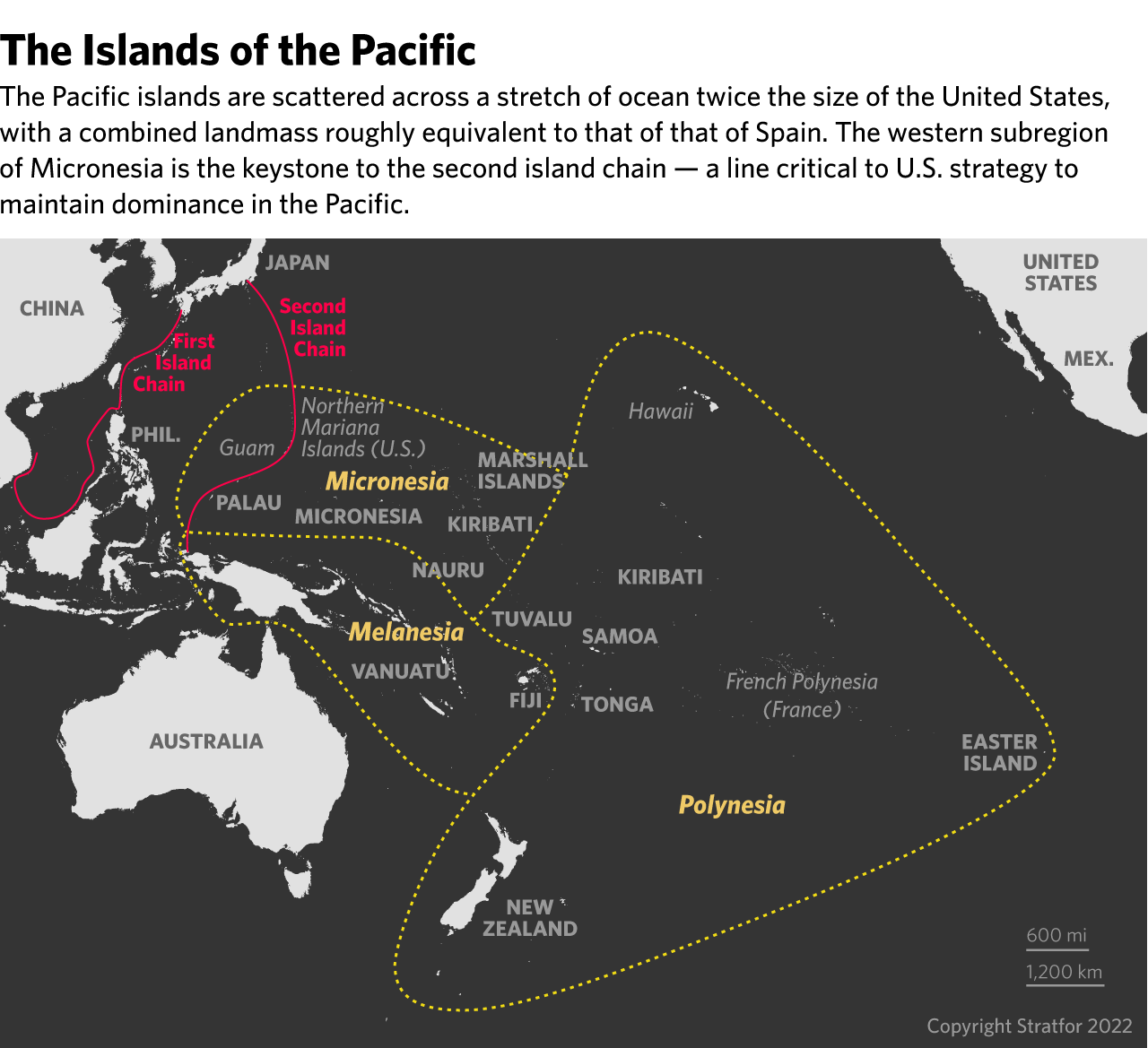
All three regional heavyweights have deep interests in the Pacific Islands, a region that has historically been a quieter theater for U.S.-China and Australia-China competition but is now receiving greater political attention amid recent developments in the Solomon Islands. In late March, China signed a security agreement with the Solomon Islands that permitted Chinese naval vessels to replenish in the country and Chinese police to deploy there at the request of Honiara, the country's capital. This follows the November 2021 protests in the Solomon Islands, which targeted the Chinatown on the island of Malaita and saw Australia deploy police to restore order at the request of the Solomon Islands. Amid these developments, along with rising tensions between China and both Australia and the United States, all three governments are more intentionally engaging with the region to avoid losing influence in the strategic middle ground of the Pacific.
- Besides the Solomon Islands agreement, Beijing has signed wide-ranging deals with the 10 Pacific Island countries that have diplomatic relations with China, including memoranda of understanding related to China's Belt and Road Initiative focused on trade, investment and infrastructure development. These countries also hope to access China's massive tourism market, jointly develop maritime mineral and fuel resources, and counterbalance relations with Australia and the United States.
- U.S. interaction with the region has been focused on nations in Micronesia — namely, the Freely Associated States (FAS) of Palau, the Marshall Islands and the FSM, which provide Washington exclusive naval access to the region in return for aid and the right of local citizens to live and work in the United States. However, Washington's attention to the region has lapsed in recent years. President Biden only appointed a new lead negotiator in March 2022 to renew the Compacts of Free Association with the Marshall Islands and FSM (set to expire in 2023), over a year after the last meeting in December 2020.
- Australia's relations with the Pacific Islands are region-wide and heavily focused on investment. But Canberra's closest ties are concentrated in Melanesia in the form of agreements with Fiji, Vanuatu, the Solomon Islands and Papua New Guinea that give the island nations access to Australia for foreign workers in exchange for providing the Australian navy regional maritime access. In September, Australia also signed onto AUKUS, a weapons access deal with the United States and the United Kingdom that secures Canberra long-term access to nuclear submarines. This technology will allow Australia to boost maritime deterrence and surveillance in the broader Indo-Pacific, but especially in the Pacific Islands.
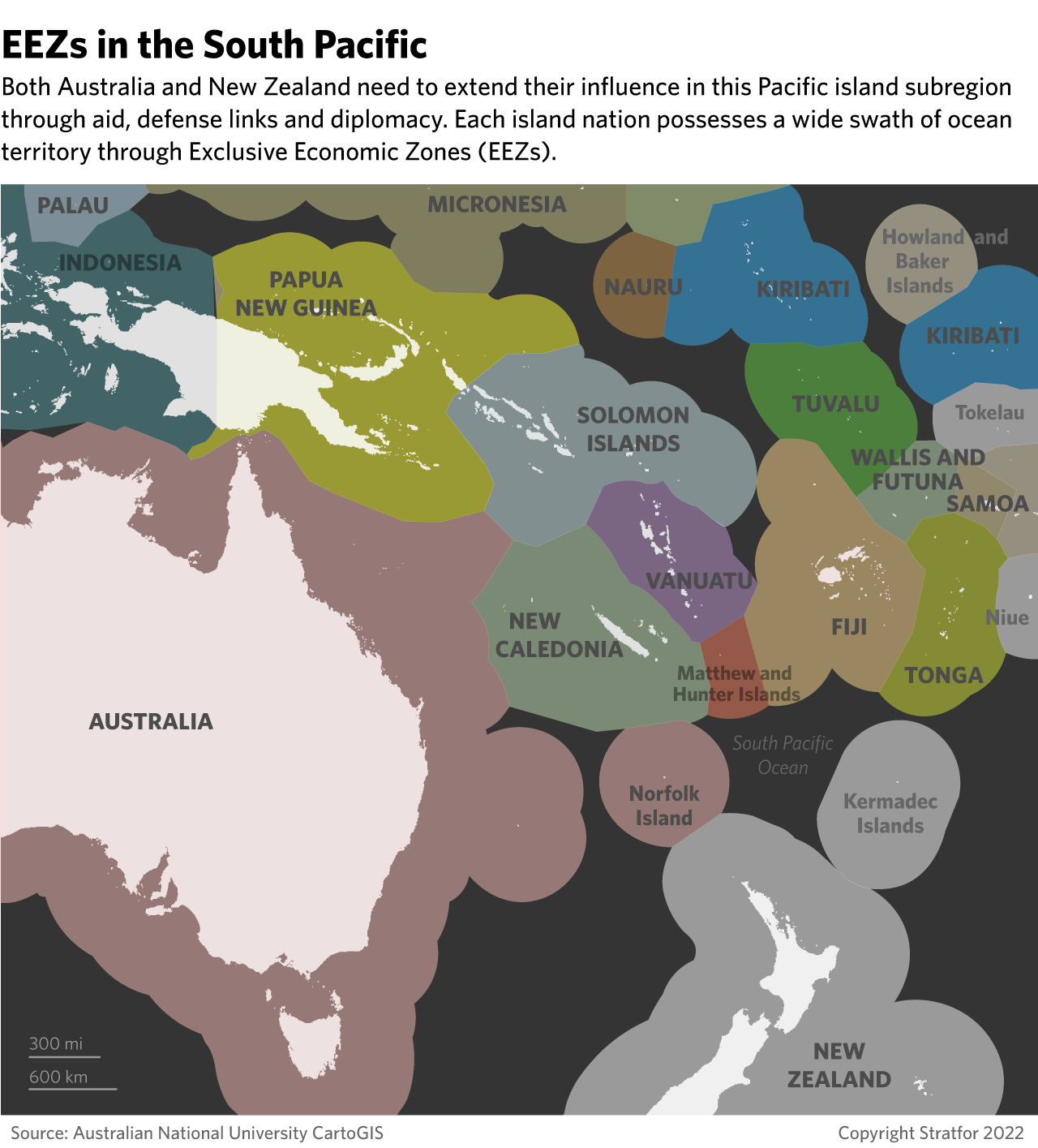
These developments will test the United States, Australia and China's regional engagement strategies and give Pacific Island nations unique leverage to maximize foreign assistance from these major global powers. Though most Pacific Island nations have minuscule populations and economies, this new attention from Beijing, Canberra and Washington will enable the Pacific Islands to rebalance external involvement toward domestic development and regionally salient issues like climate change. It will also require them to deftly balance strategic issues like foreign military access without ceding territorial or resource sovereignty, a consideration evidenced in the delayed Chinese joint communique. Though the Pacific Islands may face some risk of retaliation (i.e. Chinese trade coercion) if they push back too strongly on such deals, the deep-seated fear in China of losing regional influence to the United States or Australia — and vice versa — puts these small nations in a strong bargaining position.
- Amid an election year in which hawkishness against China is a widely accepted measuring stick for governing effectiveness, Washington will be under pressure to up its trade and investment game in the Pacific Island region and bolster ties with nations outside the FAS to counter China's influence. The United States may also seek to expand the IPEF to more Pacific Island nations. To avoid losing influence in Micronesia, the United States will push to make meaningful progress on FAS negotiations as well — lest it risks ceding its strong military footing in the region to China, which has long looked for ways to boost its influence in the traditionally pro-U.S. states of Palau, the Marshall Islands and the FSM.
- The recent setback with the regional development deal will test China's ability to tailor its engagement to the needs of Pacific Island nations, which are currently more concerned with climate change and local economic issues than they are with the region's security. Addressing such local needs, however, is not usually Beijing's strong suit in matters of development assistance. Should China be able to salvage the deal, this would serve as a much-needed diplomatic win as Beijing fends off global opprobrium for its tacit support of Russia's invasion of Ukraine.
- In Australia, heightened competition for influence in the Pacific Islands will test new Prime Minister Albanese's ability to maintain (and perhaps improve) trade ties with China, while also rebuffing Beijing's regional military advances — partly through continued elevated security engagement with the United States. Likewise, in New Zealand, the administration of Prime Minister Jacinda Ardern will be under pressure to boost both its trade and security engagement in the Pacific Islands region. This will challenge Ardern's preferred approach toward China of prioritizing trade relations and reserving ''competition'' mainly for issues of human rights and less for the military realm.
