
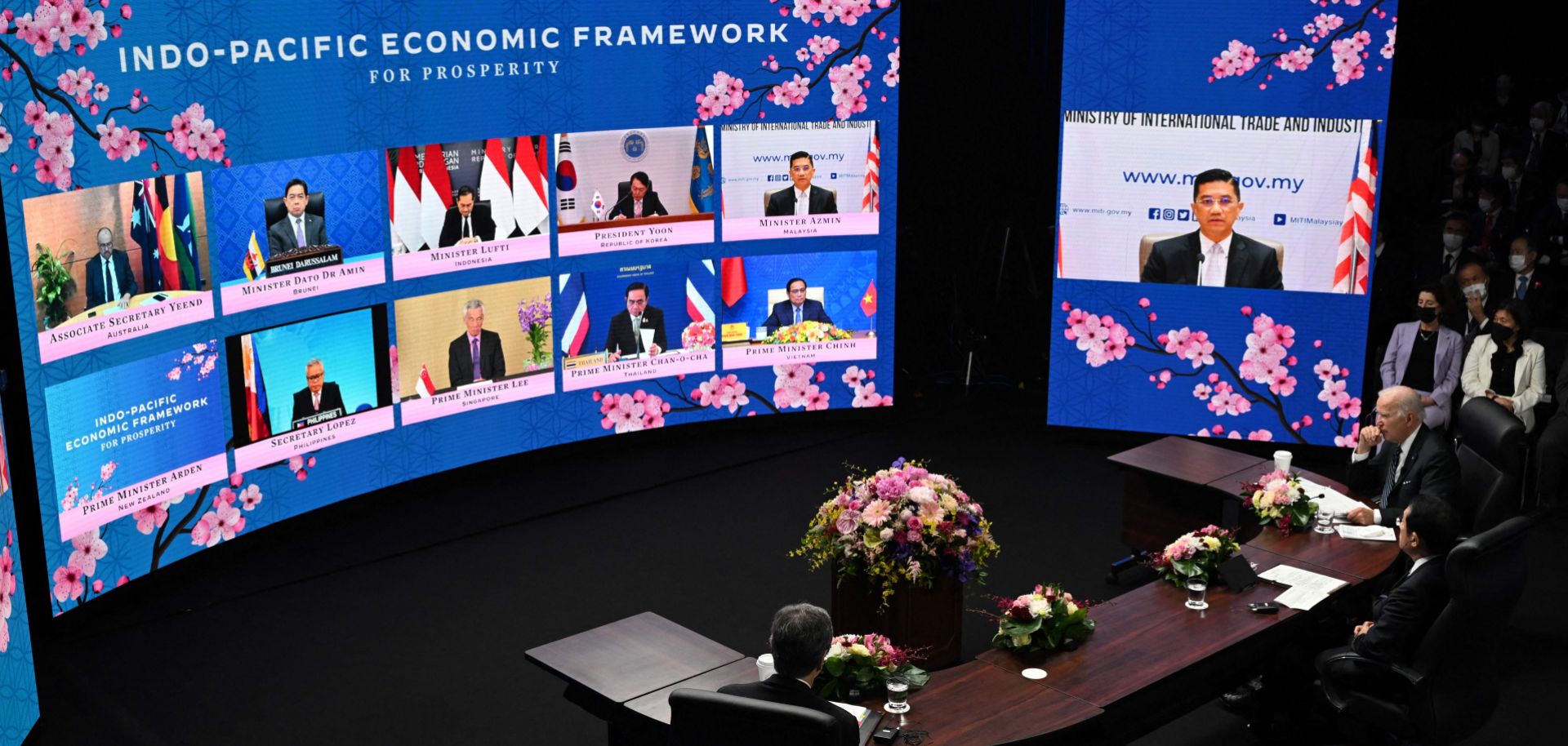
A photo taken on May 23, 2022, in Tokyo shows U.S. President Joe Biden and Japanese Prime Minister Fumio Kishida attending a video call with other leaders from countries in the Indo-Pacific Economic Framework.
The Indo-Pacific Economic Framework is a new vehicle for the United States to counter China economically in the Asia-Pacific region, but its narrow scope and disagreements between members will limit the effectiveness of the new initiative. During U.S. President Joe Biden’s five-day trip to Asia, the United States and 12 other countries announced on May 23 that they were “launching the process to establish” the Indo-Pacific Economic Framework for Prosperity. According to a joint statement, the IPEF — which Biden first unveiled during the East Asia Summit in October — will form the economic cornerstone of the United States’ strategy in the Asia-Pacific region after the former U.S. administration withdrew from the Trans-Pacific Partnership (TPP) in 2017, less than one year after the United States signed the free trade pact. In addition to the United States, the IPEF will include Australia, Brunei, India, Indonesia, Japan, Malaysia, New Zealand, Philippines, Singapore, South Korea, Thailand and Vietnam (collectively, the 13 participating nations make up about 40% of the global economy). With the IPEF, Washington is hoping to counter China’s economic heft in the Asia-Pacific region by providing an alternative framework to address critical issues, such as supply chain challenges. The new initiative also aims to deepen physical and digital trade ties between the United States and the region, as well as establish regulatory and technology standards.
- Negotiations among IPEF members will focus on four main “pillars”: trade, supply chain resiliency, clean energy/decarbonization, and taxes/anti-corruption. Countries in the framework can choose which of the four pillars they want to join — decisions that, according to U.S. officials, will be made over the next two weeks.
- Once countries decide which pillars they want to join, talks on the pillars themselves will begin. The United States hopes these talks will reach final agreements within 12-18 months — an ambitious timeline that would wrap up before the United States hosts the 2023 Asia-Pacific Economic Cooperation summit and enters the 2024 presidential election cycle.
- The United States hopes more Indo-Pacific countries will ultimately join the IPEF. Taiwan had expressed a desire to do so prior to the May 23 announcement, but the White House reportedly decided to exclude Taipei from the initial launch for fear of alienating China and scaring off possible participants.
Even if the IPEF’s four pillars are implemented, the agreement will be narrower in scope than previous U.S. Indo-Pacific-focused economic initiatives. Unlike the TPP or its successor the Comprehensive and Progressive Agreement for Trans-Pacific Partnership (CPTPP), the IPEF is not a free trade deal that reduces tariffs and other trade barriers. Given this, the U.S. Chamber of Commerce and other U.S. supporters of free trade have expressed concern that the new framework does less to further U.S. economic and business interests in the region and is also not robust enough to counter the China-backed Regional Comprehensive Economic Partnership (RCEP), which is a free trade agreement, that went into effect in January 2022. However, many have argued that economic partnerships can no longer be boiled down to tariffs alone, and need to involve deeper discussions on technology standards, environmental and labor issues, and increasingly the digital economy. However, the TPP was negotiated with many of those issues in mind and its successor CPTPP covers many of the issues that the United States is pointing to as focal points, including labor protections, regulatory standards, the digital economy, environmental issues and anti-corruption, in addition to a host of other issues related to market access. The TPP was less focused on climate change and the global supply chain, which may lead to a broader scope in those areas in the IPEF. But it appears talks among IPEF members on the other issues may largely just rehash those already broached in TPP talks. Nevertheless, with free trade agreements clearly out of vogue in Washington — and following the July 2021 expiration of the Trade Promotion Authority that made it easier for U.S. presidents to secure free trade deals — the Biden administration likely believes that this narrow scope is the best it can do.
- U.S. National Security Advisor Jake Sullivan argued on May 23 that not being a free trade agreement was “a feature of the IPEF, not a bug,” and that the new framework was a “21st-century economic arrangement designed to tackle 21st-century economic challenges.”
The limited scope and lack of market access will impede the IPEF’s ability to serve as an alternative to China for most Asia-Pacific countries. Some of the countries involved in the IPEF have their own free trade deals with the United States, such as South Korea. But many Asia-Pacific countries are also dependent on exports and, by engaging in trade talks with Washington, are thus primarily hoping to secure greater access to the massive U.S. market (including the reduction of tariffs and non-tariff barriers) — something the IPEF agreement will not give. Of the 12 Asian countries launching talks for the IPEF, India is the only one that is not also a member of the China-backed RCEP free trade agreement. Every single ASEAN member that the United States is courting for the IPEF had a significantly higher percentage of their total trade with China in 2021 than the United States, with trade with China often being around 20% for each member while closer to 10-15% with the United States. And with the Chinese economy poised to grow faster than the U.S. economy in the coming years, that gap is likely to only widen without more opportunities for these countries to access the U.S. market. But barring a major shift in U.S. political support for trade liberalization, the Biden administration (and probably any subsequent administration over the next decade) is unlikely to be in a political position to give Asian states the expanded market access they desire.
Significant divisions among IPEF members will make it likely that some (if not many) will simply choose not to join all four of the pillars, thus limiting the framework’s overall effectiveness. IPEF talks will likely be difficult when it comes to determining the scope of economic engagement between members, due in large part to U.S. policy whiplash. Indeed, the communique announcing IPEF talks was telling in and of itself, as the United States had to agree to weaken the language around “launching negotiations” to instead say the signatories were “launching the process to establish” negotiations in a bid to get more countries on board. Given that the IPEF is an executive agreement by the United States and not a Congressionally-approved free trade agreement, negotiators from other countries will be concerned that a future White House administration could easily undo the agreement with the stroke of a pen. This looming fear will not only curtail IPEF countries’ willingness to make significant (and domestically unpopular) concessions in discussions with the United States on specific trade issues, but it will also leave them hesitant to make the IPEF initiative a key part of their overall economic strategies. Then-Japanese Prime Minister Shinzo Abe, for example, spent a lot of domestic political capital in breaking down Japan’s farm lobby during TPP talks, only to see the United States reject the deal in 2017.
Without concrete prospects of greater access to the U.S. market, the countries involved in IPEF negotiations will have little incentive to make concessions in areas like combatting climate change or corruption, which will undermine some of the core pillars of the deal. In other trade talks, ASEAN countries, as well as India, have typically shied away from including concessions on issues related to environmental standards, labor standards, anti-corruption protections and other concerns that the IPEF seeks to address under the trade and anti-corruption pillar. And these countries are likely to do so again in IPEF negotiations on this pillar, assuming they partake in them at all. The United States may find even less support for the climate-related pillar, as India is not targeting net zero emissions until 2070 — two decades after most countries. Even Australia and Japan have pushed back on different aspects of global climate negotiations that other developed countries have backed; during the COP26 U.N. climate conference in October, Australia opposed harsh language about phasing out subsidies for fossil fuels and Japan declined to join a list of nearly two dozen developed countries agreeing to phase out financing of fossil fuel projects abroad. The IPEF pillar focused on supply chain resiliency may find the most initial success, as it is a common interest for all parties involved, particularly when it comes to the global semiconductor and energy sectors. But a supply chain-focused agreement among IPEF countries won’t be robust enough to achieve the United States' broader strategic interests in the Asia-Pacific region, even if it addresses supply chain-related risks in the future for the domestic U.S. economy.
