
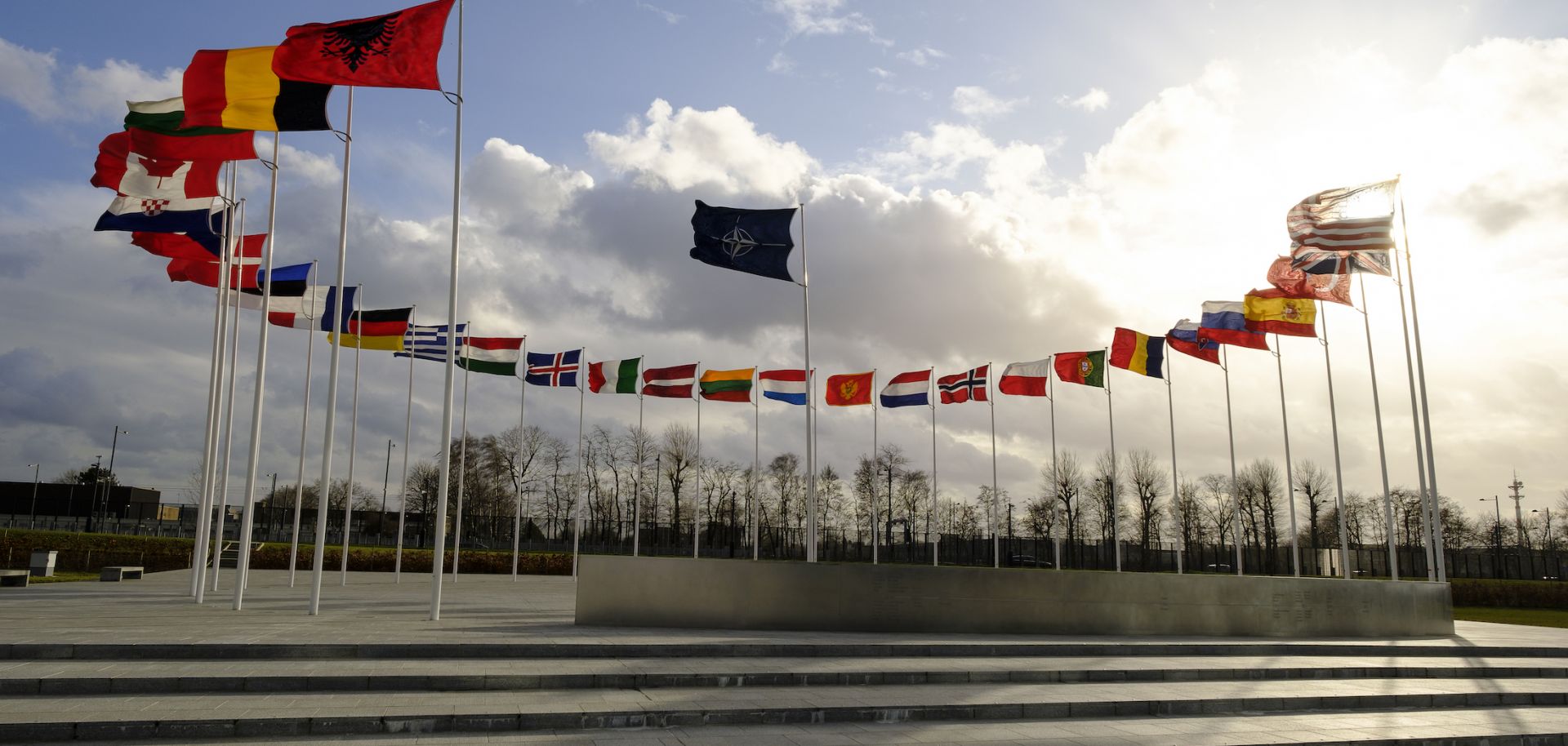
NATO headquarters on Feb. 11, 2020, in Brussels, Belgium.
Russia will perceive Sweden and Finland's NATO membership as another eastward move by the alliance that would further encircle it in the Baltic region. Moscow will respond with disruptive measures, but a direct conflict between Russia and Sweden or Finland is not feasible at this time. Russia has sent mixed messages regarding how it perceives the prospect of Finland and Sweden joining NATO, suggesting that while it did not perceive the possibility as an existential threat, the move would force Moscow to increase arms deployments to the Baltic region. This in turn would raise the odds of accidental clashes between Russian and Western forces, though the risk exists regardless given the growing importance of the Baltic Sea and Arctic to military competition and training. Before the Ukraine war, Moscow viewed Finland and Sweden as outside of its sphere of influence, and had already factored in the possibility of Finnish and Swedish NATO membership in its decision to invade. This does indeed suggest that Moscow does not view their membership as an existential threat, and so would not respond to the development with extreme measures that could risk a direct military confrontation with NATO. In any event, Russia currently lacks the military capability to conduct a military incursion against Finland since 70% of Russia's ground forces are committed to Ukraine at present (though some have withdrawn from there due to heavy losses of personnel and equipment). Even if Russia did want to carry out preemptive military action against Finland, doing so would require weeks of highly visible preparations and the implementation of mobilization measures, which would take months.
- Russian President Vladimir Putin on May 16 said Russia had no problem with Finland or Sweden, so there was no direct threat from NATO enlargement to those countries, but that the expansion of NATO military infrastructure into this territory would certainly provoke a corresponding military response.
- Former Russian President and current Deputy Chairman of Russia's Security Council Dmitri Medvedev on April 14 warned that should Sweden and Finland join NATO, then Moscow would strengthen its land, naval and air forces in the Baltic Sea, including the deployment of nuclear weapons and hypersonic missiles to the region, but said their membership was different for Russia because "we do not have territorial disputes with these countries, as with Ukraine."
- The Russian Ministry of Foreign Affairs on May 12 said, "Finland's accession to NATO will cause serious damage to bilateral Russian-Finnish relations, stability and security in the Northern European region. Russia will be forced to take retaliatory steps, both of a military-technical and other nature, to stop the threats to its national security that arise in this regard." While Russian officials repeatedly warned of "military-technical" response measures should its demands not be met before invading Ukraine, such measures toward Finland likely will comprise only the deployment of military hardware to the Baltic area.
Russia's short-term response to Finnish and Swedish accession to NATO could include cyberattacks and other destabilization measures, some of which have likely already commenced. Despite Russian officials' contradictory, but threatening, rhetoric, Moscow has few means to prevent or deter the two countries from joining NATO, or impose significant costs on them for doing so. Since it cannot credibly threaten a conventional military strike, Russia would likely resort to threatening rhetoric, often mentioning the likely deployment of nuclear weapons to the Finnish border and Baltic Sea region. Moscow will also consider actual moves to increase the costs on Sweden and Finland for their move toward membership, including cyberattacks and political interference campaigns, perhaps aimed at worsening supply chain disruptions and inflation. Such attacks could be used in tandem with disinformation and propaganda campaigns intended to fuel discontent over economic difficulties and the growing military and asymmetric threat from Russia that NATO membership brings. Russia could also seek to shut off natural gas supplies to Finland as soon as May 23, when Finnish utilities' next gas bills are due.
- Medvedev on April 14 noted that "no sane person wants higher prices and taxes," suggesting that Russia could implement a disinformation campaign to convince voters in Sweden and Finland that NATO membership will raise the cost of living.
- Many Finnish government websites crashed April 8 while Ukrainian President Volodymyr Zelensky addressed the Finnish parliament via video, most likely due to Russian cyberattacks, underscoring that Russian cyber and political interference measures have already begun.
- According to May 12 Finnish media reports, lawmakers in the Nordic country have been briefed that a gas shutoff and possibly other economic retaliation could be part of Russia's response to Finland's move to join NATO.
Russia's mid- to long-term response will likely involve a significant increase in its military infrastructure near Finland and the Baltic and Arctic regions. Finland and Russia share a 1,340-kilometer (about 833-mile border), and its accession would more than double the length of NATO's land borders with Russia. The Russian side of the border is severely underdeveloped due to its remoteness and decades of government neglect. To remedy this, Russia will move to expand its civilian border control infrastructure and construct new fortifications along the Finnish border should Finland join NATO. Russia will be particularly sensitive to NATO activities in Finland given the proximity of Murmansk, Russia's only ice-free port with unrestricted access to the Atlantic and world sea routes. The transportation route to and from Russia's commercial and military window on the Arctic would become well within range of NATO spy planes given Finnish membership. Moscow will have to spend large sums on constructing housing and facilities for more Russian ground forces to be based around its second-largest city, St. Petersburg — which sits less than 200 kilometers from the Finnish border — and in the border region of Karelia. The other major point of Russia's military response will be in the Kaliningrad exclave, which will likely officially become home to tactical nuclear and hypersonic weapons, and the Gulf of Finland, where Russia will likely deploy additional coastal missile and anti-aircraft batteries. These measures will require substantial defense spending increases toward capital-intensive construction projects — a cost that will come on top of the massive expenditures related to its war in Ukraine.
- Russia has already deployed nuclear weapons in its Baltic exclave in Kaliningrad, Lithuanian Defense Minister Arvydas Anusauskas said April 14; nuclear-capable hypersonic Kinzhal missiles were spotted on a Russian fighter landing in Kaliningrad on Feb. 7, before the Russian invasion of Ukraine.
- Moscow could attempt to use migrant flows to destabilize Finland and Sweden, similar to how Belarus weaponized migrants against Poland and Lithuania in summer and fall 2021, though reduced migration and travel flows through Russia due to the war in Ukraine will make this difficult in the near term. Though its length and remoteness make the Finnish border an attractive target for such a gambit, it is unlikely to become a preferred route to Europe through Russia because harsh conditions make it a dangerous journey for much of the year.
- The Arctic Council and other current Arctic governance models could well break down, as Sweden and Finland joining NATO would formally split the Arctic into two spheres: NATO countries and Russia. Disruptions to cooperation in science and the regulation of marine resources have already been seen in the wake of the Ukraine war.
