
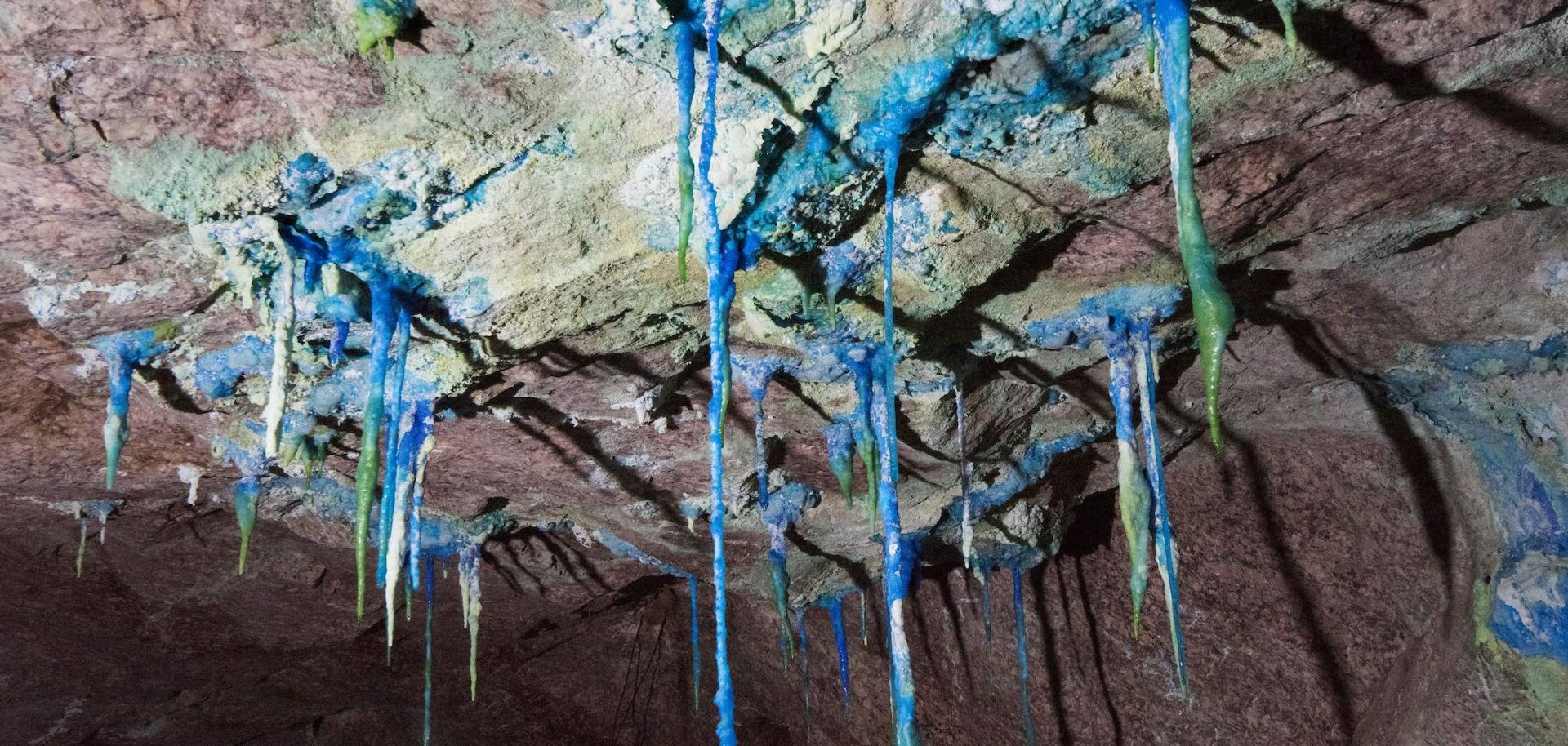
A tunnel at Steenkampskraal rare earth mine July 29, 2019, in the Western Cape province of South Africa.
A newly uncovered campaign by Chinese threat actors trying to boost opposition to Western rare earth processing plants showcases that China's information campaign is now expanding to target strategic industries. China's threat actors created fake accounts on social media to criticize rare earth mining companies and planned manufacturing facilities in Texas, U.S. cybersecurity firm Mandiant reported June 28. Mandiant, which has named the Chinese information campaign DRAGONBRIDGE, said it identified accounts used as part of the scheme on multiple social media channels, including Facebook and Twitter, as well as at least one online forum.
- The campaign first targeted Australian rare earth mining and processing firm Lynas Rare Earths with accounts posing as local residents concerned about Lynas' proposed light rare earth separation plant in Hondo, Texas. In February 2021, the U.S. Department of Defense awarded Lynas a $30.4 million contract under the Defense Production Act to help build the plant. DRAGONBRIDGE's fake accounts claimed that building the plants would cause irreversible environmental damage and criticized the Biden administration's March 2022 decision to invoke the Defense Production Act to boost the U.S. supply of critical minerals. DRAGONBRIDGE's accounts also quoted and reposted genuine statements from U.S. political figures criticizing or opposing the planned facility to amplify the threat actor's messaging.
- Subsequent to the campaign against Lynas, DRAGONBRIDGE-linked social media accounts began targeting Canadian rare earth mining company Appia Rare Earths & Uranium Corp. and USA Rare Earth, the latter of which bills itself as the first fully integrated mine-to-magnet rare earth company based completely outside China.
While this specific disinformation campaign has had a negligible impact, it signals a tactic that China could use more in the future. Mandiant pointed out that the most recent campaign by DRAGONBRIDGE differs from previous information campaigns China has carried out in the United States in two key ways. First, the campaign used more nuanced tactics than previous Chinese information campaigns. China sought to manipulate online social media discourse to increase concern over the environmental and health impacts of Western rare earth mining and processing plants. The accounts also tried to leverage statements and political positions undertaken by figures like U.S. President Joe Biden's use of the Defense Production Act. While China has largely failed to significantly boost opposition to the plants thus far, the decision to exploit political divisions in the United States to try to manipulate online discourse is something that China could expand on in future campaigns. Second, the campaign targeted an industry of significant strategic interest to China. Previous information campaigns focused on supporting China's geopolitical narrative or targeting Chinese nationals (or ethnic Chinese population groups) abroad. China has an effective global monopoly over the rare earth industry, producing around an estimated 70% to 80% of the world supply. Rare earth are of extreme importance to national security due to the importance of magnets and other rare earth products in defense applications, including precision-guidance systems, night-vision goggles, stealth technology and batteries.
- China threatened to block rare earth exports to the United States during the U.S.-China trade war and the United States and other Western countries have sought to break China's dominance in the sector by establishing new mining and processing facilities, like Lynas' proposed facility in Texas.
This highlights how China's information campaigns in Western countries are becoming more sophisticated, even if they are still largely rudimentary and unsuccessful compared to Russian information operations. In the campaign against the rare earth industry, China is borrowing tactics from Russia, which has long used information campaigns and other tactics to support environmental movements in Europe and North America. For example, during the initial debate on the use of hydraulic fracturing, or "fracking," to produce oil and natural gas in Europe — which would have offset Russian natural gas exports to Europe — during the early 2010s, Russian media outlets and online accounts supported anti-fracking campaigns and amplified anti-fracking discourse online. Most European countries indeed wound up banning fracking. Russia probably found more success than China in part due to Russians' closer cultural connections to Western audiences and the stronger anti-fracking movement in Europe it managed to tap into. Moving forward, China could seek to emulate Russia by targeting other strategic industries, such as biotechnology and artificial intelligence, that have more domestic opposition in the West due to environmental and ethical concerns as a way to boost China's edge in those industries. China will also probably continue to expand its online targeting of Mandarin-, Wu- and Yue-speaking communities in the West and Chinese- and Taiwanese-Americans to stoke anti-U.S. and anti-Taiwan sentiment. The risk of more concerted Chinese efforts to carry out broader and more sophisticated information campaigns is likely much higher in places like Taiwan and India, which hold much greater strategic importance to Beijing and thus make it more likely that Beijing will support riskier information campaigns that could provoke retaliation and potentially limited Western sanctions.
- In September 2021, FireEye (now Mandiant) reported how Chinese threat actors aimed to stoke protests and dissent in the United States, frequently using Chinese languages. Given the growth of anti-Asian hate crimes in the United States, China may find more success in exploiting such social discord going forward.
