
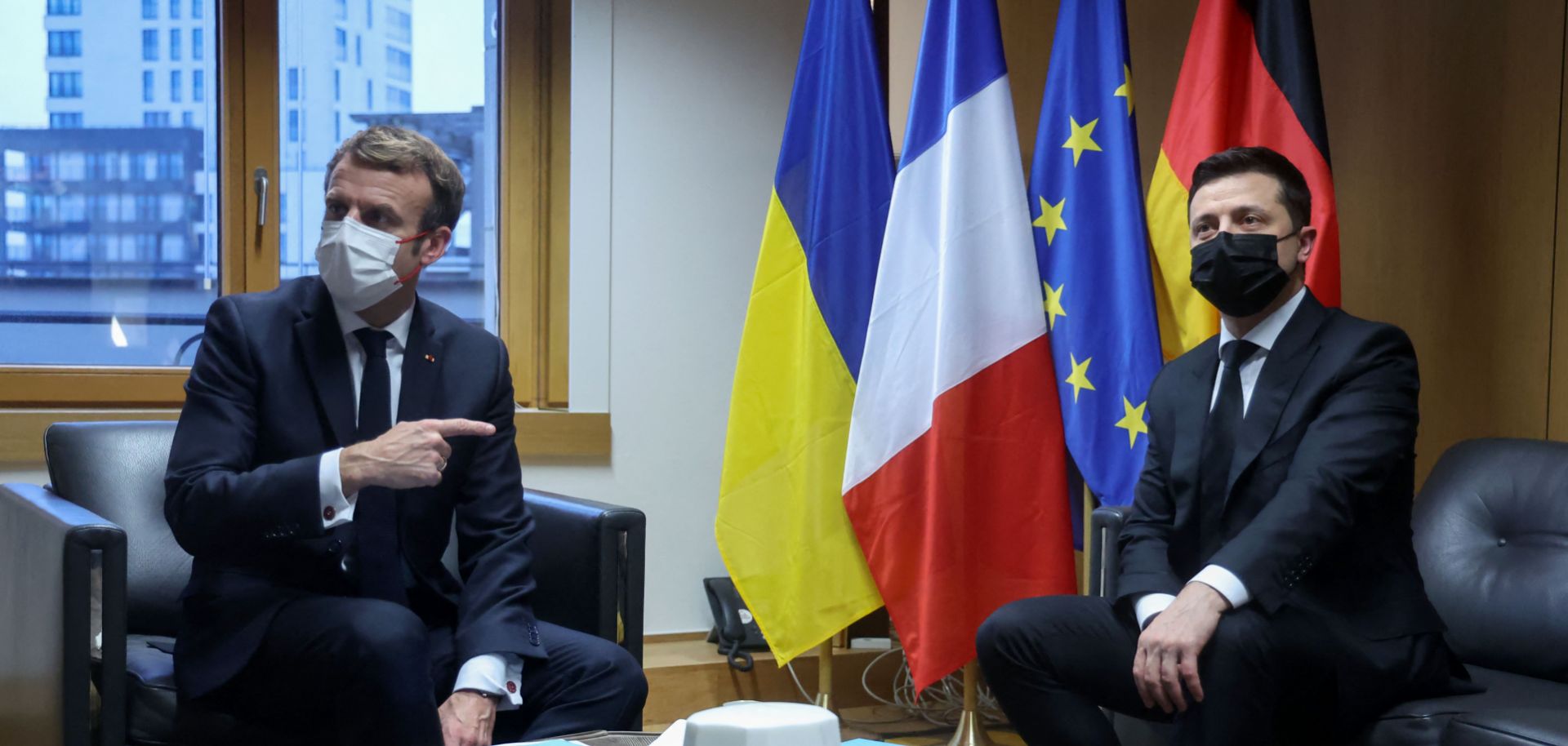
French President Emmanuel Macron (left) meets with Ukrainian President Volodymyr Zelensky during an Eastern Partnership summit at the European Council headquarters in Brussels, Belgium, on Dec. 15, 2021.
Ukraine, Moldova and Georgia are unlikely to join the European Union for the foreseeable future, but the bloc will look for alternative ways to increase economic and political cooperation with them as a part of its geopolitical competition with Russia. France, which holds the rotating presidency of the European Union, announced on March 7 that the bloc will officially assess membership requests from Ukraine, Moldova and Georgia. EU heads of state and government will probably discuss the issue during a summit on March 10.
- While Ukraine, Moldova and Georgia have sought to enter the European Union for years, the war in Ukraine has accelerated their requests for membership. Ukrainian President Volodymyr Zelenskyy formally applied for EU membership on Feb. 28, only days after the beginning of Russia's invasion of the country. On March 3, Moldovan President Maia Sandu and Georgian Prime Minister Irakli Garibashvili announced their respective countries' accession requests.
Ukraine, Moldova and Georgia's institutional shortcomings, economic weaknesses and territorial disputes — combined with internal EU politics — will prevent these three countries from entering the European Union for at least another decade. Brussels' decision to formally review the three accession requests is meant to send the message that it supports incorporating Ukraine, Moldova and Georgia into Western alliances amid growing threats from Russia. The move, however, is highly symbolic as there are several factors that explain why none of these countries will actually enter the bloc any time soon:
- The process of EU accession is slow and requires candidate countries to implement a series of substantial economic and institutional reforms to comply with EU rules. This process often takes years or even decades (Serbia, for example, became an official candidate to join the European Union in 2012 and the negotiations are still ongoing). Ukraine, Moldova and Georgia are still dealing with high levels of corruption and inefficient economic and political institutions that will take years to change.
- In addition, Ukraine, Moldova and Georgia have pro-Russian breakaway territories within their borders that do not recognize the central government, which prevents EU accession. The European Union does not want to repeat the problems it has with Cyprus, a country that joined the European Union in 2004 despite having a third of its territory under the control of a republic that only Turkey recognizes. This issue is particularly severe in Ukraine, whose very own territorial integrity and sovereignty are now under question due to the ongoing war. Should Russia depose the current Ukrainian government and replace it with a pro-Moscow regime, Kyiv will almost certainly withdraw its EU application; Brussels' interest in providing financial assistance to Ukraine would also severely decrease in this scenario. And even if regime change does not occur, Russian military occupation of a portion of the country will likely still dim Ukraine's EU accession prospects.
- Finally, there is the issue of “enlargement fatigue” in the European Union. After the bloc's massive enlargement between 2004 and 2007, when 12 countries joined, many governments (especially in Western Europe) believe that the European Union has become too complex to govern, and argue that deepening the integration between the current member states should take precedence over accepting new countries. Accepting new member states also requires the unanimous agreement of the bloc's existing members. Even if Central and Eastern European governments push to fast-track the accession process for Ukraine, Moldova and Georgia, resistance from Western governments will thus delay progress.
Even if formal accession does not happen, the war in Ukraine will motivate the European Union to look for alternative ways to provide the three countries with additional funding and political support. Ukraine, Moldova and Georgia are already members of the bloc's Eastern Partnership program, which promotes political and economic reforms in Eastern Europe and the Caucasus. As a part of its geopolitical competition with Russia, the European Union will likely become more creative in its foreign policy by, for example, offering these countries other kinds of association agreements that focus on trade and institutional reforms without going so far as to offer them full membership in the bloc. These programs would probably result in additional funding for Ukraine, Moldova, Georgia and others, which would grant Brussels some degree of soft power and political influence over them without necessarily committing the bloc to these countries' political, economic and security protection.
- In the case of Ukraine, should the current pro-EU government survive the war with Russia, EU institutions and private companies will likely be heavily involved in the post-war reconstruction efforts.
- In the case of Moldova, the European Union will likely increase financial assistance to help Chisinau deal with the surge in migrants coming from Ukraine.
EU financial help and association agreements, however, will still carry the risk of fueling separatist and anti-West sentiments in Ukraine, Moldova and Georgia. Closer ties with the European Union, even if they do not result in accession, could accelerate the independence process of the pro-Russian breakaway territories in these countries and trigger new acts of aggression from Moscow. In Ukraine, its former pro-Russian government's move to scrap an association agreement with the European Union in 2013 is what triggered the country's pro-West Euromaidan movement that, in turn, led to Russia's annexation of Crimea in 2014 and the emergence of separatist governments in eastern Ukraine. In addition, prolonged accession talks and painful structural economic reforms that do not result in membership could produce disenchantment and anti-EU sentiments in the candidate countries.
