
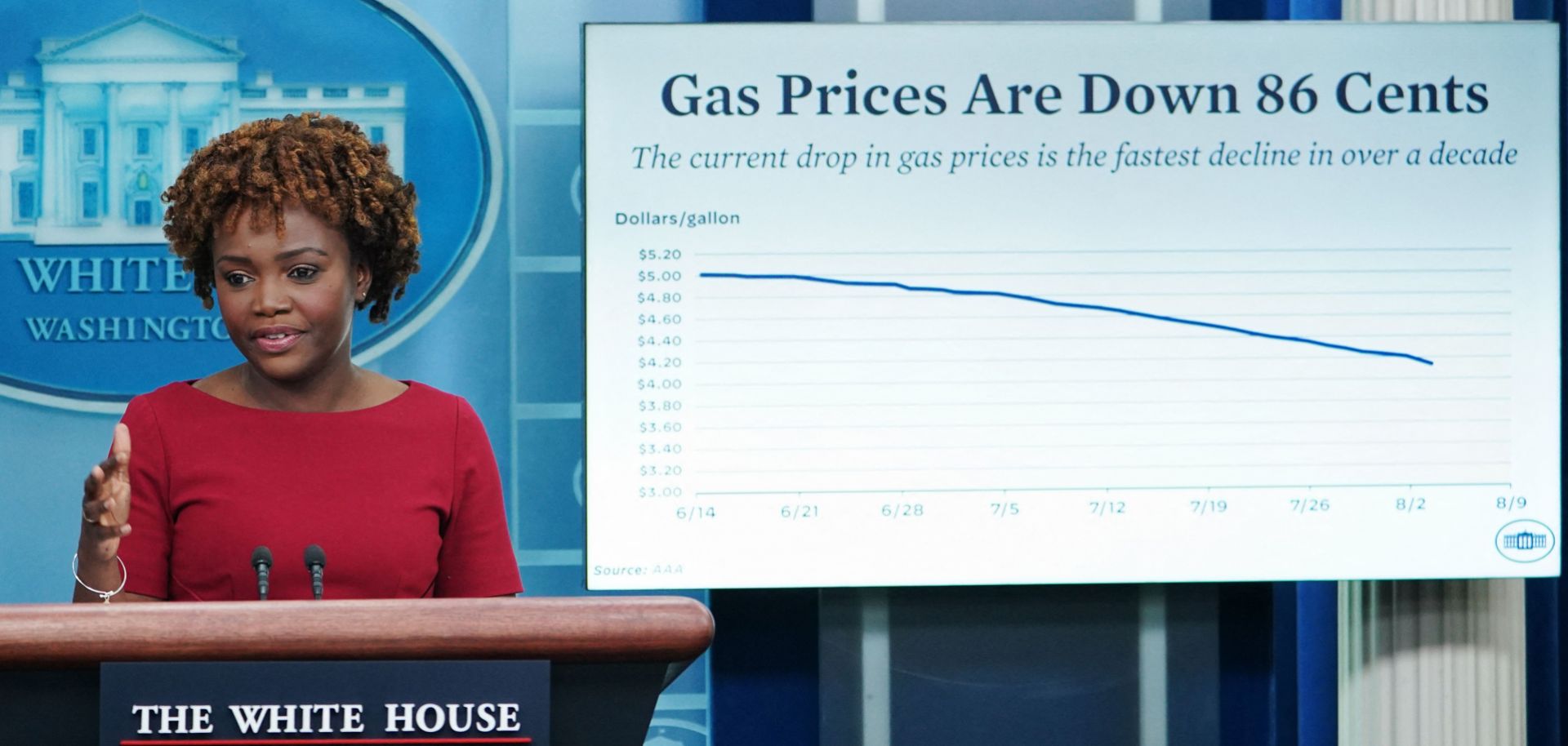
White House Press Secretary Karine Jean-Pierre discusses the recent drop in U.S. gas prices during her daily media briefing in Washington D.C. on Aug. 3, 2022.
Although oil prices have fallen to pre-Ukraine war levels, supply constraints and high risks in global markets could make this recent slide temporary. On Aug. 4, West Texas Intermediate (WTI), the U.S. crude oil benchmark, fell below $90 per barrel for the first time since Feb. 10, two weeks before Russia launched its invasion of Ukraine. The same day, the European crude oil benchmark Brent (which is most commonly used to price other crude grades traded globally) fell below $95 per barrel for the first time since the war began. Since then, WTI has nudged back above $90 per barrel, but as of late Aug. 8, was still just $90.36 per barrel. These developments, however, have coincided with a number of risks on the oil supply side of the market.
- During an OPEC+ meeting on Aug. 4, the world's top oil-producing countries agreed to increase production in September by just 100,000 barrels per day (bpd) — around 0.1% of the global oil market. But OPEC+ will likely still fail to reach even that production growth figure, as the bloc's compliance with the production deal was over 300% in the month of June, which signals most producers are already struggling to reach their quotas and will continue to do so.
- In the United States, the drop in oil prices was partially caused by an unexpected increase in U.S. crude oil inventories. On Aug. 3, the U.S. Energy Information Administration reported that crude stocks had risen by 4.5 million barrels compared with the previous week — contrasting with industry analysts' forecast, which saw stocks declining by 600,000 barrels during the same time period. This signals a softening in U.S. oil demand, which typically surges in July and August during the busy summer travel season.
Why Are Prices Falling?
The recent decline in oil prices has been primarily driven by an expected drop in global demand amid an increasingly gloomy economic outlook. In late July, the International Monetary Fund slashed its global economic growth projections by 0.4 and 0.7 percentage points for 2022 and 2023, respectively, from its April forecast — citing widespread inflation, the ongoing Ukraine crisis and China's economic slowdown. Within this ''gloomy and more uncertain'' climate, the institution said it now expects the world economy to expand only 3.2% before slowing further to 2.9% next year. On July 28, the United States also reported negative economic growth for the second consecutive quarter — a commonly accepted definition of a recession — in the second quarter. Worsening expectations about the global economy are being buoyed by several forces, including high inflation (induced in part by high oil and natural gas prices) as well as multiple central banks raising interest rates to combat that high inflation — a policy that will choke off economic growth as borrowing costs increase. Within this climate, growth in global oil demand is likely to slow and perhaps turn negative.
- Downgrades in expected global economic growth have led the Paris-based International Energy Agency to cut its projection for global oil demand growth in 2022 by 100,000 bpd since its May forecast and in 2023 by 300,000 bpd since its June forecast.
A fragile deal in Libya to bring more oil to the market, along with the potential easing of EU sanctions on Russian exports, has also contributed to the price drop. On the supply side of the equation, the most significant factor has been a deal signed in early July between Libya's political rivals ending a two-month blockade on most of the country's oil exports. The agreement has brought the country's oil production back to 1.2 million bpd, according to Libya's state-owned National Oil Corporation, effectively doubling output from levels reported in late June. The European Union's recent moves to weaken some of its Ukraine-related sanctions on Russian oil have also raised the specter of more Russian oil being available than expected. For example, while the bloc's ban on shipping insurance for Russian oil is still slated to go into effect on Dec. 5, on July 22 the European Union exempted transactions with state-owned Russian companies like Rosneft to allow European trading houses to provide financial services to Russian exports of oil and agricultural products to third countries. This, coupled with the watering down of the original EU oil embargo on Russian oil, suggests the bloc could issue more exemptions as a means to reduce the knock-on effects of sanctions on energy prices.
What Could Send Prices Back Up?
While a global recession may send oil prices lower, risks stemming from the ongoing war in Ukraine could easily push global oil prices back above $100 per barrel — if not much higher. These include:
- A gas crisis in Europe: Natural gas prices in Europe have further increased in recent weeks after Russian natural gas giant Gazprom cut throughput on Nord Stream 1 — the most important Russian pipeline to Germany — to just 20% of its capacity. The Kremlin has also repeatedly made veiled threats of cutting off or keeping Europe's natural gas supplies low this winter. Dutch TTF, the largest continental European natural gas benchmark, is trading at around 200 euros per megawatt-hour (MWh), comparable to about $350 per barrel in oil price terms. Gas prices in Europe could surge much higher when demand increases this winter, which would send Europe into a recession. Such a price hike could also result in an oil crisis as energy-starved European countries start substituting oil products for natural gas in certain applications.
- A G-7 oil price gap: The developed economies in the Group of 7 (G-7) are also hoping to reach an agreement to cap Russian oil prices at $40 to $60 per barrel. The deal would ideally go into effect before the European Union begins to implement its shipping insurance ban on Dec. 5. Such a cap, however, risks only further increasing global oil prices. Not only has the proposed cap been criticized for being difficult to enforce, but it could trigger Russia to cut oil exports, particularly if the West puts into place strong enforcement mechanisms, such as secondary sanctions targeting Chinese and Indian companies still buying Russian oil. Thus far, the United States has ruled out this move and Russia has refrained from cutting oil exports substantially to put further economic pressure on the West. But the G-7 price cap may lead the Kremlin to cut exports to countries unwilling to violate the price cap or implement a similar ruble-for-oil mechanism that led to many European companies shedding Russian natural gas imports over an unwillingness to pay for gas in rubles. Such moves could also push the United States to abandon its current hesitation over imposing secondary sanctions, further elevating global economic risks, if Russia cuts oil exports first.
Developments unrelated to Ukraine could also send oil prices hurdling in the opposite direction. These include:
- Political turmoil in Libya, Brazil and Iraq: Political crisis in major oil-producing nations could shoot oil prices back up by decreasing global supplies. Despite the July deal to end Libya's oil blockade, the country is still mired in a deep political crisis that could lead to the blockade being re-implemented at any time. Indeed, the country still has two political figures claiming to be the country's sole prime minister and both are backed by different armed groups that are currently fighting against one another in the country's capital of Tripoli. But Libya isn't the only major oil producer that could experience a political crisis in the coming months that could disrupt oil production. In Brazil, a country that produces about 3 million bpd, President Jair Bolsonaro has already started to discredit the country's electoral institutions and electoral process in what could presage a disputed election if he loses a narrow vote in the country's October presidential election. In Iraq, a country that produces about 4.4 million bpd, rival Shiite factions are also preventing a government from forming that could lead to rising intra-Shiite violence and more demonstrations at oil sites in the country's Shiite-dominated south.
- An Iran nuclear crisis: Although the greatest geopolitical risk remains the Ukraine war, Iran's accelerating nuclear development could also trigger a foreign policy crisis that causes similar turmoil in global oil markets. Iranian officials have repeatedly stated in recent weeks that the country now has the technical capability to build a bomb. Iran's stockpiles of highly enriched uranium to 60% (very close to 90% weapons grade) is already enough to produce a crude nuclear device if enriched further. Indirect negotiations between the United States and Iran to rejoin the 2015 Iran nuclear deal restarted in Vienna on Aug. 4 and EU officials said on Aug. 8 that a final text was ready. But it remains unclear whether Iran will accept the agreement currently on the table, which does not offer Tehran any face-saving concessions from the West.
Looking Ahead
Going forward, the most acute risk will remain a sudden and widespread disruption in Russian oil exports, which is one of the reasons Saudi Arabia and the United Arab Emirates are hesitating to increase production. Saudi Arabia and the United Arab Emirates effectively act as the central bank for the world's oil production. They are also the only two countries with significant spare capacity to increase their oil output. The Arab Gulf neighbors are likely seeking to prepare in case Russia curbs its oil exports and sends prices skyrocketing in retaliation to Western sanctions and/or in an effort to gain leverage against Ukraine and the West in negotiations. In such a worst-case scenario, Riyadh and Abu Dhabi may need to announce a massive production hike to prevent runaway crude oil prices akin to that seen in Europe's natural gas market. Saudi Arabia and the United Arab Emirates are thus likely taking a cautious approach to ensure they have room to quickly ramp production when it matters most. And the limited steps that other OPEC+ members have taken in recent months to boost production, along with the concurrent decline in oil prices amid the world's deteriorating global economic environment, will likely only further validate this approach.
- With Russia's oil production currently stymied by Ukraine-related sanctions, Saudi Arabia and the United Arab Emirates are realistically the only OPEC+ members with enough spare capacity bound by the pact to increase production in a meaningful way. As part of the OPEC+ pact, Riyadh and Abu Dhabi agreed to only increase their production by just 26,000 and 7,000 bpd in September, respectively.
