
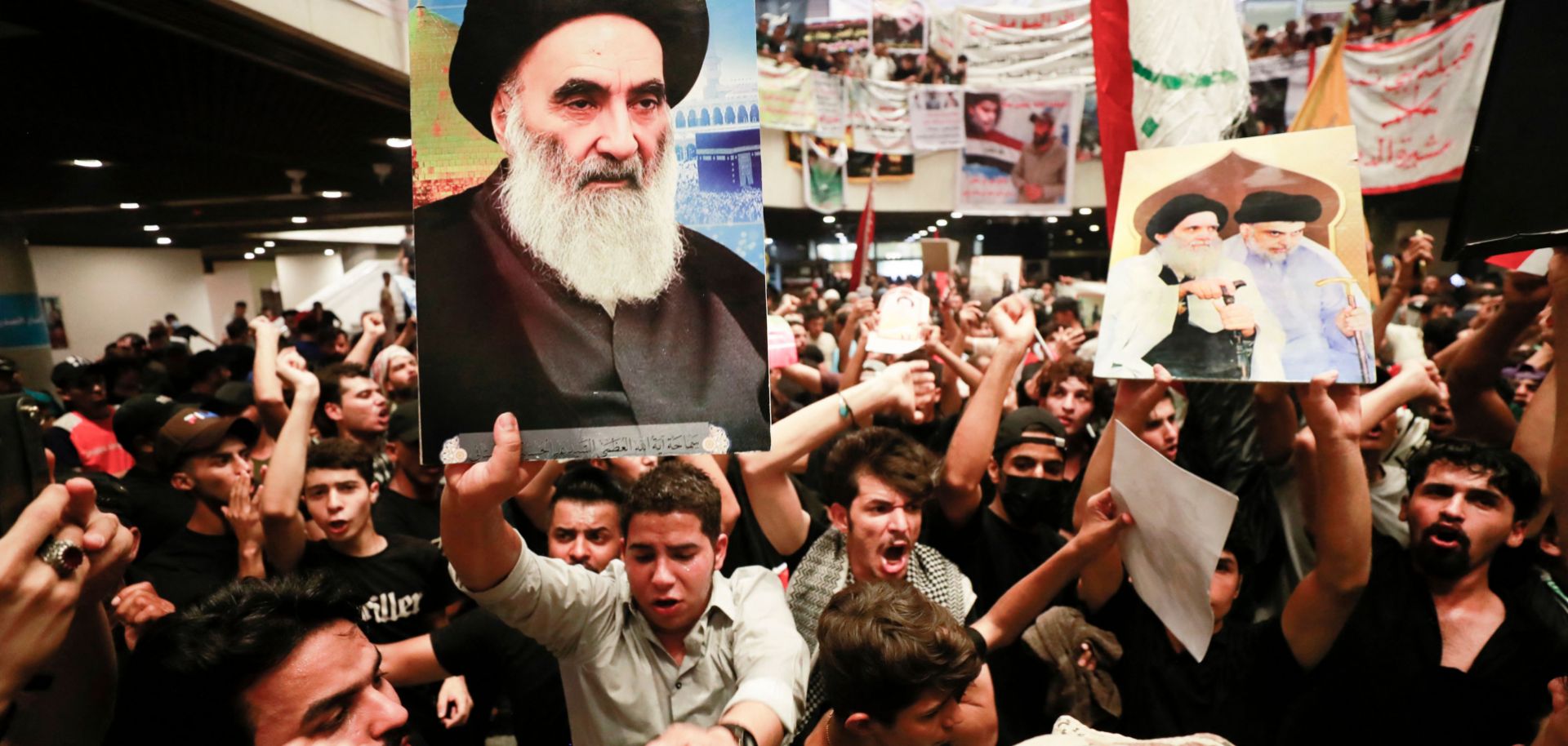
Supporters of Iraqi cleric Muqtada al-Sadr protest the nominee for prime minister from a rival Shiite faction Aug. 3, 2022, in Baghdad's high-security Green Zone.
Rivalries among Iraqi Shiite factions are preventing the formation of a new Iraqi government, and the political paralysis risks turning into a deeper, violent conflict that lessens Baghdad's already limited ability to solve the country's many economic crises and mitigate social unrest. Over the weekend of July 30-31, followers of Shiite leader Moqtada al-Sadr breached Baghdad's Green Zone barricades twice and set up camp in parliament, where they are demanding new elections and systemic political reforms. In response, their rivals in the Shia Coordination Framework (SCF) have held competing protests and are planning more, though so far the groups have not clashed. Caretaker Prime Minister Mustafa al-Kadhimi has called for a national dialogue between the two groups to ease the impasse.
- Al-Sadr is a cleric and former militia leader who has amassed a following of millions of Shiite supporters thanks in part to his late father's political and religious prominence. Sadrists are typically nationalist and devout, and hold populist views on economic issues, such as wanting higher public wages.
- The SCF comprises other Shiite political coalitions and groups, several of which are close to Iran and maintain armed militias.
- Iraq's government has struggled to enforce the rule of law, enabling multiple armed militias to flourish, many of which are closely associated with political groups.
The current standoff represents an escalation in the monthslong power struggle to form a government, and underscores the immense challenge of adjusting Iraq's political quota system. The Sadrists won the most seats in the October 2021 parliamentary elections, but their rivals within the SCF sought a government of consensus that saw power shared among all groups that won any seats in the election. The latter approach is how Iraq's governments have been formed since the ouster of Saddam Hussein. Because Iraqi law requires a parliamentary supermajority to elect a president, neither the Sadrists nor the SCF has managed to form a government.
- Al-Sadr appears to have decided to escalate the dispute just before Ashura, a time of increased passions among his devout Shiite followers, to maximize numbers at the parliamentary sit-in.
- According to Iraq's 2005 Constitution, after elections, coalitions group together into blocs in parliament and select the next president, who is supposed to be Kurdish under an ethnosectarian quota system that guarantees key positions for major groups (the presidency goes to a Kurd, the premiership to a Shiite and the parliamentary speakership to a Sunni).
Three paths forward from the impasse exist, all of which carry risks of political violence. The current caretaker government under Mustafa al-Kadhimi will try to convince the rival sides to join in his proposed political dialogue to forestall violence, which could take the form of violent protests, limited militia attacks, and, in the most extreme scenario, civil war. Under the following scenarios, ranked in decreasing order of likelihood, Iraq could see:
- Prolonged political paralysis between Shiite rivals. In this scenario, the Sadrists and SCF remain at loggerheads for weeks, potentially months, preventing the election of a new president and bringing policymaking to a halt. This could give some of the other stakeholders in the negotiation process, including Sunni and Kurdish leadership, opportunities to propose coalitions that might prove satisfactory to both the Sadrists and the SCF. The national dialogue process could also take place within this scenario, but with both sides only participating at a very superficial level, and so would be unlikely to yield systemic change.
- External intervention that forces one or both main Shiite camps to yield. Should an outside power decide to intervene, this scenario has the potential to see the quickest resolution. Iran is the main foreign actor that has sway given the major players are both Shiite blocs. It is also because Tehran maintains a regular dialogue with Iraqi officials, especially leaders of the militias that the Islamic Revolutionary Guard Corps funds and trains, like Kataib Hezbollah and Asaib Ahl al-Haq. Iran could send officials to try and negotiate with Tehran's allies in the SCF, which could help de-escalate the impasse if Iran views the current situation as detrimental to its interests, such as if it decides living with the October 2021 election results is better than gambling on new elections that could see Iran lose influence. Meanwhile, while the United States and other Western governments have significant influence in Baghdad thanks to their economic and security support for Iraqi federal authorities, these connections primarily lie with Sunni and Christian stakeholders rather than nationalist leaders like Sadr who reject Western influence or Iran-leaning leaders like SCF leader Nouri al-Maliki. This means that Washington lacks much ability to impact the current standoff.
- An agreement to hold new elections. This scenario could scramble the numbers of Sadrist versus SCF members of parliament, and the Sadrists have been demanding new elections doubtless precisely in hopes of gaining the supermajority needed to select a new president without needing a coalition. Of course, the outcome of the election is uncertain, and in any case, parliament would have to approve holding them in the first place.
- A new civil war. This worst-case scenario remains the least likely, for now. Rather than pitting Sunnis against Shiites, such a conflict might see Shiite fight Shiite. Some Shiite political parties have associated armed militias and followers willing to take to the streets, so significant violence is possible should these groups clash. For now, however, the Sadrists and the SCF appear uninterested in provoking such violent conflict for fear of angering public and elite opinion, thereby reducing their political influence.
No matter what scenario unfolds, Iraq's deep structural economic problems will persist, leaving the drivers for unrest in place, despite surging oil prices benefiting the Iraqi economy. Arguably, high global energy prices spurred by the Ukraine conflict, supply chain issues, refinery shortages and other disruptions have dulled the economic impact of the continued political paralysis in Iraq by increasing the value of oil, Iraq's main source of government revenue, putting less pressure on Iraqi political stakeholders to find a solution. The country's vast oil wealth, however, has never translated into economic stability for all of Iraq's 42 million people, 30% of whom live under the poverty line. Many Iraqis struggle with unemployment that hovers at about 14% and underemployment, which mostly impacts the youth — and who have an unemployment rate of 40%. Without a permanent government in place executing policy, the country cannot effectively address the economic problems afflicting Iraqis across social classes, to say nothing of the chronic shortages of water and power. This will keep the risk of social unrest high regardless of how the current inter-Shiite tensions play out.
- Iraq is one of the world's most oil-rich countries, and revenue from oil exports has hit record highs in the first half of 2022 thanks in part to the uncertainty around Russian crude amid the Ukraine war.
- Iraq faces seasonal protests over cyclical resource shortages, particularly clean water and electricity. This is especially an issue in southern Iraq, which has a high population density and where the power grid is more dependent on imported supplies.
