
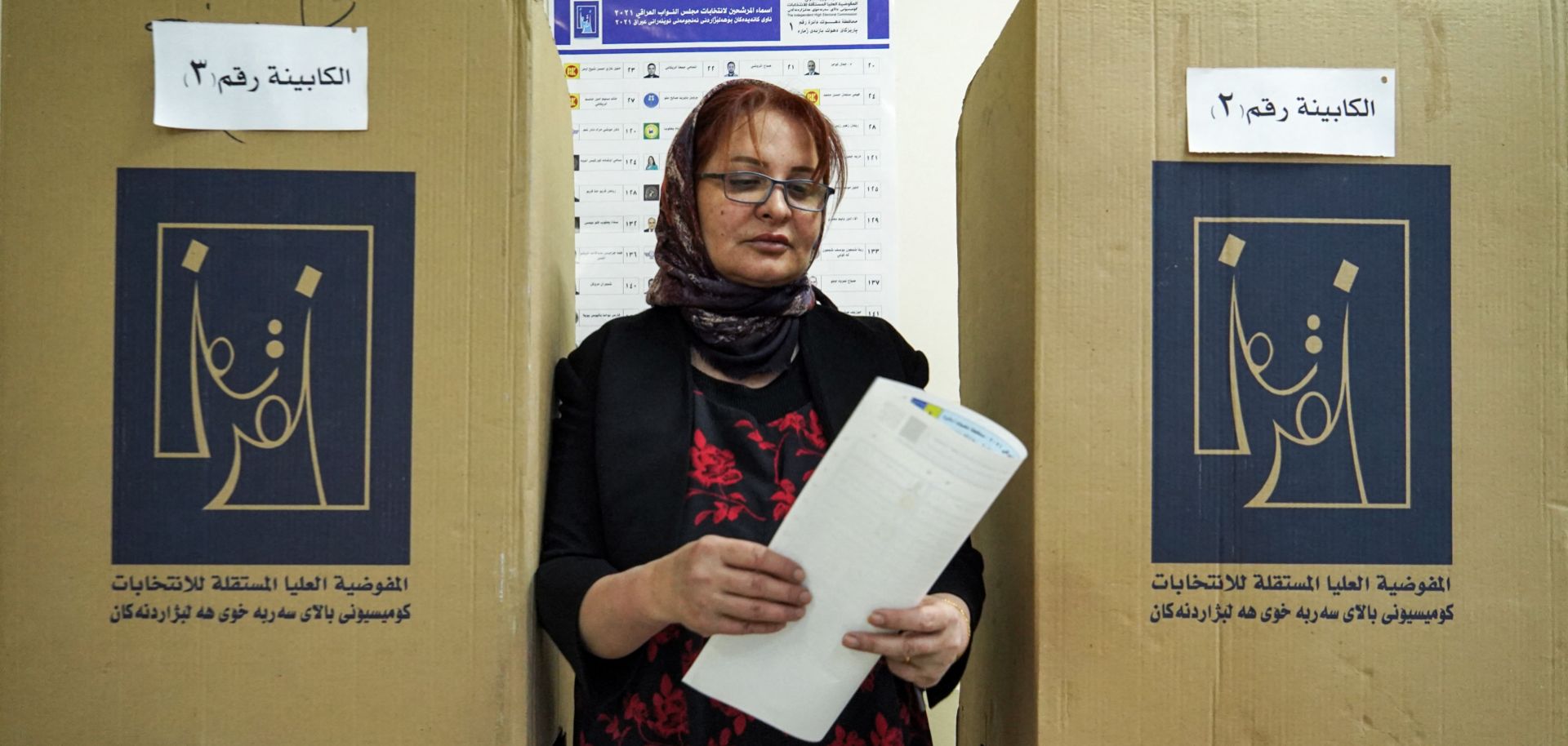
A woman walks to cast her ballot in Iraq’s parliamentary election at a polling station in Dohuk on Oct. 10, 2021.
Iraq’s Oct. 10 parliamentary election has left Shiite groups with the most seats, portending several more years of political continuity. But the loss of seats by Iran-aligned groups, combined with the anti-government sentiment indicated by low voter turnout, will also increase the likelihood of social unrest. Iraq’s latest parliamentary election will yield little change in the country, despite being held months early to satisfy activists’ demands for reform. Results released by Iraq’s High Electoral Commission on Oct. 11 indicate that the parliamentary group aligned with Shiite cleric Moqtada al-Sadr won 73 seats, significantly more than any other group, followed by two established Sunni and Shiite coalitions. Sadrists (followers of al-Sadr) will thus play the dominant role in the government formation process, just as they did following the last election in 2018. This, along with Iraqis signaling their lack of trust in Baghdad by not voting, will contribute to stagnant politics — making it challenging to move toward the kind of responsive governance that could help solve Iraq's economic and security quandaries.
- The Iran-backed, militia-aligned Fatah coalition won significantly fewer seats than they did in 2018. Independents, meanwhile, won 50 seats.
- Iraq has one of the most powerful legislatures in the Middle East. In addition to its vast governing and legislative responsibilities, the Iraqi parliament is also in charge of determining who becomes the prime minister, the most powerful political position in the country.
Popular disillusionment with the government drove many voters away from the polls, weakening the electoral mandate of the next government. Only 41% of Iraqi voters cast ballots in the Oct. 10 parliamentary election, marking a slight drop from the 44% that voted in the 2018 election. This low turnout reflects the low expectations many Iraqis have for the government's ability to create change. Anti-government protests in October 2019 created a class of activists that demanded and won early elections they hoped would bring in new politicians open to adjusting Iraq’s long-set policies. However, over the last year, the government introduced minimal electoral reforms, deflating activists’ hopes that the next round would differ from previous polls.
- Thousands of Iraqis took to the streets in October 2019 to rally against government corruption. Since then, at least 600 protesters in the country have been killed in clashes with security forces or attacks conducted by Iran-backed militias.
The next Iraqi government is unlikely to introduce significant reforms, as politicians will remain fixated on retaining their share of seats in parliament and influence in and over the cabinet, rather than addressing structural issues. Iraq has immense economic challenges that successive governments have repeatedly tried and failed to solve. It is one of the most hydrocarbon-rich countries in the world, with the vast majority of economic activity solely reliant on the future of an aging oil and gas sector. One of the major debates that will take place in the next parliament and government is how to transition away from that dependence on energy revenue. But structural inefficiencies, combined with endemic corruption that has been built into the Iraqi economy over decades, will make it challenging for any government to make progress.
- The majority of Iraqis are Muslims, split into three main ethno-sectarian groups: Shiites, Sunnis and Kurds. But Iraq is also home to many other ethnic and religious minorities, including Christians. In electing candidates, Iraqi voters tend to prioritize those who hail from their ethno-sectarian group over the policies they promise to support. The balancing act of negotiating consensus between these groups has historically led to drawn-out government formation talks following inconclusive parliamentary elections, contributing to political stagnation. It took eight months to form a government after the 2018 election failed to result in a clear majority.
Popular unrest is likely to continue, as frustrated Iraqis continue to take to the streets to demand change. Groups that lost ground in parliament may also stage demonstrations to retain their voice on political matters. Iran-aligned groups will have slightly less power in the next government but will still instigate unrest as they seek to maintain their power in the streets to compensate for the power they lost in the legislature. Intra-Shiite rivalries are a major source of instability in Iraq, and the Fatah alliance’s loss in electoral popularity happens amid a raging debate in the country over Iran’s influence in Iraq. Civil society groups, meanwhile, will keep demanding anti-corruption reforms, social and political liberalization, economic benefits, and more — opting to pressure politicians in the streets instead of in negotiations due to their distrust that the parliament has their best interests at heart.
- Iran-aligned groups have already promised to appeal and reject the results of the latest parliamentary election in a joint statement issued Oct. 12
