
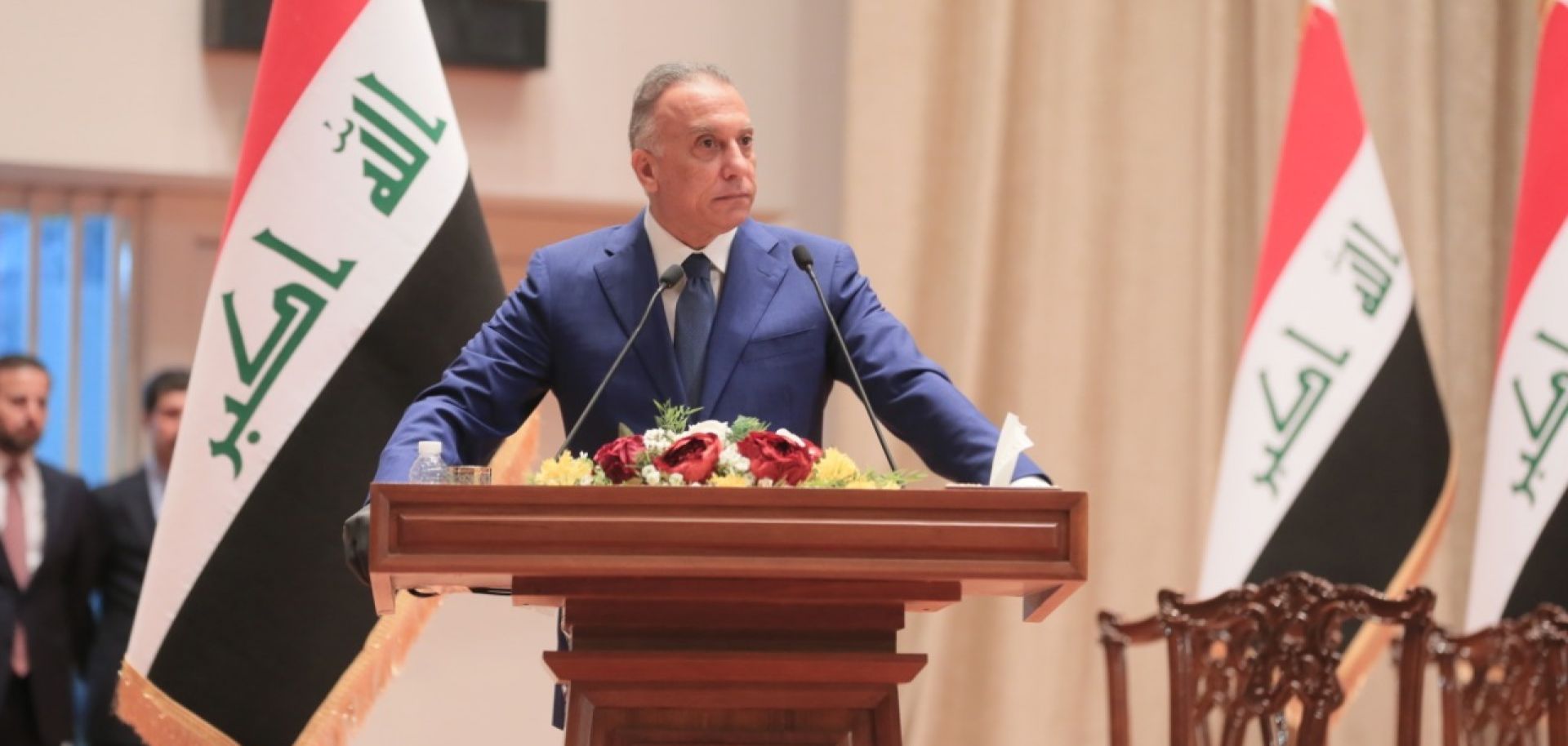
Iraqi Prime Minister Mustafa al-Kadhimi makes a speech in Baghdad on May 6, 2020. The following day, Iraq's parliament granted a vote of confidence to al-Kadhimi’s new government and swore in a majority of his 22 ministers.
On May 7, Iraq swore in its first legitimate government since violent protests led to the collapse of its last government in December. After months of political turmoil, the formation of the new government, led by former intelligence chief Mustafa al-Kadhimi as prime minister, is in itself an achievement. But no matter how coherent al-Kadhimi’s administration proves to be, Iraq’s increasingly dire economic situation — made worse by the COVID-19 crisis and subsequent oil market shocks — will make it difficult to maintain social and political stability, as well as manage domestic and external security.
The new government’s primary challenge in 2020 will be keeping Iraq's s already weak economy from completely caving amid the added financial strain from COVID-19.
- Iraq is highly dependent on oil and gas revenue, with 90 percent of government revenue coming from crude sales.
- Before the emergence of COVID-19, the government had already anticipated a budget deficit of about $42 billion in 2020, which was based on Brent crude prices remaining at $56 per barrel.
- But with oil prices now at around $30 per barrel due to pandemic-induced drops in demand, the International Monetary Fund anticipates the Iraqi economy could shrink as much as 4.7 percent this year, while the World Bank projects an even sharper contraction of 9.7 percent. The actual hit to Iraq’s GDP, however, will likely exceed these projections, which are both based on an optimistic trajectory of the outbreak.
The best the government can hope to achieve is maintaining the status quo and ensuring Iraq's deteriorating financial stability doesn't devolve into greater social instability.
- A quick recovery remains highly unlikely as pandemic-induced oil price shocks rob Baghdad of its primary source of revenue and reveal the depths of the country’s economic deficiencies.
- The success of al-Kadhimi’s government will instead hinge on keeping the economy afloat without seeing skyrocketing unemployment, inflation, a collapse of foreign currency reserves, and a dramatic uptick in poverty.
The Iraqi government will respond to this economic pressure by shaking up stagnant negotiations and cutting politically sensitive parts of the budget, such as public wages.
- Falling oil revenue has prompted the government to consider reducing Iraq’s public wage bill, which has ballooned over the past 20 years and now constitutes about a third of state spending. Just paying for the extra benefits for salaried workers alone costs $36 billion — ten times what they cost 15 years ago.
- The federal government is also trying to cajole Iraqi’s semi-autonomous Kurdistan region into handing over its oil revenue in ongoing budget discussions with the Kurdistan Regional Government. With both Baghdad and Erbil increasingly desperate for cash and ways to balance their precarious budgets, the COVID-19 crisis could open a new door for compromise between the two.
- The new government has also prioritized revising how Iraq grants licenses to international oil companies in order to increase Baghdad’s share of the spoils. Al-Kadhimi's administration recently submitted a new draft of the country’s National Oil Company law, which establishes the terms of state energy production and development. This issue has long belied previous Iraqi governments and will be hotly debated in and outside parliament. But since oil exports are nearly the sole source of Iraqi revenue, Baghdad has a vested interest in maximizing what it obtains in agreements with external parties.
In the coming year, an emboldened protest movement will force the government to make small political reforms and maintain the country’s basic economic safety net.
- Anti-government protesters have called for an overhaul to Iraq’s political system, including changing an electoral law in order to trigger early elections.
- The protest movement is fueled by the economic anxieties and demands of a groundswell of young Iraqi citizens, with 60 percent of the country’s population under the age of 24.
- But the new government remains unlikely to impose sweeping reforms, as each group in Iraq’s confessional system — which divides political spoils by ethno-sectarian precedent — seeks to preserve their own share of political and economic power.
Iraq’s mounting economic challenges will further undermine the Iraqi government’s ability to keep the Islamic State from resurging in pockets across the country.
- Concerns about COVID-19 spreading within the ranks of Iraqi and international military forces have led the U.S.-led coalition against the Islamic State to disband or suspend some activity in recent months.
- But a recent uptick in Islamic State attacks in Baghdad and areas further afield indicates the group remains a persistent challenge to the Iraqi government and the country’s overall stability.
- As oil prices remain low, the continued loss of state revenue will eventually impede Iraq’s ability to fund, equip and train its armed forces in counterterrorism efforts.
