
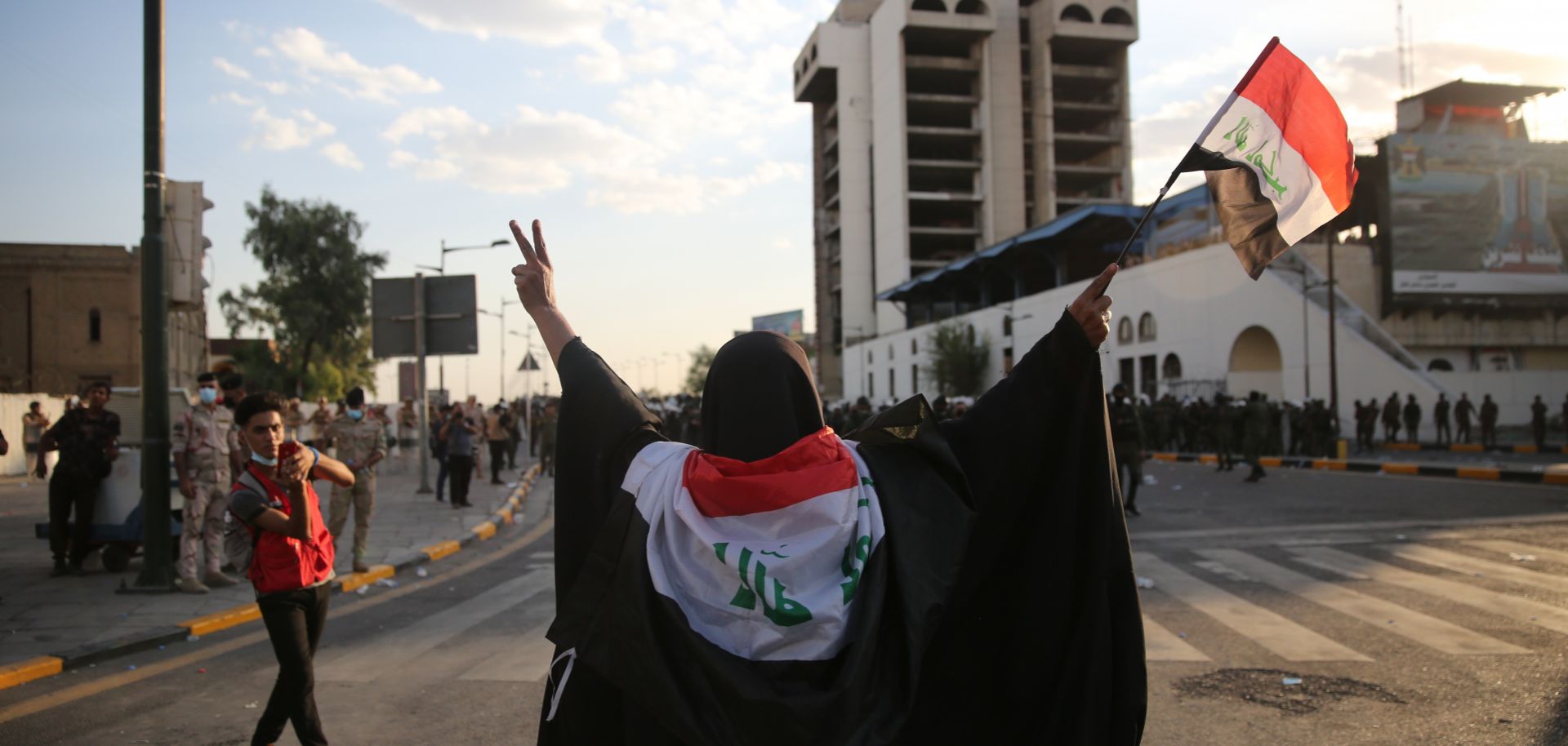
A woman waves an Iraqi flag as riot police charge toward protesters in Baghdad on May 25, 2021.
A resurgence of protests in Iraq risks destabilizing the country’s one-year-old government ahead of October elections, but is unlikely to unseat Iran’s deep-rooted influence in Baghdad. May 25 protests demanding reform and accountability from the Iraqi government for extrajudicial killings reignited popular mobilization in numbers akin to those seen in 2019 before the COVID-19 pandemic. Similar protests are likely to continue leading up to October parliamentary elections, which will be a flashpoint between Iraq’s activists and the Iran-backed militias that they believe are to blame for the dozens of assassinations and attempted assassinations of activists in Iraq over the last two years.
- After hours of mostly peaceful demonstrations under the banner “Who killed me?” on May 25, Iraqi security forces in Baghdad launched live fire and tear gas at some unruly protests, killing at least two demonstrators and injuring several more. The government had approved a permit for the protests, which were largest in Baghdad and took place across nine provinces.
Many Iraqis are frustrated with their government’s failure to rein in the growing political power of Iran-backed militias in the country. Activists and human rights organizations in Iraq widely believe that the Iran-backed militias are directly connected to the uptick in assassinations and harassment targeting activists and journalists over the last two years, which has become one of the most serious security issues in Iraq alongside the ongoing Islamic State insurgency. In addition to economic and electoral reforms, protesters are demanding the government take more action to protect civilians from violence conducted by the many militias operating as non-state security actors across the country.
- Since October 2019, at least 560 protesters in Iraq have been killed in clashes with security forces or attacks conducted by gangs widely believed to be affiliated with Iran-backed militias. There have also been 34 assassinations and 47 assassination attempts of activists and journalists over the same time period, conducted typically by armed men on motorbikes. Iraqi human rights organizations and independent Iraqi journalists widely attribute these killings to gangs affiliated with Iran-backed militias.
- Many Iraqis also feel that militia leaders operate outside the rule of law, making incidents like the May 26 arrest of militia commander Qasim Muslih high-profile tests of the government’s ability to prosecute militia members. If the government releases Muslih quickly, activists will likely be dismayed and perceive it as bowing to the militias. But if the government detains Muslih for a long time, militia members are likely to retaliate, like they did May 26 by threatening the security of Baghdad’s Green Zone.
Prime Minister Mustafa al-Kadhimi and his government, however, will struggle to keep Iraqi militias from gaining power in Baghdad. Containing the influence of Iran-linked militias in Iraq was one of al-Kadhimi’s first pledges upon taking office in May 2020. But since then, the prime minister and his government have largely proven unable to fulfill this promise, fueling the frustration behind the recent protests. The Fatah Alliance, which is linked to Iran-backed militia groups, remains the second-largest bloc in the Iraqi parliament and has pushed back against activists’ rising demands for reforms for fear such changes could threaten their powerful political position.
- Al-Kadhimi established a commission in May 2020 to investigate extrajudicial killings in response to the public outcry, but little has come of the commission since then.
- The Fatah Alliance includes politicians connected to the mostly Iran-backed militia groups in Iraq’s Popular Mobilization Units, an umbrella organization that has become a formal component of the Iraqi state's security forces. The Fatah bloc emerged from obscurity to win their powerful position in parliament in 2018 and opposed al-Kadhimi’s initial appointment in May 2020, given his focus on keeping militias in check.
With Baghdad unable to answer protesters’ primary demands, the demonstrations will likely continue to gain momentum ahead of the election and become a major source of unrest. The continuation of protests could see more Iraqis willing to challenge al-Kadhimi’s leadership on other issues. Ongoing unrest leading up to the October vote could even disrupt or delay the elections themselves. Many protesters are determined to boycott elections, which they view as a way to cement the Iran-backed militias’ political position.
- Al-Khadimi reiterated on May 27 in a security meeting that his government does not intend to delay the election.
The protest movement, however, will ultimately fail to dislodge Iran’s deeply entrenched influence in Baghdad. As demonstrations continue, protesters’ push against Iran-backed militias will probably start expanding to calls for rooting out Iran’s overall influence in the country, which the Iraqi government is unlikely to respond to for fear of damaging its ties with an important ally.
- Iran supplies electricity, as well as food and goods imports, to Iraq. Iran has also provided security training to militias that operate as an official component of Iraq’s security forces.
- While it doesn’t directly control the actions of its allied militias in Iraq, Iran is able to influence the political situation in Baghdad indirectly via the leaders of those groups.
