
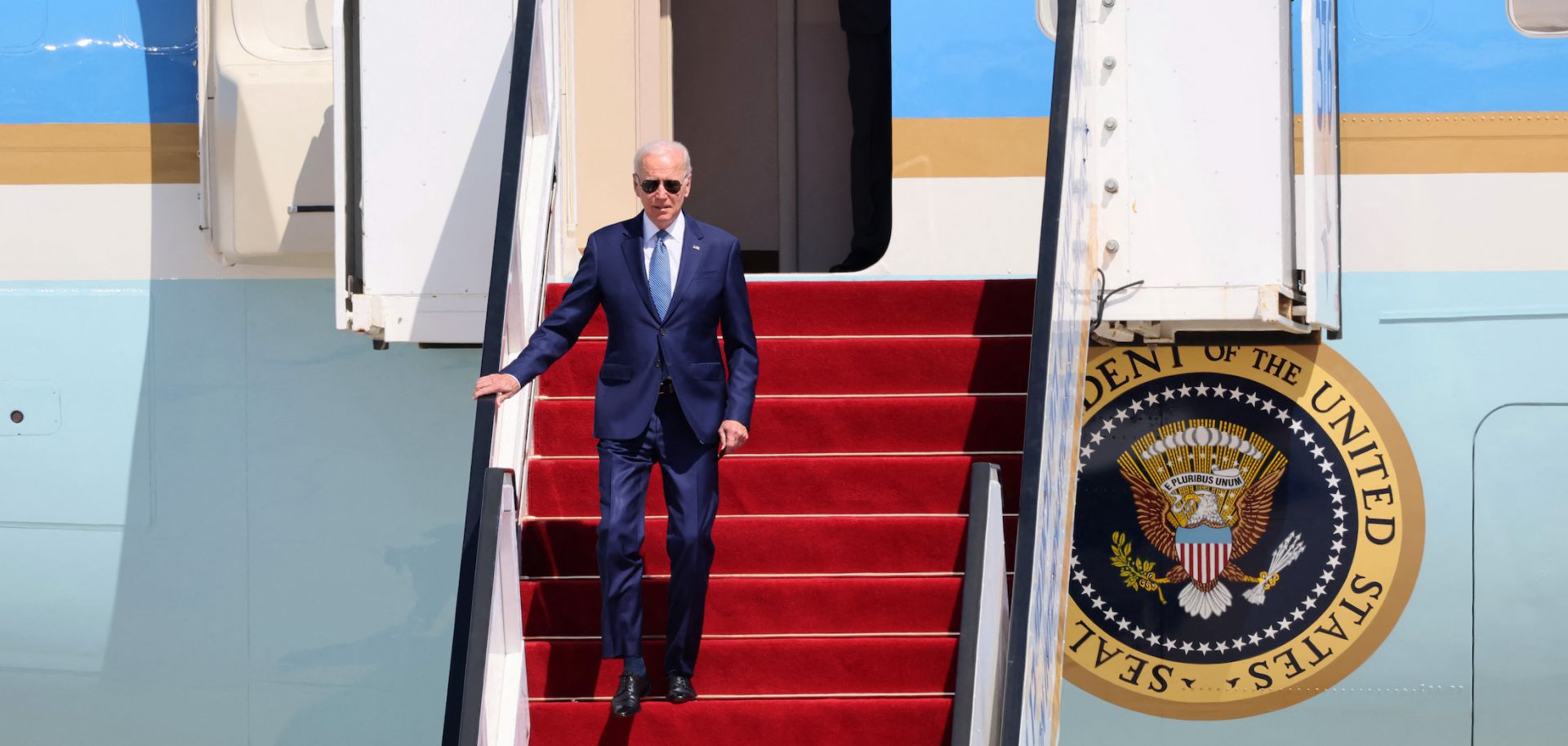
U.S. President Joe Biden disembarks from his plane near Tel Aviv, Israel, on July 13, 2022, as he starts the first leg of his Middle East tour.
U.S. President Joe Biden’s trip to Saudi Arabia will reinforce the importance of the bilateral relationship to Washington’s energy and regional security goals. But it will also showcase the limits of U.S. influence in the Middle East as regional governments protect their economic interests and diversify their alliances. President Biden will travel to Saudi Arabia on July 15-16, where he will attend a Gulf Cooperation Council (GCC) summit in Jeddah after flying directly from Israel — a historic route made possible by warming Saudi-Israeli ties. Biden will also visit the Palestinian territories and hold meetings with other Arab Gulf leaders on the sidelines of the GCC summit. But the U.S. president’s stop in Saudi Arabia — where he’ll meet with Saudi King Salman and Crown Prince Mohammed bin Salman — is likely the key focus of his Middle East tour, as the White House tries to enlist Saudi support to counter threats from Iran and stabilize global oil prices.
- Biden’s upcoming trip to Saudi Arabia has spurred some pushback from lawmakers in Congress, where anti-Saudi sentiment remains strong due to the kingdom’s poor human rights record and role in Yemen’s devastating civil war. In a July 9 op-ed published by The Washington Post, Biden defended the aims of his trip, writing that his goal was to “reorient — but not rupture — relations with a country that’s been a strategic partner [of the United States] for 80 years.” As evidence of that partnership, Biden cited Riyadh’s role in helping Washington “restore unity among the six countries of the Gulf Cooperation Council,” facilitate the current cease-fire in Yemen and “stabilize oil markets with other OPEC producers.”
- The official White House announcement said Biden will “discuss a range of bilateral, regional and global issues” during his visit to Saudi Arabia, including the U.N.-mediated truce in Yemen and “expanding regional economic and security cooperation,” as well as “deterring threats from Iran, advancing human rights, and ensuring global energy and food security.”
While Biden will push Saudi Arabia to produce more crude oil to lower oil prices, there are limits to how far Riyadh can increase its production. Rising gas prices have placed the Biden administration in hot political water at home ahead of the U.S. midterm elections in November, which the White House is hoping to mitigate by lobbying Saudi Arabia to increase its oil production. As one of the world's top oil producers, Saudi Arabia is in a strong position to offset Russian oil production lost to the Ukraine crisis and related sanctions. Riyadh, however, is unlikely to agree to significant production increases on top of the ones it’s already planning in accordance with its OPEC+ partners (Russia being chief among them), as well as the kingdom’s own economic goals. In addition to these strategic constraints, there are also logistical limits to how much more oil Saudi Arabia can produce and export. At 11 million barrels per day (bpd), Saudi Arabia’s current oil production may already be nearing its max, as the kingdom often doesn’t sustain such high output levels for more than a few weeks at a time. This means Biden’s visit to Saudi Arabia is unlikely to yield any big breakthroughs in his administration’s push to quickly stabilize global oil markets by injecting it with more Saudi exports.
- Saudi Arabia has kept close to its OPEC+ production targets, which involve voluntary limits on production to keep prices high. In response to mounting pressure to increase output and help offset rising prices, global oil producers in OPEC+ recently approved a plan to boost production for the month of August by 648,000 bpd. This effectively restores all production that was cut in 2020 due to the COVID-19 pandemic.
- Statements made by Saudi officials have also reiterated Riyadh’s unwillingness to jeopardize its oil production alliance with Russia.
- For several years, Saudi Arabia has said its production capacity has an upward limit of 12.5 billion bpd. In mid-May, Saudi Arabia announced it aimed to increase its oil production capacity to over 13 million bpd by early 2027 — a timeline it’s unlikely to accelerate purely on Washington’s behalf.
Saudi Arabia, for its part, will likely use the trip to pressure Biden on a strategy for countering Iranian aggression and, in particular, Tehran's accelerating nuclear advancement. Recent talks between global powers to resurrect the 2015 Iran nuclear deal, formally known as the Joint Comprehensive Plan of Action (JCOPA), have stalled and show no sign of restarting. The continued lack of progress is increasing the likelihood of the negotiations collapsing altogether without a deal in place that limits Iran’s nuclear development in exchange for the United States providing sanctions relief. The United States and its Western allies’ inability to counter Iran’s growing list of demands in JCPOA talks, as well as keep Tehran from continuing to ramp up its nuclear activity in the meantime, has undoubtedly weakened Saudi Arabia’s trust that Washington can deliver what Riyadh wants and needs in terms of protection from the Iranian nuclear threat. To address the growing risk of Iranian nuclear proliferation, Saudi Arabia has already begun taking matters into its own hands by pursuing de-escalation talks directly with Tehran. The onslaught of Iran-linked attacks on Saudi soil in recent years has further weakened Saudi Arabia’s trust in the United States’ ability and willingness to protect the kingdom’s security interests as well. In 2019, the attacks on Saudi Aramco’s Abqaiq and Khurais oil facilities failed to trigger a significant U.S. military response. Since then, Washington has also done little to protect Riyadh from the barrage of missile and drone attacks launched by Iran-backed Houthi rebels in Yemen, which has only recently slowed as part of the Saudi-backed Yemeni government’s latest cease-fire deal with the militant group.
- Washington and Saudi Arabia (as well as several other Middle Eastern countries) share similar concerns over Iranian regional hegemony, as well as Tehran’s ballistic missile and nuclear programs. But the faltering Iran nuclear talks, stop-and-go negotiations over integrated air defense, and the persistent risk of Iran-backed attacks against Saudi Arabia (as well as other U.S. allies like the United Arab Emirates), have revealed the limits in Washinton’s ability to protect its regional partners from Iranian aggression. One reason Biden’s administration is pushing for Israeli-Arab normalization is that it could help broker inter-regional security ties that don’t rely on the United States in the long term. But such prospects are still tenuous and will take years to develop, and will also require political shifts in countries with strong opposition to Israel, such as in Iraq, Kuwait and Lebanon.
- Biden’s trip will likely include a push for an integrated air defense system between Saudi Arabia, Oman, Kuwait, Bahrain, Qatar, the United Arab Emirates, Israel, Iraq, Jordan and Egypt, with Iran as the main adversary in focus. A plan for integrated air defense in the region has surfaced many times in recent years but has made little traction due to numerous political barriers, including hostility in many Arab countries to normalizing ties with Israel. The difficulty of such an integrated air defense plan is one reason why the United States is unlikely to draw down its substantial military footprint in the region, and why the U.S. government continues to have to reassure its Middle Eastern partners regarding U.S. security guarantees in case of an Iranian or Iranian proxy attack.
The recent softening of the U.S. stance on Saudi Arabia’s human rights record will also be on display during Biden’s visit. The White House’s official announcement identified human rights as a core focus of Biden’s Middle East tour. But the U.S. president is unlikely to put any real pressure on Saudi Arabia (by, for example, threatening to impose sanctions or cut off arms sales) regarding its human rights record both during and after his upcoming trip. Biden promised to make Saudi Arabia a “pariah” on the campaign trail in 2020. Shortly after taking office, his administration also released a previously classified report in February 2021 publicly blaming Saudi Crown Prince Mohammed bin Salman for the 2018 assassination of journalist Jamal Khashoggi, and imposed visa bans on 76 Saudis associated with the act under a new so-called “Khashoggi Policy.” But the White House has since largely toned down its heated rhetoric toward Riyadh and scaled back its sanctions pressure. The Biden administration is also now actively considering arms sales with Saudi Arabia after initially freezing such deals in the first weeks of its term. Biden’s trip to the kingdom stands as further testament to this eased stance, as the visit by a U.S. president who has been more vocally critical of the Saudi monarchy’s human rights record will help reaffirm Saudi Crown Prince Mohammed bin Salman’s international legitimacy as a leader and the de facto ruler of Saudi Arabia following the Khashoggi murder. Biden’s upcoming meetings with the crown prince and his father are thus highly unlikely to result in sanctions or other retaliatory measures that would impede U.S.-Saudi commercial relations, including arms sales.
In addition, the visit will highlight the U.S. dilemma between moderating its footprint in the Middle East while also preventing Saudi Arabia from deepening its relationship with China and Russia. Amid the strain in its relationship with the United States in recent years, Saudi Arabia’s relationships with China and Russia have grown. This will impede Washington’s ability to use its ties with Riyadh (and other nearby countries) as leverage against Moscow and Beijing — especially as the United States tries to shift its security focus from the Middle East to containing Chinese aggression in Asia and, more recently, Russian aggression in Europe. Saudi Arabia has been steadily deepening its economic ties with China, which are centered around oil and, increasingly, commercial and military cooperation. Similarly, Saudi Arabia did not strongly condemn the Russian invasion of Ukraine earlier this year and has continued to work pragmatically with Russia on the OPEC+ production agreement, which undermines the White House’s strategy of politically isolating Moscow. This expanding cooperation with the United States and its Western allies’ adversaries has strengthened Riyadh’s ability to withstand U.S. sanctions and other pressure tactics, thus reducing Washington’s leverage over the kingdom. However, Saudi Arabia remains highly dependent on the United States, which still provides the lion’s share of arms exports that Riyadh relies on for its security. Attracting more Western (particularly U.S.) investments remains a primary focus of the kingdom’s economic diversification strategy as well. This continued reliance will be on display during Biden’s upcoming visit to Saudi Arabia, where he’ll be welcomed with open arms as the kingdom seeks to maintain a friendly relationship with his administration.
- China buys about a quarter of Saudi Arabia’s oil exports, about three times as much as the United States purchases.
- Biden’s recent Washington Post op-ed mentioned that the United States needed to maintain strong relationships in the Middle East to “put [America] in the best possible position to outcompete China” and “counter Russia’s aggression.”
