
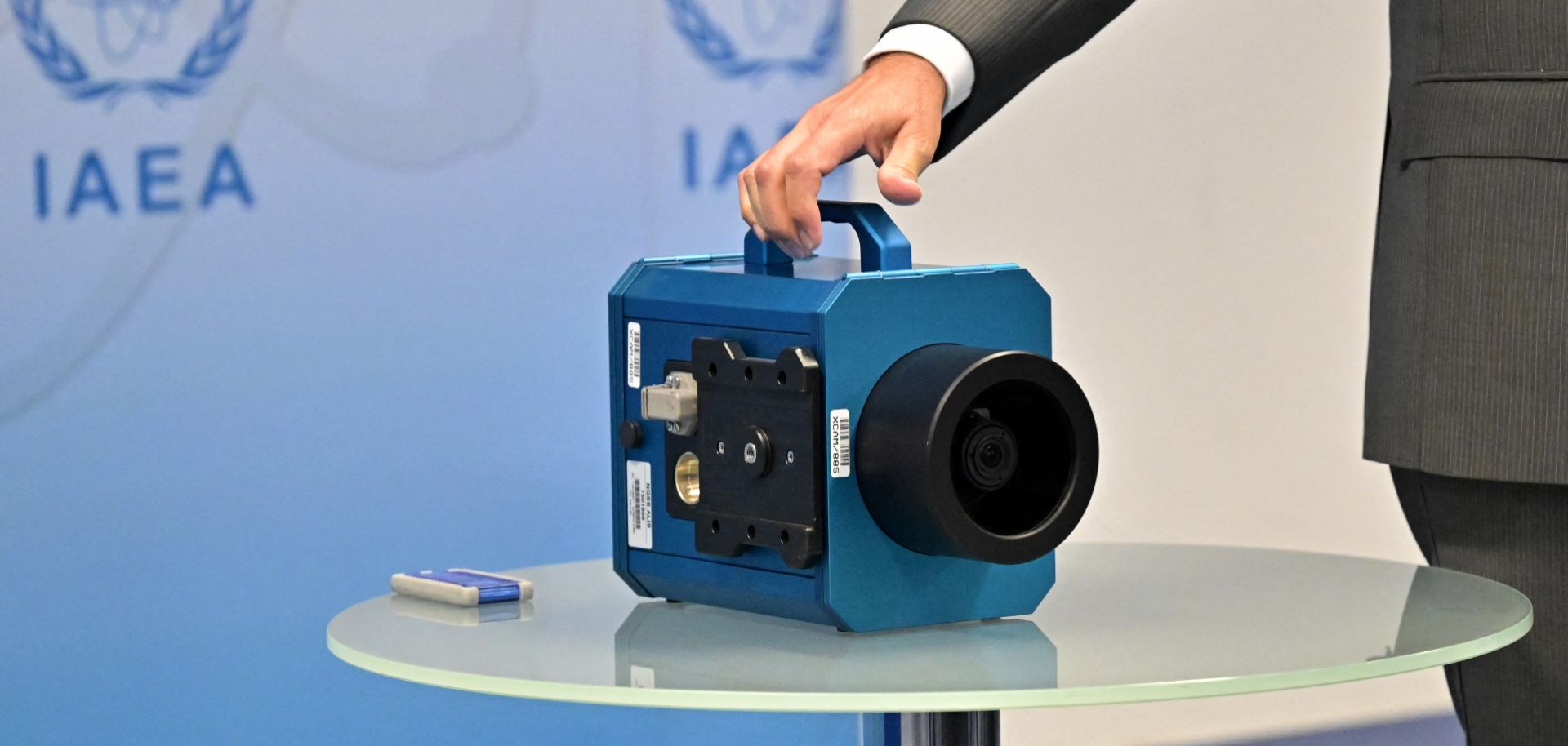
Rafael Grossi, the head of the International Atomic Energy Agency (IAEA), shows journalists one of the cameras used to monitor Iran’s nuclear activity during a press conference in Vienna on June 9, 2022, after Iran announced it was turning off 27 such cameras.
Iran’s disconnection of more than two dozen U.N. cameras monitoring its nuclear activity may deal a final blow to embattled talks in Vienna, which would increase the risk of covert and potentially even direct conflict with the United States and Israel, as well as the likelihood of Tehran acquiring nuclear weapons. On June 8, Iran informed the International Atomic Energy Agency (IAEA) that it was dismantling the equipment for 27 video cameras that the U.N. watchdog uses to monitor Iran’s nuclear program. In response, IAEA Director General Rafael Grossi warned that if an agreement to restore the cameras was not reached in the next three to four weeks, any hope of salvaging the 2015 nuclear deal — formally known as the Joint Comprehensive Plan of Action (JCPOA) — would be dead. Iran’s June 8 announcement came a day after the IAEA’s 35-member Board of Governors approved a resolution criticizing Iran’s failure to explain uranium traces discovered at undeclared sites in the country. Prior to the board’s vote, Iran said it turned off two of the monitoring cameras and also announced it had begun installing advanced IR-6 centrifuges (which are more reliable and have a higher capacity and efficiency than older generations of Iran’s centrifuges) in two new cascades at its underground Natanz Fuel Enrichment Plant.
- The dismantled cameras were originally installed as part of an additional deal signed in 2015 that gives the IAEA extra monitoring equipment beyond Iran’s core obligations to the agency. The rest of the IAEA’s access to Iran’s nuclear program remains intact.
- On the evening of June 7, the IAEA Board of Governors approved a resolution drafted by France, Germany, the United Kingdom and the United States that demands Tehran start cooperating with the agency “without delay,” citing Tehran’s continued failure to provide “credible information” on the traces of enriched uranium found at undeclared nuclear sites.
- Iran previously announced its intention to install the IR-6 centrifuges at Natanz, but held off on doing it as Vienna talks were going on.
The latest tit-for-tat escalation between Iran and the IAEA comes as nuclear talks in Vienna remain stalled, and as Tehran nears a significant quantity of highly enriched uranium. The eighth and supposedly “final” round of nuclear talks halted on March 11 after Russia demanded special guarantees from the West that Ukraine-related sanctions would not affect its relationship with Iran. Russia said that its concerns had abated just a week later. But the pause also coincided with leaks in Western media that the administration of U.S. President Joe Biden was preparing to remove Iran’s Islamic Revolutionary Guard Corps (IRGC) from the U.S. list of designated foreign terrorist organizations — one of Iran’s key demands for resuming compliance with the JCPOA. The reports spurred backlash in Washington and eventually led the White House to abandon the offer. In the three months since, Iran’s nuclear program has continued to increase its stockpiles of enriched uranium to levels viewed as dangerous by the West, Israel and the IAEA. On June 6, Grossi told a press conference that Iran was just a few weeks away from having a significant quantity of 60% enriched uranium — close to the roughly 90% considered weapons-grade.
- The IAEA said in its most recent report that Iran had stockpiled about 43.1 kg (in uranium mass) of 60% enriched uranium — roughly around the 42 kg mark that is estimated to be a “significant quantity,” which the IAEA defines as the amount where the manufacturing of a nuclear device cannot be ruled out. Iran surpassing this threshold would be extremely concerning for Israel and the West.
- Iran is the only non-nuclear state enriching uranium to 60%, which has virtually no non-military applications, and can be quickly enriched to the 90% U-235 purity level considered weapons-grade. This would rapidly accelerate the timeline in which Iran could produce enough weapons-grade nuclear material for one nuclear device (not, as commonly misstated, build a nuclear bomb).
In the short term, the United States will seek to avoid escalating tensions as it faces multiple other domestic and foreign policy challenges. The White House may hold off on any escalation as long as possible as it is already dealing with many other crises, including the ongoing war in Ukraine and a domestic economy plagued with record inflation fueled by high oil prices, as well as a broader desire to “pivot” away from the Middle East to counter China’s geopolitical rise. One senior U.S. official disputed Grossi’s recent characterization that the JCPOA talks could die within weeks, saying more information from Iran could still get negotiations back on track. The official’s remarks are consistent with a change in the overall U.S. messaging regarding the urgency of Iran nuclear talks since February. During the latest round of negotiations before they stalled, U.S. officials repeatedly said that if a deal to revive the JCPOA was not reached by the end of February (and later extended to March), the United States would need to resort to other options. But then in late February, negotiators failed to reach an agreement in the wake of Russia’s invasion of Ukraine. And since then, U.S. officials have largely dropped putting a definitive deadline for talks, likely to avoid backing itself into a corner on having to act.
Iran may also try to avoid near-term escalation by using its announcements as leverage to bring global powers back to the negotiating table. But if talks are not quickly resumed, it could lead to more regional insecurity, as well as a higher risk of covert and potentially even direct conflict with the United States and Israel. There is only so much longer negotiations between Iran and global powers can remain on life support without a dramatic escalation to a nuclear crisis – especially as Tehran accumulates near-weapons grade uranium and installs more IR-6 centrifuges (which will accelerate the growth of its nuclear stockpile), and also generally makes its nuclear activities more opaque through actions like shutting of IAEA cameras (which will increase Western and Israeli fears over its nuclear intentions). Iran’s increased nuclear ambiguity, coupled with decades of distrust regarding Iran’s nuclear program, will only result in Israel approving more covert missions — and potentially more daring and/or more overt missions – aimed at setting back Iran’s nuclear program, as well as its missile and drone programs. Even the United States may be forced to consider expanding its covert activity or even military strikes on Iran’s nuclear program. Iran would be all but certain to respond to such actions in various asymmetric ways that could further escalate matters, including through potentially more aggressive missile or drone attacks carried out by its regional proxies and/or cyberattacks targeting critical infrastructure.
A significant escalation of tensions between Iran, the United States and Israel would only increase the likelihood of Tehran becoming a nuclear state and, in turn, a greater threat to regional stability. Iran has already seen how fears of a nuclear conflict have led the United States and NATO to avoid getting directly involved in the Russia-Ukraine conflict. Iran has also been under massive sanctions for over a decade, absent the brief respite between 2016 and 2018 when the JCPOA was implemented. While the sweeping sanctions on Iran’s oil exports have damaged its economy and led to frequent rounds of anti-government protests, Iran may assess that it can withstand sanctions permanently without provoking social unrest significant enough to jeopardize the government’s grip on power. Moreover, sanctions enable the Iranian government to demonize the West and then justify its existence — and possibly the acquisition of nuclear weapons — to its domestic population. Should Vienna talks collapse and lead to the further U.S. and Israeli strikes on Iran’s nuclear and missile program, as well as a continuation of large broad sanctions, Iran may thus only conclude that it should develop nuclear weapons. At the bare minimum, such an escalation of tensions would only reinforce Iran’s nuclear hedging strategy, where it continues developing its nuclear program for civilian applications while not actually trying to build a nuclear bomb, while still retaining the option to build such a bomb and reducing the timeline to do it.
- Any Iranian move to acquire nuclear weapons may quickly lead to nuclear proliferation in the Middle East. Israel could publicly declare it has nuclear weapons to establish nuclear deterrence. Saudi Arabia, meanwhile, could double down on its efforts to acquire nuclear weapons or, like Turkey and Israel, be brought under the United States (or Israel’s) nuclear shield.
- How China approaches heightened nuclear tensions with Iran will be key to watch moving forward. China was one of five countries that voted against the IAEA’s most recent resolution. However, Beijing would likely be deeply concerned about nuclear proliferation in the Middle East between various stakeholders, as well as another nuclear state that has deep ties to Central Asia in addition to Pakistan and Russia. This could eventually increase China’s willingness to abstain or not veto new sanctions or resolutions against Iran. It could also see Beijing increasingly exert its soft power influence to try to deter Iran from developing nuclear weapons.
