
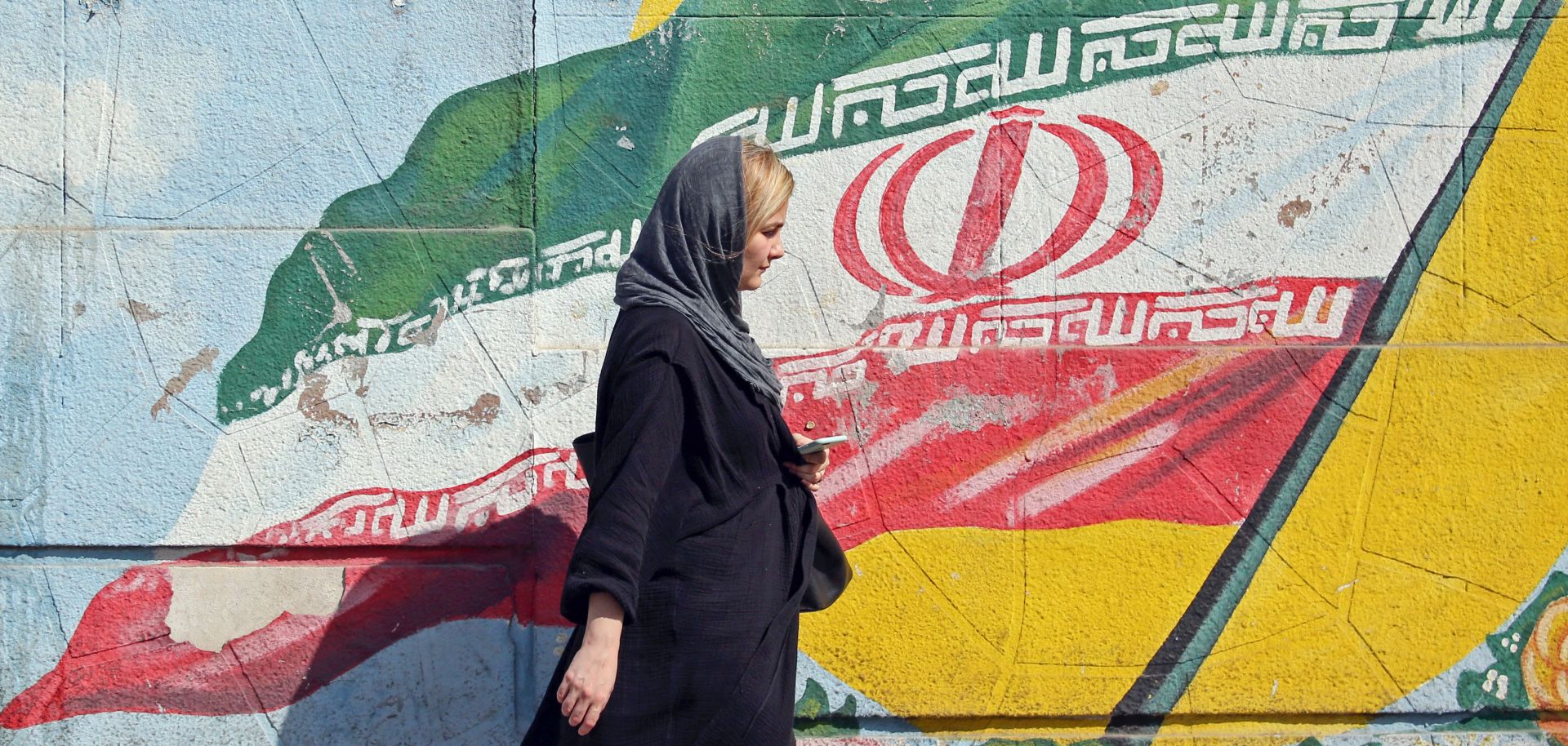
A pedestrian walks past a mural depicting the Iranian national flag in Tehran, Iran.
Economic strain is weakening Iranians’ trust in their government and causing unrest that will impede Tehran's ability to return to compliance with the 2015 nuclear deal. Less than a year after taking office, the administration of Iranian President Ebrahim Raisi is grappling with a growing wave of economically-motivated protests. In recent weeks, sporadic and unusual demonstrations have cropped up in major cities including Tehran, Isfahan and Shiraz, as well as across Iran’s southwest Khuzestan province. The rallies were initially triggered by a government decision to adjust food subsidies in early May, but have since morphed into broader calls against economic inequality and government corruption — galvanized by the recent collapse of a building in the country’s historically under-resourced southwest region left dozens dead.
- On May 23, a 10-story building in the southwestern Iranian city of Abadan collapsed, killing at least 36 people. The incident has since prompted intense criticism and scrutiny of the government’s building safety standards and contracts with dubious construction companies.
- On May 9, President Raisi announced plans to overhaul Iran’s $100 billion subsidy program, lowering the amount the government pays for bread and other staples by targeting subsidies to smaller numbers of more needy Iranians. Lowered subsidies for staples including sugar, chicken, cheese and cooking oil will be rolled out in the coming months.
The global economic shocks created by the Ukraine crisis are testing Iranians’ patience with their country’s persistently weak, sanctions-strapped economy. High global energy prices increased Iran’s oil revenue at the beginning of 2022. But those gains have since been offset by the global economic fallout from Russia’s Feb. 24 invasion of Ukraine, which has further increased the cost of other goods that Iran imports, including medicines, wheat and fertilizer. Indeed, the need to preserve limited financial resources, as well as prevent the onset of shortages in the event Iran becomes unable to pay for imports, is what prompted the Raisi government to increase food prices and adjust subsidies that catalyzed the current protests.
- Iran purchased about 30% of its grain imports from Russia and Ukraine prior to the onset of the Russo-Ukrainian war. Disruptions to that supply caused by the ongoing conflict have since significantly increased the price of bread in Iran.
- With the backing of the country’s legislative and judicial leaders, Raisi granted Iran’s central bank exceptional authority to stabilize the foriegn exchange market after the Iranian rial rate fell to a record low of 310,000 to the U.S. dollar on June 1.
- Russia is heavily discounting exports that compete with some of Iran’s key exports (namely, crude oil and steel), which — combined with the fact that Iranian exports remain under Western sanctions — has limited Iran’s ability to benefit from high global commodity prices. This is because China and other countries willing to violate Western sanctions are still more likely to import Russian goods, which are not subject to Western secondary sanctions.
The continued momentum and growing scope of the protests indicate Iranians’ growing distrust of their government, which will constrain President Raisi’s administration for the remainder of its term. Overall apathy toward the government in Iran existed prior to Raisi’s election in June 2021, and a lack of trust in the government’s ability to solve economic issues is a well-known phenomenon in the country. But the fact that anti-government sentiment has emerged as strongly as it has — and so early in Raisi’s presidency — indicates that Raisi has not been able to fulfill any of his campaign promises related to the economy, which will haunt him throughout his next three years in office. Raisi will try and communicate to Iranians in historically under-resourced areas like Abadan that the government hears their concerns. However, without significant economic growth to show for it, this message will likely fall on deaf ears and do little to quell Iranians’ increasing frustration with the current administration, with could reduce the government’s legitimacy. More serious unrest that erodes the Raisi government’s ability to project power across all of Iran is unlikely, but cannot be ruled out if the country’s economy continues to deteriorate.
- The economy featured heavily in Raisi’s campaign promises. In his inauguration speech in August, Raisi said his main goals were “eradicating rent-seeking, strengthening the national currency, creating stability in the economy, attaining self-sufficiency, and addressing people’s needs.”
- Members of Raisi’s conservative political allies are beginning to turn on him amid Iran’s worsening economic instability. Conservative members of parliament, including the powerful speaker, and conservative media outlets have criticized Raisi’s economic policies. The president will likely lose political allies if Iran’s economic situation does not improve, which would only further destabilize his administration.
The surge in political dissent will make it harder for the Iranian government to move forward in nuclear talks abroad. Anti-government protests at home caused by the poorly performing economy will compel the Raisi administration to remain engaged in nuclear talks with the United States in the hopes of securing sanctions relief and, in turn, easing the economic grievances drawing people to the streets. But the removal of U.S. sanctions would also risk making Raisi’s policies the core target of Iranians’ anger by removing an important scapegoat for the country’s economic malaise. Additionally, in the current climate of growing political dissent, appearing too eager to reach a deal with the United States and its allies would risk being seen as a capitulation to the West. These political factors will drive Tehran to delay its timeline for inking a nuclear deal, despite the economic benefits of sanctions relief. By reducing his administration’s willingness to heed Western demands, Raisi’s fragile political position at home will also make reaching a nuclear agreement all the more difficult.
- Over the past year, Iran has been engaged in talks with major world powers to restore compliance with the 2015 nuclear deal — formally known as the Joint Comprehensive Plan of Action (JCPOA) — that would see Iran scale back the development of its nuclear program in exchange for the United States lifting sanctions on the Middle Eastern country.
- In the past decade, Western sanctions related to Iran’s nuclear activity have contributed to inflation, shortages of key goods and declining GDP growth in the country. In 2021, Iran’s then-foreign minister said U.S. sanctions had inflicted about $1 trillion in damage to the economy.
- In recent years, Iranian leaders have had to walk the tricky line between touting Iran’s ability to independently withstand sanctions pressure — part of the so-called ‘resistance economy’ that sees Iran looking inward for its economic strength — and blaming the United States and other Western countries for keeping sanctions in place and hampering Iran’s economy. Raisi has heavily championed the tenets of the resistance economy; his administration’s failure to solve the country’s economic problems could thus harm the ideological appeal of the attempt at economic self-reliance.
