
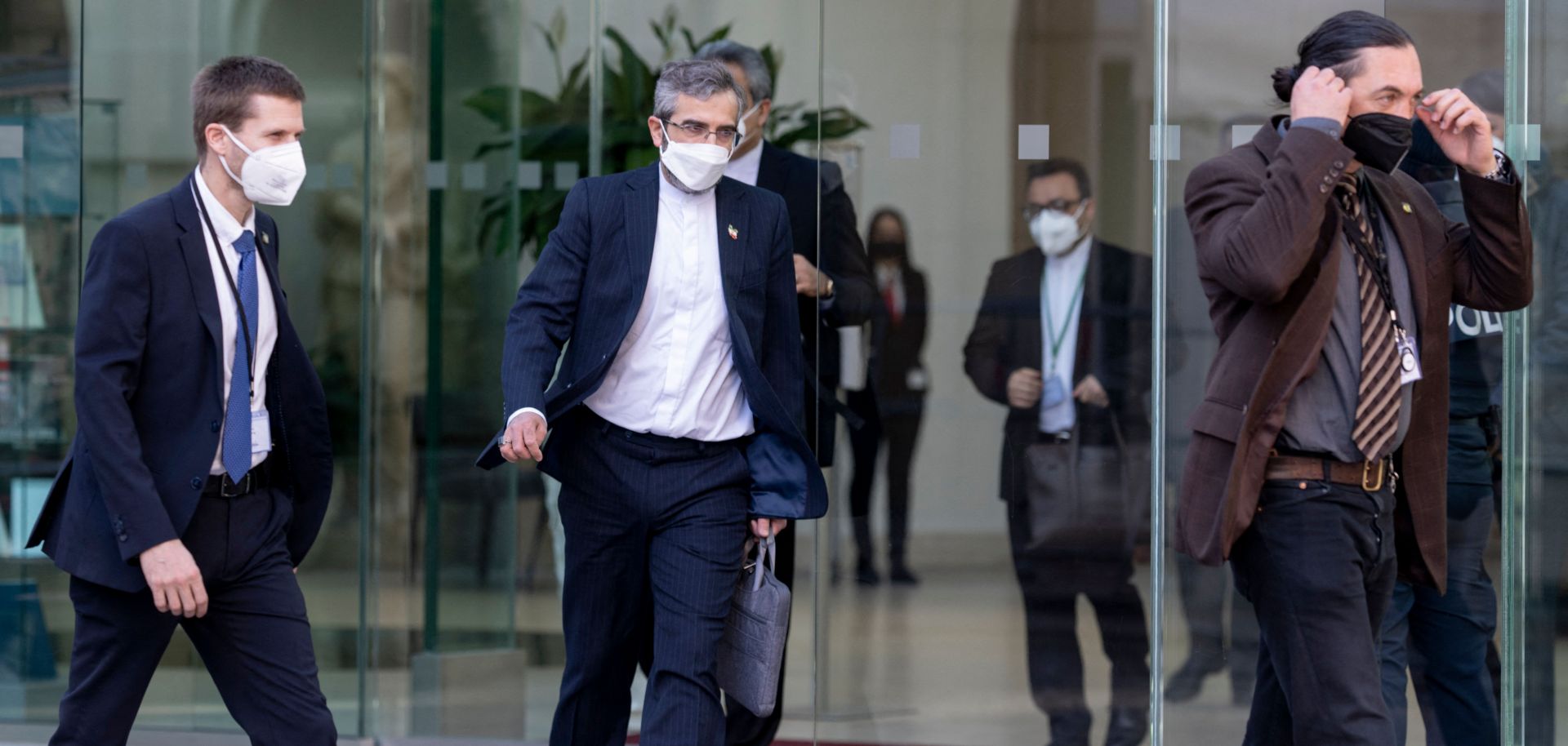
Iran's chief nuclear negotiator Ali Bagheri Kani (center) is seen leaving the venue in Vienna, Austria, where Joint Comprehensive Plan of Action (JCPOA) talks have been held on March 11, 2022.
Russia's last-minute demands in Iran nuclear talks risk upending negotiations altogether — and with it, the West's hopes of adding more Iranian oil exports to the tight oil market and mitigating Tehran's aggressive regional behavior. In a March 11 tweet, EU foreign policy chief Josep Borrell said the final text of a deal restoring compliance with the 2015 nuclear deal — formally known as the Joint Comprehensive Plan of Action (JCPOA) — was ''essentially ready,'' but that ongoing talks between global powers in Vienna to reach the agreement needed to be paused ''due to external factors,'' referring to Russia's recent push for sanctions relief. Over the last 10 days, Russian negotiators in Vienna have demanded Western governments guarantee the sanctions they've imposed related to the Ukraine invasion do not threaten Russia's economic, political and military relationship with Iran. In response, the United States and its Western allies have struggled to come up with a concession palatable to Moscow, causing Russian negotiators to table an amended version of their demands (which were functionally the same) earlier this week. The impasse has, in turn, placed Iran nuclear talks on pause without a clear timeline for their resumption.
- In response to talks being put on hold, the spokesman for Iran's foreign ministry said ''no external factor will affect our joint will to go forward for a collective agreement.'' China's lead negotiator in Vienna said that he hopes that talks will resume in the coming days and that the text of an agreement restoring the 2015 Iran nuclear deal only needs ''final touches.''
- Over the past year, major world powers have been working toward inking an agreement that would see Iran scale back the development of its nuclear program in exchange for the United States lifting sanctions on the Middle Eastern country's oil industry.
Russia is trying to thwart the West's attempt to add more oil to the global oil market and divert some Western attention toward Iran. Prior to its invasion of Ukraine, Russia had been playing a facilitating role in Iran nuclear negotiations. But the sweeping sanctions imposed on Russia in recent weeks have shifted the Kremlin's national security priorities. High oil prices (which help Russia and hurt the West) will impact the scope and duration of Western sanctions on Russia, and the United States and its allies are trying to add every molecule of oil that can be produced and bring it to the market. Iran, which can ramp up oil production by 1.5 million barrels per day within about six months, is the world's largest source of oil that's currently offline due to U.S. sanctions. Moreover, keeping nuclear talks in flux and potentially causing negotiations to collapse could divert some Western attention away from Russia's ongoing military operation in Ukraine, particularly if a nuclear crisis erupts as Iran's program continues progressing.
Without Russia's approval, the West and Iran are unlikely to reach an agreement in the coming weeks. Russia is not only a permanent member of the U.N. Security Council that approved the original JCPOA in 2015, but a member of the JCPOA's Joint Commission that would oversee any reintroduction of the agreement. Getting to a new Iran nuclear agreement without Russia would thus likely require a different format than the JCPOA, which would be tantamount to reopening negotiations on everything the JCPOA includes in terms of constraints on Iran's nuclear program and the scope of U.S. sanctions removal. Washington would almost certainly reject straying from the JCPOA format as it would give Iran more room to demand a weaker deal on technical issues, like the use and development of more advanced and efficient centrifuges. Against this backdrop, Iran and the United States could try to negotiate a temporary, more narrow deal where the former freezes its nuclear program at current levels and the latter allows a limited amount of sanctions relief. But Tehran has so far categorically rejected the idea of inking a deal that provides anything less than full sanctions relief under the original terms of the JCPOA. The United States and its Western allies, for their part, are unlikely to agree to sanctions carved out for trade with Iran and would insist on keeping the two issues unlinked, even if there is a negotiation process ongoing in Ukraine. Given these factors, cutting out Russia from Iran's nuclear negotiations would almost certainly result in the talks collapsing. Russia may weaken its demands in the future, but that largely depends on whether the conflict in Ukraine evolves in a way that satisfies Moscow's core concerns with NATO and Ukraine's ability to join the Western security alliance or the European Union.
The longer nuclear talks remain on hold, the greater the risk of negotiations collapsing without a deal in place, which could lead to more Iran-linked violence in the Middle East, including attacks on tankers and Arab Gulf countries, as well as higher covert activity against Iran's nuclear and missile programs. When nuclear talks restarted in late 2021, European and U.S. diplomats said the window for negotiating would not last longer than February due to the imminent threat posed by Iran's growing nuclear stockpiles and enrichment levels, and if a deal was not concluded by then, they would need to consider other options to retaliate against Iran's nuclear activity, such as snapping back on U.N. sanctions or expanding U.S. sanctions. At the end of February, the gaps had been narrowed enough to continue negotiations into March. Although the crisis in Ukraine and increase in oil prices will lead to a lower willingness by the United States and Europe to escalate things with Iran, tighter sanctions remain possible. Without a deal, Iran will continue expanding its nuclear activity and back a more aggressive regional strategy. This could see pro-Iranian militias, like Houthi rebels in Yemen, conduct more attacks on Saudi Arabia and the United Arab Emirates. Iran's military could also directly attack tankers in the Persian Gulf, as well as conduct more disruptive cyberattacks targeting the United States and its Middle Eastern partners. For Iran, such a strategy would be designed to pressure the United States and European Union to return to the negotiating table by adding to the multiple crises Washington and its Western allies are already dealing with. The more Iran's nuclear program progresses and the longer talks are stalled, the more likely it is that Israel will also accelerate covert activity against Iran's nuclear and missile programs, even if the United States opposes such action due to the risk of further escalating regional tensions and instability.
