
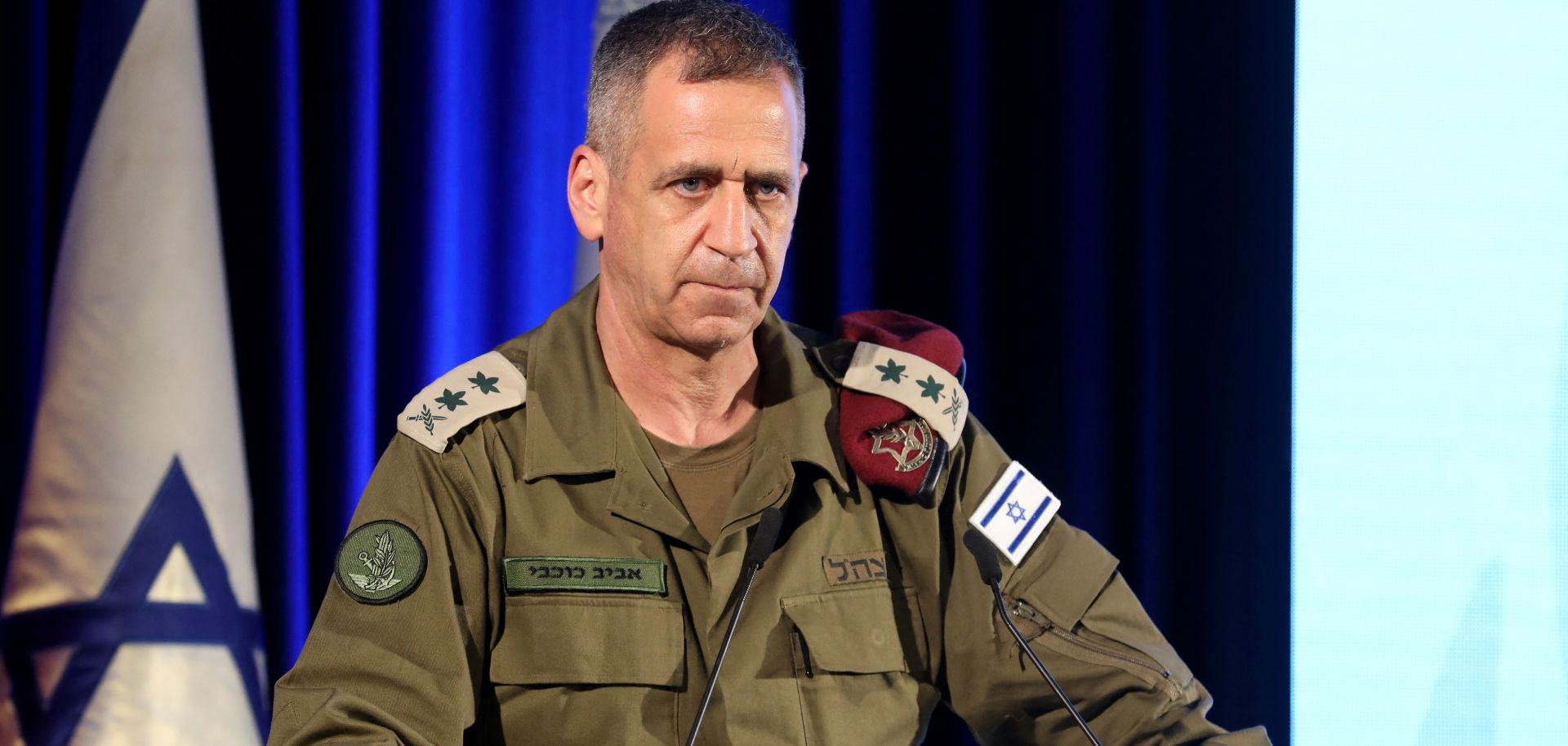
Israeli Defense Forces Chief of Staff Aviv Kochavi is seen in Jerusalem on Nov. 29, 2021, shortly after Israeli Prime Minister Naftali Bennett said Iran was re-entering talks on its nuclear program to seek sanctions relief in exchange for ''almost nothing.''
While it remains remote, the risk of a major war breaking out between Israel and Iran is slowly growing as the two rivals continue to trade tit-for-tat tactical escalations. On March 13, Iran claimed responsibility for a dozen ballistic missile strikes targeting a secret Israeli intelligence base in the Iraqi Kurdistan capital of Erbil. The following day, Israel's National Cyber Directorate declared a state of emergency after most government websites were temporarily taken offline in a large distributive denial of service (DDoS) cyberattack that Israeli media has since blamed on Iran. These recent incidents come a month after a still-unverified Israeli airstrike hit an Iranian unmanned aerial vehicle (UAV) base in the western province of Kermanshah in mid-February (Iran has not directly blamed Israel for this rumored attack, though coinciding reports published by the Associated Press of a fire at the same base and explosions heard by locals indicate some veracity behind the possible Israeli strike). Other Iranian and Iraqi sources cited by the Middle East Eye said the March 13 missile attack in Erbil was in response to an Israeli sabotage mission on a drone factory near Tabriz. The latest Iranian attacks on Israel were likely also, in part, linked to the deaths of two Iranian Revolutionary Guards Corp (IRGC) officers in an Israeli airstrike outside the Syrian capital of Damascus on March 7, which Iran vowed to avenge.
- Israel does not have an official presence in Iraqi Kurdistan. But since the United States invaded Iraq in 2003, Israel has maintained close ties with the regional government in Erbil, including by supporting Kurdistan's failed independence bid in 2017.
- Iran has carried out numerous cyberattacks against Israel over the years, including a massive hack aimed at disrupting Israel's water supply reported in July 2020.
- Israel has long conducted sabotage and covert campaigns against Iran in Lebanon, Syria and Iraq, as well as within Iran itself. Inside Iran, Israel typically uses on-the-ground assets to sabotage sites related to Iran's military and nuclear program, as it did in November 2020 when Israel used a remotely controlled robot to assassinate Iran's chief nuclear scientist Mohsen Fakhrizad. Iran often vows to respond to these attacks at a time and manner of its choosing.
Regardless of the outcome of the West's negotiations with Iran over its nuclear program, Iran and Israel will continue to tactically escalate their covert campaigns against one another. The current agreement negotiators in Vienna are in the process of finalizing would only restore the terms of the original Iran nuclear deal signed in 2015, and does not address Israel's other concerns regarding Tehran's foreign policies, as well as its military and cyber capabilities. This leaves Israel in a position where it will continue its covert campaign against Iran (and potentially escalate, especially if no deal emerges) to degrade Tehran's drone, missile and nuclear programs. Iran, meanwhile, will continue to see Israel as its primary regional and ideological enemy regardless of any nuclear deal and may be willing to use more significant and overt force, such as its ballistic missiles fired from its home territory, against claimed Israeli targets outside Israel — especially if nuclear negotiations among global powers collapse without a deal. If verified, last month's alleged Israeli attack on the Iranian UAV base would signal that Israel is willing to escalate from its confirmed sabotage operations against Iran to launching direct airstrikes on Iranian turf. And given the subsequent Iranian missile attack against the Israeli intelligence base in Erbil, it would also signal that in response to such strikes, Iran is prepared to use its ballistic missile system and potentially drones to strike claimed Israeli targets in regions (like Iraqi Kurdistan) or countries that are friendly to Israel.
- Members of Israel's military establishment have largely signaled they expect the Vienna talks to yield a deal in which Iran only agrees to scale back some of its nuclear activity in exchange for limited sanctions relief, thus leaving most of Israel's other security concerns unaddressed. In case Iran nuclear talks collapse before reaching an agreement, Israel has also continued to conduct widely-reported ''Plan B'' military exercises in preparation for a possible war with Iran, including a January 2022 airstrike drill against presumed Iranian nuclear targets.
While both Israel and Iran will seek to avoid a major regional war, the exchange of tactically escalated strikes between the two still carries an inherent risk of triggering unplanned cycles of violence, including in states or regions friendly to Israel. With both Israel and Iran displaying a greater willingness to explore new ways to strike at one another, the risk of a cyberattack or an air, drone, or missile strike inflicting unplanned casualties or damage. Israel would likely escalate in response to a cyberattack that resulted in civilian deaths, a conventional strike that causes damage inside Israel, or the loss of an aircraft while conducting operations against Iranian targets regionwide. Iran, for its part, would likely escalate in response to covert Israeli actions that are either conducted inside Iran or are launched by new third-party countries like Bahrain and the United Arab Emirates (which have both recently normalized ties with Israel). Both escalation patterns would likely be designed to retaliate to the immediate provocation and then de-escalate again. However, given the high state of tensions between Israel and Iran, a potential rapid escalation to regional war cannot be ruled out. Additionally, countries or regions that are friendly to Israel — like Iraqi Kurdistan, as well as newly normalized Bahrain and the United Arab Emirate — will face an increased risk of Iranian attacks on their soil. Israel-linked commercial activity, like shipping, could also see an escalated risk of Iranian strikes.
- Israel has found itself in several accidentally-triggered wars brought on by deep underlying tensions. Last year's Gaza conflict, for example, started after Israeli police carried out a crackdown against Palestinian protesters at a mosque in Jerusalem. Israel's 2006 war with the Iran-backed militant group Hezbollah in Lebanon also started after three Israeli soldiers were killed in a cross-border raid.
- The United States and Iran came close to overt war in late 2019 after the killing of a U.S. soldier by Iranian proxies in Iraq prompted Washington to rapidly escalate against Tehran, which ultimately led to the sudden U.S. assassination of IRGC General Qassem Soleimaini. The risk of a U.S.-Iran war declined once Iran fired ballistic missiles at U.S. bases in Iraq, inflicting damage but no American casualties. Washington, in turn, then declined to conventionally respond to the missile strikes.
- The United Arab Emirates already came under attack by a likely IRGC-affiliated Iraqi militia front in February. Iran-backed Houthi rebels in Yemen have also launched missile and drone attacks against the wealthy Arab Gulf country. Iranian sabotage operations have also targeted Israeli-owned and -linked ships transiting nearby waters in recent years. Tehran has also attacked Israeli embassies and diplomats, as it did in Georgia and India in 2012.
