
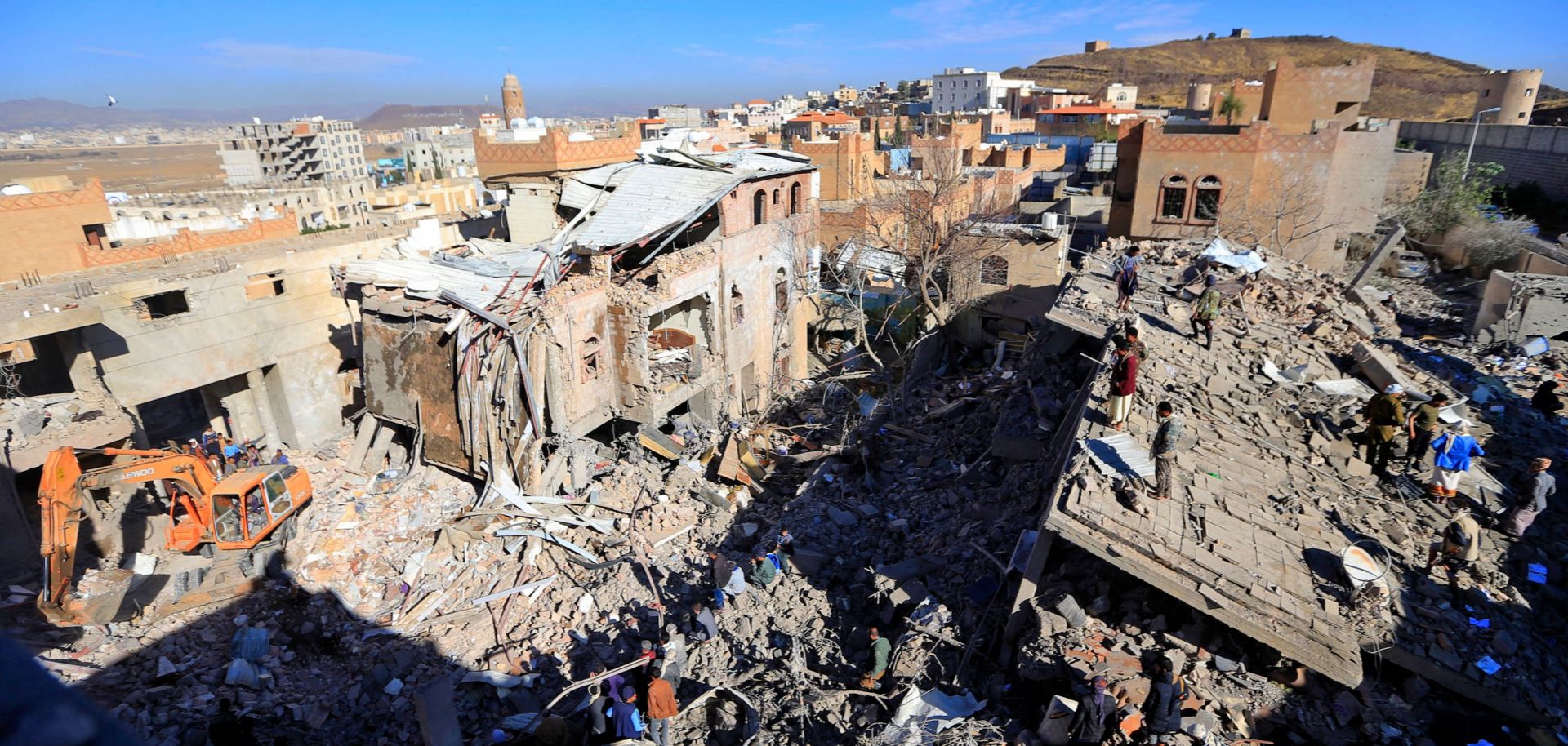
Damaged buildings in the rebel-held capital of Sanaa are seen on Jan. 18, 2022, after the Saudi-led coalition in Yemen launched airstrikes in retaliation for a deadly Houthi attack on Abu Dhabi.
The recent Houthi attack against Abu Dhabi could provoke a cycle of such strikes that undermines the United Arab Emirates’ reputation as a peaceful business hub. The attack may also increase U.S. military and diplomatic support for the Saudi-led coalition in Yemen and put fresh pressure on Iran-backed Houthi rebels. On Jan. 17, Yemen’s Iran-backed Houthi movement claimed responsibility for a reported attack on an Abu Dhabi National Oil Company (ANDOC) oil storage facility located in the capital’s industrial zone, southwest of the airport. Two Indian nationals and one Pakistani worker were killed in the attack, which according to preliminary reports, included drones, ballistic missiles and cruise missiles — some of which Saudi Arabia claimed to intercept. This is reportedly the first time the Houthi movement has successfully hit the Emirati homeland, and comes a week after UAE-backed Yemeni forces regained control of Yemen’s key energy-rich Shabwa province from Houthi rebels. In retaliation, the Saudi-led coalition in Yemen conducted overnight airstrikes on the Houthi-held capital city of Sanaa on Jan. 18.
- On Jan. 10, the UAE-trained Giants Brigade announced it had regained control of Shabwa after a 10-day assault — marking a notable setback for the Houthis’ ongoing siege of Yemen’s adjacent Marib province, which is the center of the country’s small oil and gas industry.
- The United Arab Emirates has been militarily involved in Yemen since the Saudi-led coalition intervened in 2015. But the Emiratis drew down most of their conventional forces in 2019, pivoting to relying on proxy forces like the Giants Brigade, which backs the Southern Transitional Council. Despite the drawdown, the Houthis have continued to threaten to attack the United Arab Emirates because of its support for their rivals.
- The United Arab Emirates itself has historically been spared most of the effects of the region’s instability thanks in part to its decades of non-interventionist foreign policies. But this approach changed after the Arab Spring, when Abu Dhabi concluded it had to be more directly involved in regional affairs, even militarily, to prevent rivals like the Muslim Brotherhood and Iran from threatening the United Arab Emirates.
The United Arab Emirates will use the Abu Dhabi attack to lobby for more U.S. diplomatic and military support in Yemen. Following the Jan. 17 attack against its capital, the United Arab Emirates has called on the United States to restore the terrorism designation for the Houthis, which the administration of U.S. President Joe Biden rescinded in February 2021 as part of its push for a diplomatic solution to Yemen’s civil war. The United States did not condemn the Saudi-led retaliatory airstrikes on Sanaa, which suggests Washington might be warming to backing more military pressure against the Houthis after the Abu Dhabi attack, given that Saudi Arabia is reliant on U.S. goodwill to resupply its air force. Moreover, the attack on Abu Dhabi signals that the Houthis militant wing is driving policy at the moment, undermining the probability that the U.S. diplomatic push will have much success. As a result, the United States might be more willing to restore some of the logistical and intelligence support it cut back after the assassination of Jamal Khashoggi in 2018.
- Since taking office in January 2021, the Biden administration has sought to recalibrate the United States’ approach to Yemen to support a diplomatic solution to the civil war and restrain its allies from conducting military activities that undermine its frail humanitarian situation. This has included ostensibly ending offensive arms sales to Saudi Arabia and the United Arab Emirates, as well as reversing its predecessor’s designation of the Houthi rebel movement in Yemen as a foreign terrorist organization, which U.N. officials and international aid organizations feared would further limit exports of crucial food and supplies to the war-torn country. Over the past year, however, the Houthis have also launched a major offensive to take the key city of Marib, which, if successful, would be a serious blow to the Saudi and Emirati-backed Yemeni government.
The Houthi attack may impede recent Emirati-Iranian diplomatic outreach, though Abu Dhabi will avoid overt military escalation with Iran for fear of harming domestic business and triggering a larger clash with its powerful neighbor. The United Arab Emirates said it reserved the right to continue to retaliate against the Houthis, but there is no indication that Abu Dhabi is prepared to blame the attack on Iran, despite Tehran providing Houthi militants with the knowledge and material support to conduct such strikes. The United Arab Emirates’ caution towards Iran is partially warranted by its uncertainty as to how far the United States will provide security in case of confrontation, especially after the 2019 Iranian attacks on Abqaiq in Saudi Arabia prompted no U.S. retaliation. The United Arab Emirates is also wary of provoking a military confrontation that could scare away tourists, businesses and investors — key planks of its economic development strategy. Dubai’s economy, in particular, relies on trade with Iran as well. It is likely these challenges have served as operational constraints on Houthi strikes against the United Arab Emirates, along with political considerations that such attacks may damage relations between the United Arab Emirates and the Houthis' ally Iran. However, the Abu Dhabi attacks could jeopardize efforts that the United Arab Emirates and Iran have made in recent months to mend their relations. Prior to the Jan. 17 Houthi attack, the United Arab Emirates had invited Iranian President Ibrahim Raisi to visit in February. If that invitation is rescinded, it would indicate a disruption to those reconciliation efforts.
The Houthi strikes could pull the United Arab Emirates back into a more militarily active role in Yemen, creating the risk of future Houthi attacks on Emirati territory that would undermine its economic attractiveness. In response to the Abu Dhabi attacks, the United Arab Emirates and Saudi Arabia will likely try to increase military pressure against the Houthis, potentially with more United States’ help. This, however, would risk prompting Houthis to increase their pace of attacks on the United Arab Emirates — especially Dubai, which has so far largely escaped the impacts of the region’s wars. If the Houthis do begin a more sustained campaign against the Emirates, it would deeply damage the country’s reputation as a safe place to invest and do business, harming the country’s economic diversification strategy.
