
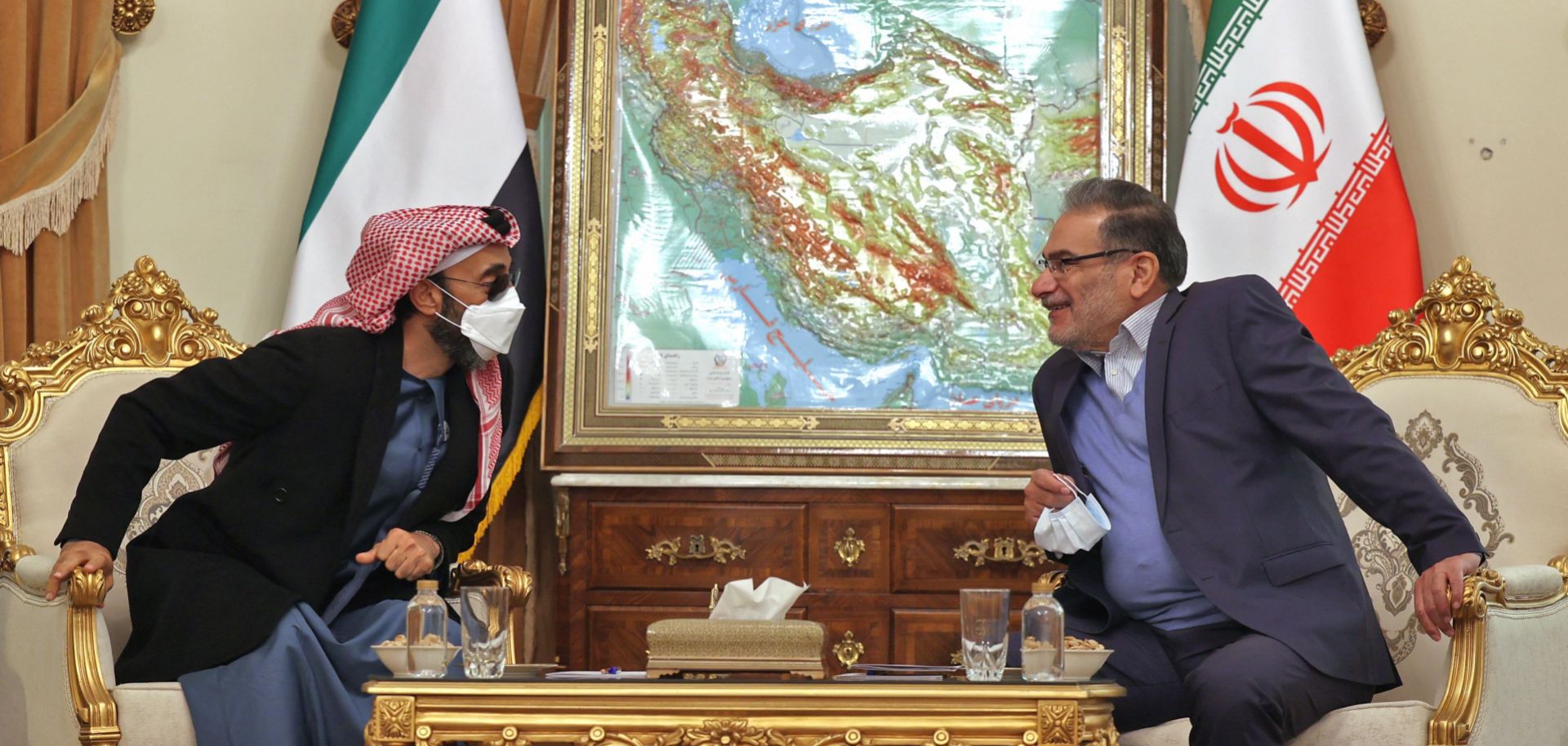
Secretary of Iran’s Supreme National Security Council Ali Shamkhani (right) meets with the United Arab Emirates’ security adviser Sheikh Tahnoon bin Zayed Al Nahyan in Tehran on Dec. 6, 2021.
A high-profile visit to Iran reflects the United Arab Emirates’ shifting calculus regarding a more public and pragmatic relationship with its regional rival for the sake of security and economic benefits. UAE National Security Adviser Sheikh Tahnoon bin Zayed al Nahyan met with Iranian President Ebrahim Raisi in Tehran on Dec. 6, a rare visit indicating some softening of relations between the Persian Gulf neighbors. Raisi reportedly said he welcomed “improved ties with the Emirates” and that Sheikh Tahnoon had invited him to visit the United Arab Emirates. Emirati state-run media did not reference this invitation in their coverage of the meeting, but did say the two leaders discussed “consolidating bilateral ties and explored an array of issues of common interest.”
- The United Arab Emirates has long viewed Iranian regional hegemony as one of the top threats to its national security. Abu Dhabi is especially concerned with the possibility of a nuclear-armed Iran, with only the Strait of Hormuz and the narrow Persian Gulf separating the two countries.
The United Arab Emirates is indicating it will be more politically pragmatic in its regional relationships to ensure its own security in the face of unchanging threats. In recent months, the Emirati government has also made moves to mend its diplomatic ties with regional rivals Turkey and Qatar, with Abu Dhabi Crown Prince Mohammed bin Zayed visiting Istanbul for the first time in a decade last month and Sheikh Tahnoon visiting Doha for the first time in four years in August. Abu Dhabi still disagrees with certain policies upheld by the Turkish, Qatari and Iranian governments – namely, Qatar and Turkey’s support for political Islam and Iran’s broadened regional influence in places like Syria and Iraq. But the United Arab Emirates’ moves to ease tensions with these countries suggest it no longer views such divergences as a dealbreaker for diplomatic cooperation. It also indicates Abu Dhabi acknowledges that lacking a healthy bilateral dialogue with other regional powers makes it harder for it to de-escalate issues that directly affect Emirati interests.
- Iran has long pushed for warmer ties with the Gulf Cooperation Council (GCC) states to its southwest, but the United Arab Emirates and fellow GCC leader Saudi Arabia have often rejected Tehran’s entreaties.
- As the United States’ security focus shifts to threats posed by China, the potential future drawdown of U.S. troops in the Arabian Peninsula risks leaving GCC states more vulnerable to Iran, which has engaged in naval harassment of commercial and military vessels in the Persian Gulf. A diplomatic accord between Iran and the GCC states would help mitigate that threat and provide a route to de-escalation in the event of a conflict.
For the United Arab Emirates, greater dialogue with Iran helps reduce the threat of being targeted in a greater regional conflict. An Iran with either a nuclear weapon or an advanced ballistic missile program is among Abu Dhabi’s top security concerns. Should Iran agree to any concessions on its nuclear program in ongoing talks with the United States (which recently resumed in Vienna), it would help accelerate Emirati-Iranian rapprochement. But establishing a line of communication with Iran could also enable the United Arab Emirates to broach these issues directly with Tehran, regardless of the outcome of those negotiations. Improved bilateral relations could also help mitigate the threat of becoming a target of Tehran’s aggressive regional behavior following the United Arab Emirates’ move to normalize ties with Israel – one of Iran’s largest adversaries – last year.
- Israel is a frequent target of attacks conducted by Iran and Iranian proxies.
- The United Arab Emirates normalized relations with Israel in August 2020.
A more publicly pragmatic relationship could deepen commercial and economic cooperation between the United Arab Emirates and Iran. The United Arab Emirates and Iran share a centuries-old history of exchanging goods across the Persian Gulf, which still endures today in the form of both legal and illegal trade. Many prominent Iranian firms also have a presence in the United Arab Emirates, particularly in business hub Dubai. But the crushing sanctions imposed on Tehran by the administration of former U.S. President Donald Trump have severely limited UAE-Iran trade in recent years – forcing the UAE government to even kick out many Iranian businesses. A stronger diplomatic relationship could help to bring Iranian and Emirati companies back together. Such increased economic cooperation could also eventually compel Abu Dhabi to increase pressure on the United States to lift some sanctions on Tehran to allow for more mutually beneficial commercial activity.
- The United Arab Emirates is a regional trading and transshipment hub, and currently trades roughly $15 billion worth of goods with Iran each year.
