
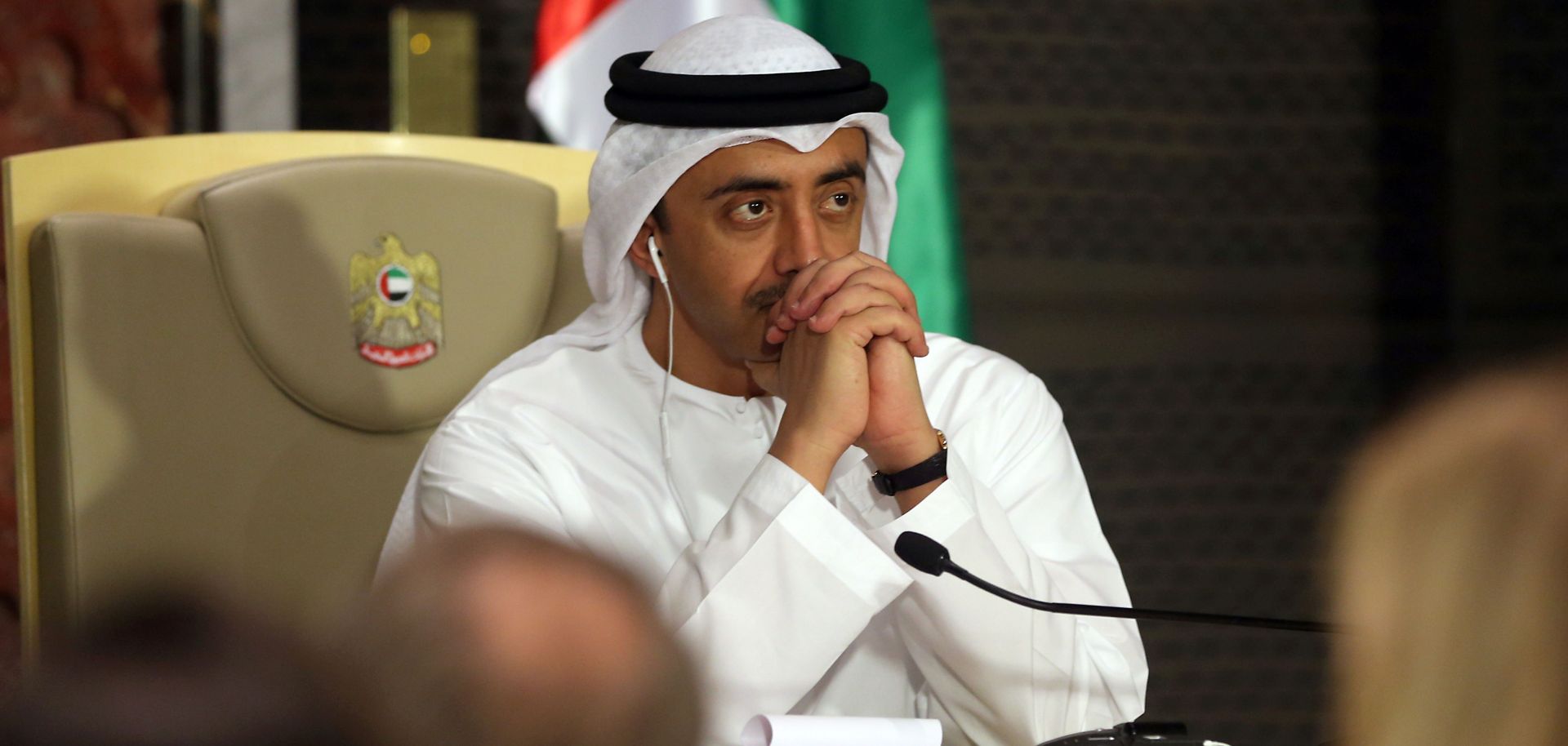
UAE Foreign Minister Sheikh Abdullah Bin Zayed looks on during a press conference in Abu Dhabi.
The United Arab Emirates is working to improve diplomatic and economic relations with Qatar as Abu Dhabi prepares for a reduced U.S. presence in the region. During a meeting in Doha on Aug. 26, UAE national security advisor Sheikh Tahnoun bin Zayed Al Nahyan and Qatar’s emir publicly discussed improving their countries’ economic ties. The visit to the Qatari capital indicates the Emiratis are attempting to turn the page on their previously hawkish anti-Qatar policies, which culminated in the Saudi-Emirati-Bahraini-Egyptian blockade of Doha between 2017-2021. Abu Dhabi’s outreach to Doha also comes as the United States is signaling a desire to draw down its military presence in the Middle East to focus more on threats in the Indo-Pacific.
- The United States recently withdrew troops from Afghanistan and is also in the process of negotiating another exit from Iraq.
- The United Arab Emirates’ close ties with the administration of former U.S. President Donald Trump enabled it to participate in the regional blockade of Qatar, as well as take greater military risks in Yemen and Libya, without fear of U.S. retaliation. But since U.S. President Joe Biden took office in January, the Emiratis have signaled an interest in shifting away from this more adventurous foreign policy in response to increased pressure from the White House and sustained criticism of Emirati behavior from U.S. lawmakers in Congress.
- The Emiratis also normalized relations with Israel in August 2020 in part because they were looking for fresh allies beyond the United States that could help offset a potential reduction in American military power to the Arab Gulf.
- The United Arab Emirates’ reputation for stability is a critical part of its appeal to international investors and foreign workers. But that reputation has recently been undermined by Iranian sabotage attacks on tankers near the country’s coastline, as well as the deployment of UAE forces to the conflicts in Yemen and Libya. Tense U.S.-Iranian relations have also called into question whether the United Arab Emirates, which hosts U.S. troops, would be pulled into a potential regional conflict between Washington and Tehran.
The slow warming of UAE-Qatar relations will likely improve some aspects of both countries’ economies as they re-invest in one another. Now that Muslim Brotherhood-supported governments in Libya, Tunisia and Egypt have either been overthrown or severely weakened, the Emiratis will likely continue to de-emphasize their focus on the transnational Islamic movement. This will create more room for cooperation, given that Qatar’s support of the Muslim Brotherhood was previously a major point of contention between the two countries. With renewed access to Qatar following the lifting of the four-year blockade, Emirati construction firms already appear ready to take advantage of the flurry of projects that still need to be finished in Doha ahead of the World Cup, which the city is scheduled to host in November 2022. The warming of ties could also see the reopening of air links between Qatar and the United Arab Emirates, which are key to connecting Doha to global tourism flows given that Dubai’s airports are the region’s largest transport hubs. Increased cooperation may also eventually see the return of Qatari investors and consumers to the United Arab Emirates for the first time since 2017. But the full recovery of the two countries’ pre-blockade business ties will likely take more time and require further efforts by both sides to improve diplomatic relations.
- Qatari investors were once a major source of income for the United Arab Emirates’ real estate sector. Qatari consumers also often frequented the country’s luxury malls and hotels. But that business abruptly stopped during the blockade.
As its tensions with Qatar ease, the United Arab Emirates’ regional strategy may increasingly focus on diplomacy rather than covert power and military action in other countries like Yemen, Libya and Tunisia. The Emiratis have already reduced their forces in Yemen and may continue to draw back from overt conflict in that theater. The United Arab Emirates could also start pushing its proxy in Yemen, the Southern Transitional Council, to take a more productive stance in easing the war-torn country’s humanitarian crisis. Additionally, Abu Dhabi may be less apt to use military power in Libya, which is scheduled to hold elections in December 2021 — relying instead on influence and aid to boost their ally Khalifa Hifter, the leader of the rebel Libyan National Army. And finally, the United Arab Emirates may become less eager to directly interfere in the domestic politics of countries like Tunisia, preferring to use aid and diplomacy over blunt instruments like travel bans to achieve strategic aims of keeping the Muslim Brotherhood at bay.
