
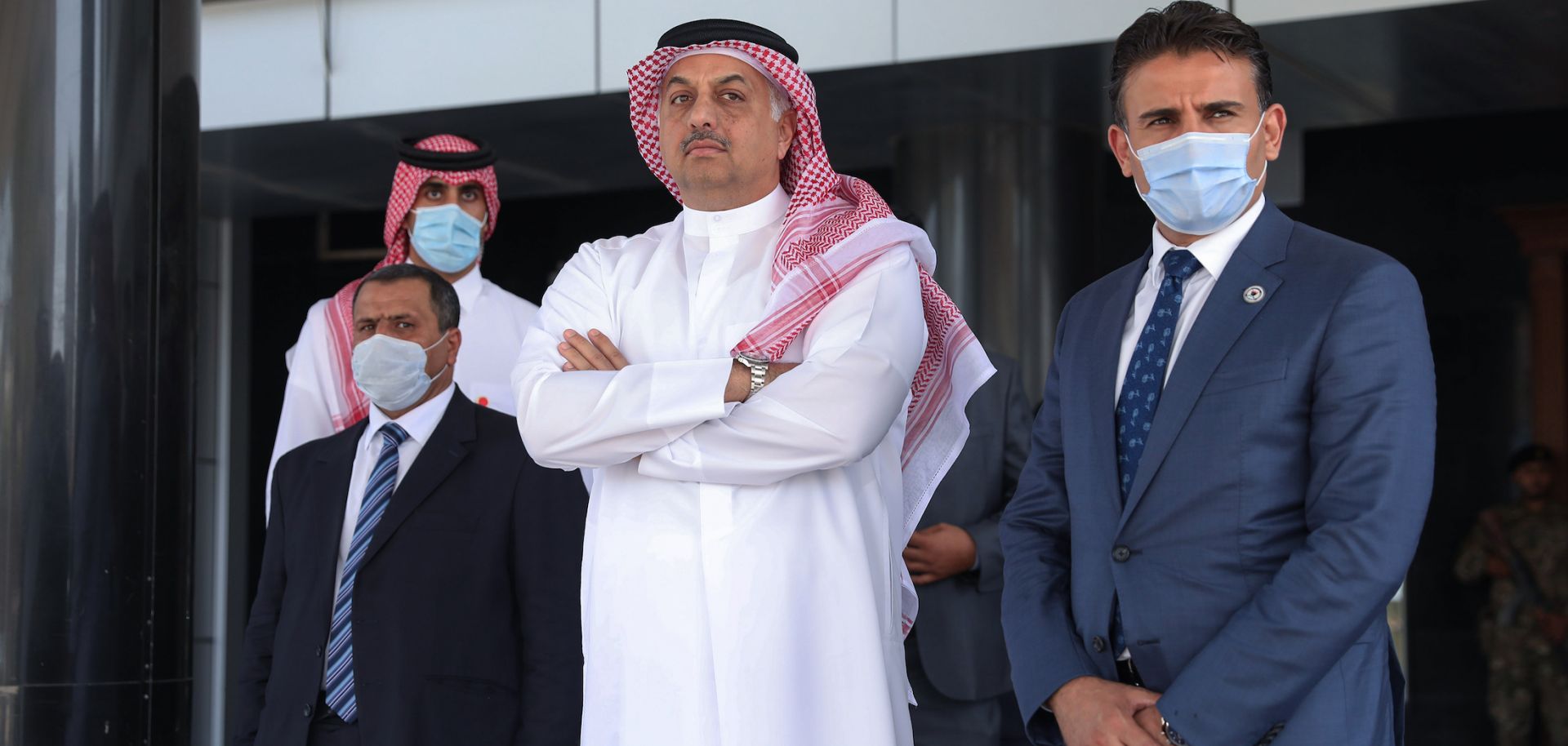
Qatar’s defense minister (center) waits for the arrival of his Turkish counterpart to meet with the prime minister of Libya’s U.N.-recognized Government of National Accord (GNA) in Tripoli on Aug. 17, 2020.
For the Gulf Cooperation Council (GCC), the potential easing of the Qatar blockade may help thaw the bloc’s most immediate crisis. But differing levels of U.S. pressure and differing approaches to threats like Iran will continue to undermine overall regional unity by driving policy rifts between Arab Gulf states. Recent leaks have indicated that the upcoming Jan. 5 GCC summit could see a breakthrough in the three-year-old blockade of Qatar. In particular, sources suggest that the airspace restrictions in the country might be lifted and that a more formal negotiation process could be announced during the summit. Upon taking office in January, the incoming administration of U.S. President-elect Joe Biden has also signaled it intends to prioritize ending the Qatar blockade as part of the new White House’s greater push to unify allies in the Middle East.
- In recent weeks, Kuwait and the United States have increased their diplomatic activity to ease the blockade. Between Nov. 30 and Dec. 1, the White House sent senior adviser Jared Kushner to hold separate meetings with Saudi Crown Prince Mohammed bin Salman and Qatar’s emir, Sheikh Tamim bin Hamad Al Thani, in a bid to facilitate a potential breakthrough.
Emirati and Bahraini insistence for deeper Qatari concessions will likely slow the reconciliation process. The blockade began in June 2017 after years of tension between Qatar and its neighbors over the former’s relationship with Iran, support for the Muslim Brotherhood, and strategic use of its media outlets (particularly Al Jazeera) to propagate political views that Egypt, Saudi Arabia, the United Arab Emirates and Bahrain saw as threats to their stability. Saudi Arabia and Egypt have since signaled they are prepared to warm to Qatar, as their concerns about Doha’s political and media influence have eased in recent years. The United Arab Emirates and Bahrain, however, have sent fewer such signals, and continue to see Doha as a destabilizing force in the region that warrants sustained pressure.
- The United Arab Emirates has taken up a regional campaign against the Muslim Brotherhood, which it sees as a direct threat to its governance model at home. This has included its covert campaign in Yemen, where the Emiratis have provided support to the anti-Muslim Brotherhood Southern Transitional Council. In Libya, the United Arab Emirates has also provided support to the anti-Brotherhood leader Khalifa Hifter and his rebel National Libyan Army. At home, Abu Dhabi has conducted a series of crackdowns to arrest Muslim Brotherhood members within its borders as well.
- Bahrain dislikes Al Jazeera’s potential to report unfavorably on its domestic situation, as it did during the Arab Spring. Manama is still working to contain the social and sectarian unrest between Shiite-dominated protests and its Sunni monarchy. Bahrain also has territorial claims on Janan Island off the coast of Qatar, as well as in the town of Zubarah on the Qatari mainland.
- Egypt suppressed its Muslim Brotherhood branch and established tight controls on media following the Arab Spring, thus limiting avenues for Qatari influence in the country.
Other drivers of disunity in the region go beyond the blockade, with varying views on regional threats like Iran and the conflict in Yemen. GCC powers do not agree on how to approach Iran, despite sharing concerns about Iranian regional hegemony. Even in proxy theaters like Yemen, where Saudi and Emirati goals are nominally unified, Riyadh and Abu Dhabi’s actions on the ground reveal they still have different approaches to achieving those goals. The Biden administration’s new regional focus on multilateralism and human rights will also leave some GCC states more exposed to U.S. pressure than others, driving further rifts in the strategies and policy prioritization of Arab Gulf neighbors.
- When it comes to curbing Iranian influence, hawkish Arab Gulf states like Saudi Arabia and the United Arab Emirates have pursued a maximum isolation campaign. Kuwait, Qatar and Oman, meanwhile, have sought to retain their ties with Tehran by taking a more measured approach.
- A policy divide has recently emerged between the United Arab Emirates and Saudi Arabia in Yemen, where the former has favored building southern separatists as a proxy ally at the expense of the latter’s allied Yemeni government.
- Biden himself, as well as his new administration officials, have specifically highlighted Saudi Arabia as a country of concern due to the kingdom’s human rights record. But Biden has so far avoided directly criticizing Kuwait, Oman, and Qatar.
