
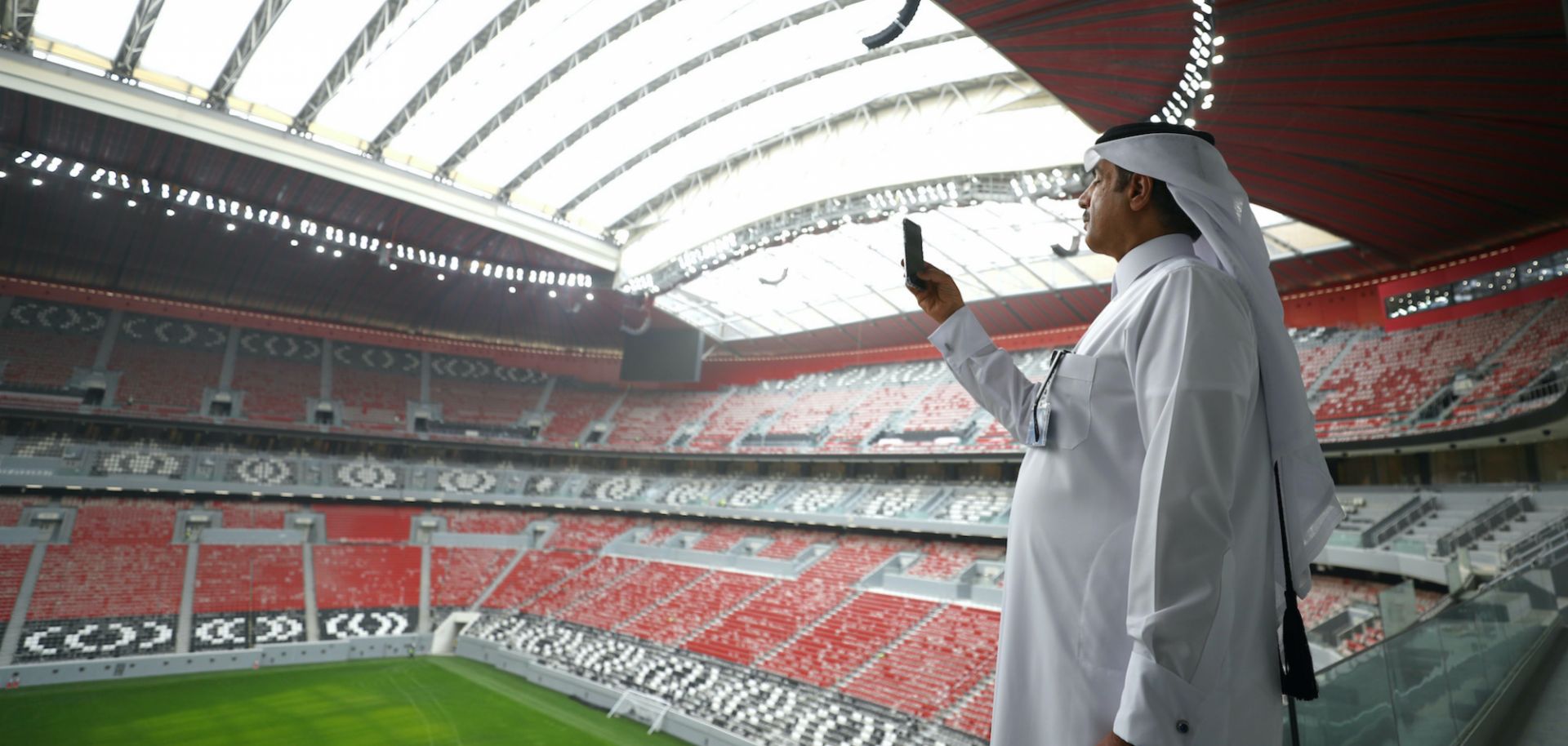
A man tours one of the soccer stadiums that will be used in the 2022 World Cup in Doha, Qatar.
As it grapples with the long-term impact of COVID-19, Qatar will have to decide whether it’s willing to make a dent in its economic allure by hosting a more subdued World Cup in November 2022. The long-awaited global soccer tournament is meant to be Doha’s big moment to shine by enabling the Arab Gulf country — which will be the first to host an international event on this scale — to show off its governance skills, modern infrastructure and tolerant national culture in a high-beam advertisement of the emirate’s economic potential.
The games have been plagued by numerous complications over the years, including accusations of corruption during the bidding process, allegations of the abuse of workers during the building of the infrastructure, and even worries that tourists might not be able to drink alcohol at events, as well as the 2017-21 Saudi-Emirati blockade that closed off many regional air, land and sea routes to Doha. But while most of those issues are in the past, Doha now must contend with the knowledge that even by late 2022, the pre-pandemic world it had built the games for probably won’t be back in full.
What’s at Stake
Qatar has invested considerable economic and political capital into the tournament. Bloomberg Intelligence estimates the country will spend around $300 billion total on stadiums, a new metro system and associated tourist infrastructure — nearly twice its 2019 GDP of $175.8 billion. For that investment to be worth it, Qatar needs the World Cup infrastructure to do more than just be a one-off money-maker: it needs it to become the bones of a major sporting hub and tourist destination.
Hosting the games, however, is also a bid fraught with risks. South Africa held the World Cup in 2010 for similar economic reasons, and was even lauded for its performance as host. But the tournament, once over, left behind underused stadiums and did not overcome that country’s economic weaknesses in the way South Africa was looking for. Though Qatar’s economy is stronger than South Africa’s was in 2010, the risk that hosting the World Cup gives only a temporary boost — and that the infrastructure goes underused once the games are over — has always lurked behind Doha’s hosting.
And since winning the hosting rights in 2010, Qatar’s urgency of being seen as best and brightest in the region has only grown. As the post-oil world looms closer, neighboring Saudi Arabia and the United Arab Emirates are often in economic competition for the very tourists, investors, and companies Doha hopes will be part of its future economy. A well-run World Cup could give Qatar’s business reputation a positive boost that will attract visitors, anchor investment deals and business transactions for years to come.
Trying to Shine in the Rain
Doha is struggling to find a solution to the latest challenge to the tournament, COVID-19, which will probably still be circulating around the world by late 2022. Japan has already showcased some of the problems of hosting a major sporting event in the midst of a pandemic: first it delayed the Tokyo Summer Olympics, and now it’s due to have a more subdued event in July 2021. Qatar faces a similar choice. Should Doha too tone down the games at the risk of losing the luster of its big publicity party?
At the moment, Qatar is preparing to host the games as normally as possible, with plans to screen visitors through testing and even preparing to offer up to one million vaccines for new arrivals. Such an approach would allow Doha to claim it’s doing all it can to prevent the spread of the virus while still hosting hundreds of thousands of global visitors. But despite Qatar’s seemingly unlimited budget for COVID-19 safety, it’s likely some infections will slip through and could be linked to outbreaks during or after the World Cup. Testing may not catch all infections and vaccines will take weeks to become effective — assuming Qatar purchases the more effective shots available and that new, more vaccine-resistant variants don’t emerge between now and late 2022.
Those health risks, however, might not bother Doha. Nearby Dubai, after all, is plowing ahead with Expo 2020 in October 2021 with few restrictions after the event was delayed by a year due to the pandemic. And Dubai, like Qatar, is an absolute monarchy with control of local media (and thus the domestic pandemic narrative) and has most of its small native (i.e. non-expatriate) population already vaccinated. Unlike Dubai’s Expo experience, however, Qatar has been dogged from almost the day it won the games with allegations that it wasn’t suited to host, which could be reinforced by a COVID-19 outbreak. The open Emirati economy has also come with the cost of sustaining a high level of COVID-19 infections, prompting countries like the United Kingdom, the United States and Israel have warned their citizens against traveling to the United Arab Emirates. Qatar too could face both legal restrictions from countries pursuing strict COVID-19 strategies and informal boycotts by visitors who don’t want to risk getting sick during the World Cup. Clearly, to pretend nothing is amiss at home still risks international backlash abroad.
But if Qatar does scale up COVID-19 controls and have more muted games, images of half-empty stadiums and vacant hotels risk making it look like a barren and dull desert country on televisions broadcast around the world, instead of a futuristic economic hub. There would also be fewer visitors to return to their home countries to tell positive stories of Qatar’s brand, undermining its tourism gains against well-entrenched Dubai. And though investors and businesses may be reassured of Qatar’s healthcare protocols, a quieter World Cup may deter investments for fear that the lackluster event reflects fundamental weaknesses in the Qatari economy.
The Aftermath
Regardless of what Qatar does to mitigate COVID-19 during the World Cup itself, it’ll also have to contend with the pandemic’s lingering effects well after. Few expect vaccines to ever fully eradicate the virus, and countries will likely go through phases in which restrictions return in the face of new flare-ups. That will undermine Qatar’s strategy to transform its World Cup infrastructure into a linchpin of its tourism and sports sectors as it becomes less certain that those stadiums will be used at full capacity for future sporting events, at least in the short term. Its many new glittering hotels might have to wait a while longer to fill up as global tourism remains depressed, with U.N. estimates not expecting global tourism to return to pre-pandemic levels until 2024. For Qatar, the years following the World Cup thus may end up just being a continuation of Qatar’s economic stagnation, instead of the hoped-for boon of non-hydrocarbon growth and investment — forcing Doha to find another way to prepare its oil-dependent economy for the future.
