
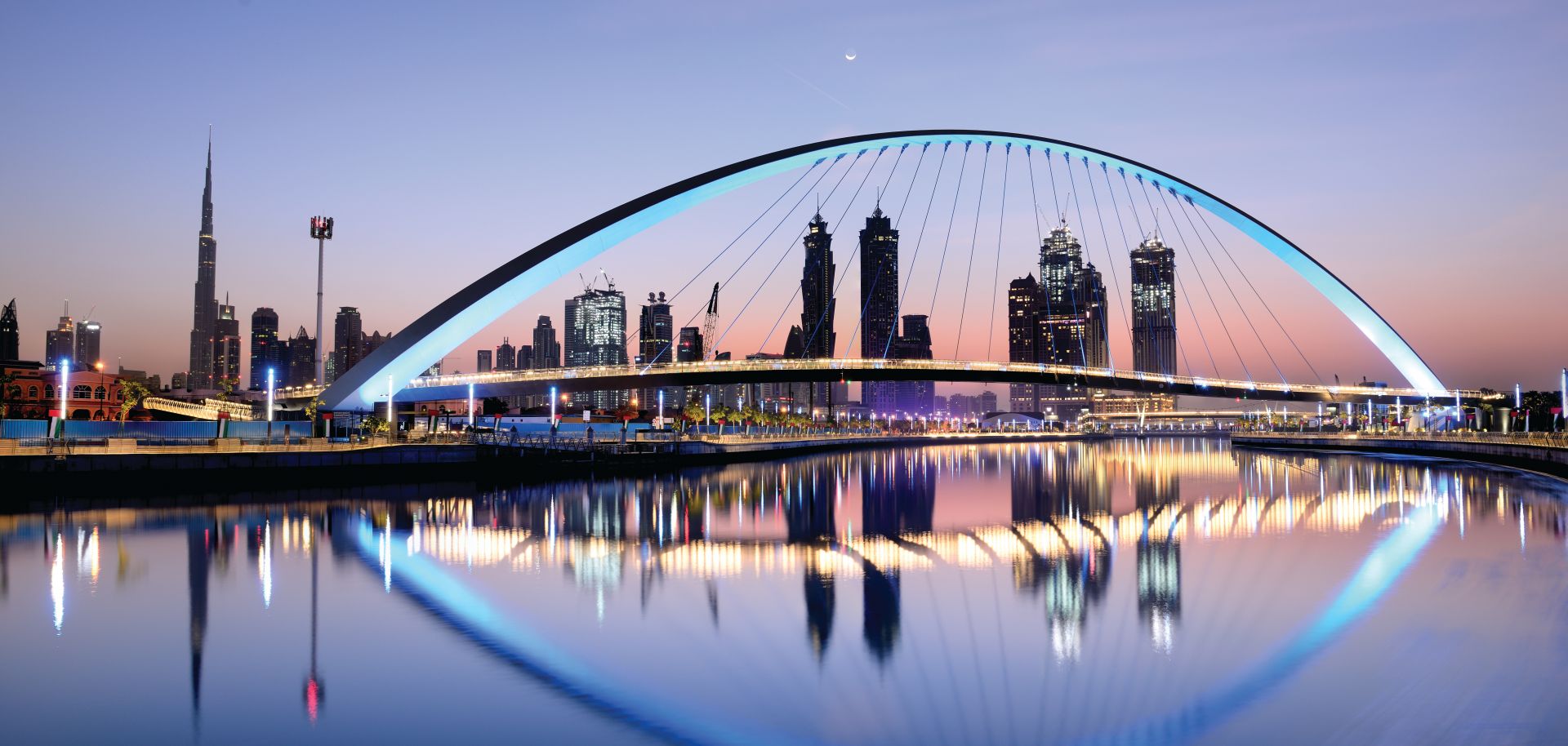
A view of Dubai, the most populous city in the United Arab Emirates, at sunrise.
By sapping Dubai's economic growth, the COVID-19 pandemic will also ultimately erode the emirate's political and economic independence from neighboring Abu Dhabi. Without the tools and funding needed to support its own recovery, Dubai will likely be forced to rely on another bailout from wealthy Abu Dhabi, which could impact Dubai's development plans, especially in tourism and finance.
Dubai’s COVID-19 Crisis
The COVID-19 pandemic is jeopardizing growth in the key sectors that have fueled Dubai's economy over the past decade, including real estate, construction, tourism and financial services. Services that rely on robust consumption are also in decline, including restaurants, bars, gyms and movie theaters. According to the Dubai Chamber of Commerce, up to 70 percent of these businesses expect they'll be closed by fall 2020.
- Dubai's real estate market, already oversupplied and in decline before the pandemic, is experiencing a rapid rental and value drop driven by a combination of expatriates leaving the country and investors avoiding new purchases. According to a recent Chestertons report, Dubai rents dropped by almost 15 percent in the second quarter of 2020.
- Construction volumes have declined and mass layoffs have taken place as the emirate's major developers slow, halt or cancel projects.
- Dubai's tourism sector remains in freefall, with fewer tourists able to visit the United Arab Emirates even with the country's borders reopened. The CEO of the Dubai-based airline Emirates said it might take up to 18 months before the sector returns to normalcy. Dubai's ambitious Expo 2020, which was expected to attract 25 million attendees from around the world, has also been moved to 2021 due to the COVID-19 pandemic.
- Dubai's financial services sector is sliding as well. Emirates National Bank of Dubai, the emirate's largest bank, saw a 45 percent profit decline in the first half of 2020, in part driven by the building up of reserves in anticipation of numerous bad loans defaulting throughout the pandemic.
Without strong financial reserves to pad the economic blow, Dubai will likely have to accept help from Abu Dhabi. To stabilize the country's macroeconomic situation, Abu Dhabi will feel compelled to intervene — and it's well-positioned to do so, with larger sovereign wealth funds in the Abu Dhabi Investment Authority ($696 billion) and Mubadala Investment Company ($228 billion), as well as control of the United Arab Emirates' sizeable oil reserves.
- Dubai's sovereign wealth fund, the Investment Corporation of Dubai, had $239 billion in assets before the pandemic. But many of these assets are in Dubai itself, which are now rapidly declining in value.
- Dubai's wealth fund is not positioned to cover its pre-pandemic, government-related debt bill of $88.9 billion, which could spark another financial crisis. The fund is also not robust enough to simultaneously stimulate the emirate's declining economy while ensuring it can also still serve as a social safety net for Dubai's 254,000 native Emiratis for the foreseeable future.
The Terms of Abu Dhabi’s Aid
In exchange for its financial support, Abu Dhabi will likely demand Dubai further cede political power to the capital emirate.
- Abu Dhabi gave Dubai a $10 billion bailout during the 2009 financial crisis, which Dubai has yet to fully repay. This 2009 bailout included political concessions, such as the renaming of the Burj Dubai skyscraper to the Burj Khalifa and greater support from Dubai against policy pushback from the poorer, five northern emirates.
- Dubai's current pandemic-induced economic crisis may be even worse than its 2009 crisis, and thus require a more expensive bailout from Abu Dhabi with potentially more strings attached.
The political concessions tied to a COVID-19 bailout would likely force Dubai's alignment with Abu Dhabi on matters of succession and internal challenges from the northern emirates, as well as foreign affairs.
- Abu Dhabi will ensure Dubai increasingly serves as an internal check on the challenges from the five other northern emirates, who sometimes object to Abu Dhabi's control of the country's direction. During the Arab Spring, Abu Dhabi sent security forces into the northern emirate of Ras Al Khaimah to detain activists and arrest at least one royal family member suspected of revolutionary activities. Dissent from the five northern emirates remains, even within royal families, and the acquiescence of Dubai's ruling Al Maktoum family in Abu Dhabi's security operations against these forces is important to maintaining political stability in the country.
- More broadly, Dubai will be expected to maintain and even strengthen its support for the Emirati government's sanctions on Iran, blockade against Qatar, and potentially its regional strategies against the Muslim Brotherhood and Islamic extremism. Dubai's alignment with Abu Dhabi will, in turn, serve as a political bulwark against the country's other northern emirates, in particular Ras Al Khaimah, whose ruling family is more open to building ties with Iran and Qatar.
Dubai’s Future Under Abu Dhabi
Granting Abu Dhabi a greater say in internal economic and political affairs could ultimately constrain Dubai's overall ability to grow at its own pace. Dubai may be forced to accept a smaller, more streamlined economy that reduces the risk of future Abu Dhabi bailouts and mitigates the impact of the maturing government-related debt in the coming years. This would undercut Dubai's independent economic strategy, leaving developments and projects driven by the Dubai government's own long-term ambitions for a robust tourist sector, vibrant real estate market and strong financial services in limbo.
- Some projects in Dubai, such as Al Maktoum Airport, could remain paused for the medium term, while other projects that were due to begin soon, such as the Dubai Creek Harbour, will likely stay frozen and could eventually be abandoned.
- Abu Dhabi's intervention could also weaken Dubai's ability to jumpstart its economy and development through megaprojects and ambitious events like Expo 2020. As a result, the United Arab Emirates' center of gravity for large-scale developments might eventually shift over to Abu Dhabi instead.
Abu Dhabi is also unlikely to position Dubai's economy for the robust growth needed to bring back many of the expatriate workers who have left the country amid the current COVID-19 crisis. This could leave Dubai with a reduced population and a small consumer base, further hampering its economic recovery.
- Up to 200,000 workers — mostly from India, Pakistan, the Philippines and Nepal — have already left the United Arab Emirates amid the country's COVID-19 crisis, according to a recent Reuters report.
- By altering its demographic balance between varying nationalities, the ongoing loss of expatriate workers could shift Dubai's social class structure away from its pre-pandemic hierarchy that favored abundant and cheap expatriate labor, to one where its native Emirati population plays a more central role in the economy.
