
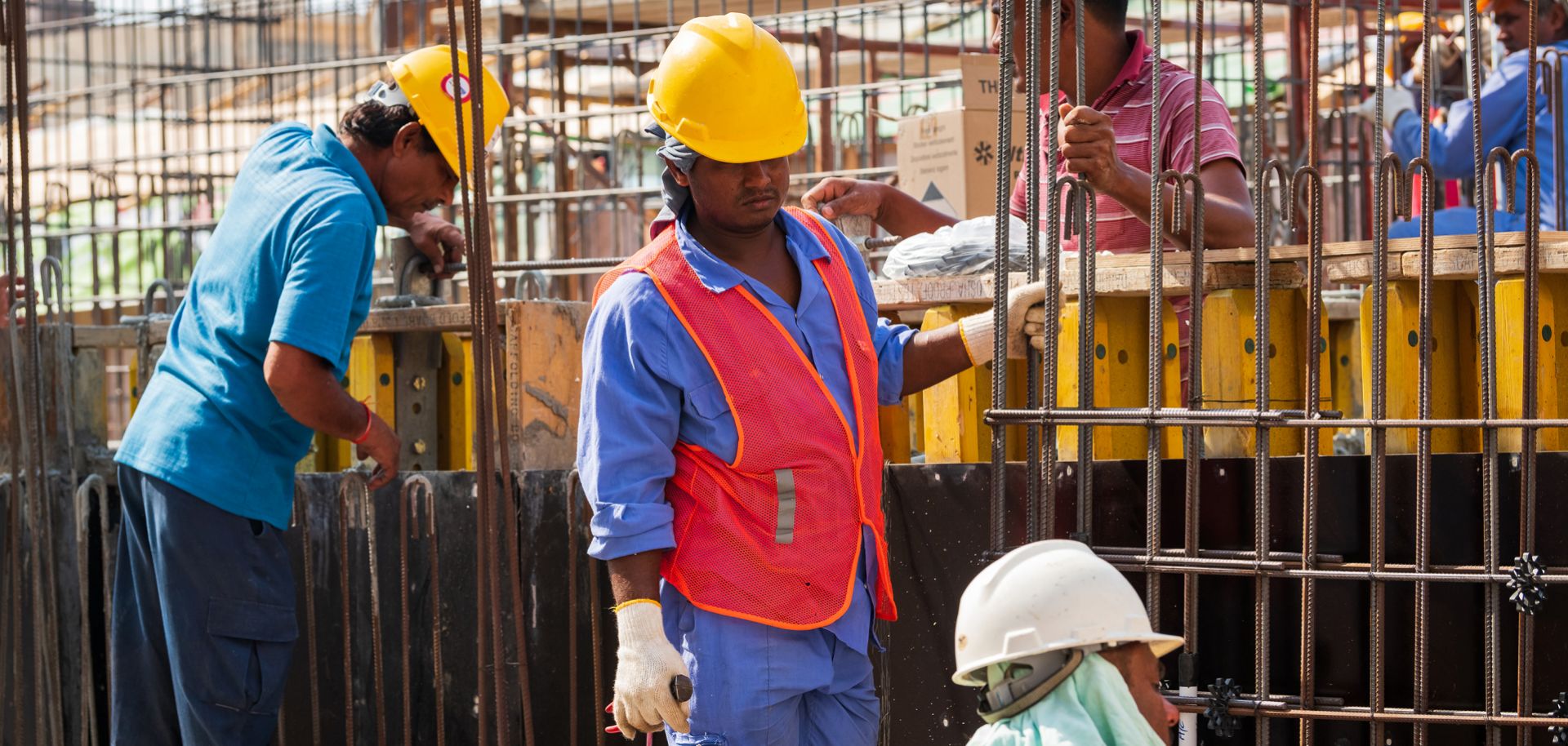
Laborers wearing hard hats work at building construction site in Manama, Bahrain, on May 18, 2020.
By reducing demand for foreign labor, the global economic fallout from COVID-19 will, over time, fundamentally alter the demographic makeup of Gulf Cooperation Council (GCC) states, which are famously home to a huge number of expatriates. Even as it helps facilitate workforce nationalization efforts across the region, the sharp loss of foreign labor and intellectual capital will eventually impede the ability of GCC governments to grow and diversify their energy-dependent economies, lengthening the timeframe for painful but necessary economic reform programs. Meanwhile, the remittance-dependent nations welcoming citizens back from the Arab Gulf, such as Egypt, will be left with even less foreign currency to manage their own mounting financial crises at home.
The pandemic-induced global recession and low energy prices will reduce the need for expatriate labor forces in the Arab Gulf, resulting in redundancies and layoffs that might not be quickly replaced.
- While it will hit energy and service industries especially hard, the economic blow from COVID-19 will leave no corner of GCC economies untouched. The International Monetary Fund expects Arab Gulf economies to shrink by 4.2 percent in 2020, driven by the slowdown in energy demand, tourism and business travel.
- Dimming employment opportunities in GCC states have already prompted expatriates to head home in large numbers. As of May, roughly 200,000 of the 3.4 million Indians living in the United Arab Emirates — the country's largest expatriate population — had registered to go home to India, with a quarter citing job loss as the reason.
- Government programs to preserve salaries in private sector jobs are prioritizing support for GCC nationals, and not extending the same guarantees to expatriates. Saudi Arabia, for example, is helping guarantee 60 percent of salaries for Saudi employees of private companies for three months. But Riyadh has signaled no plans to offer such support to the millions of foreign workers employed by those same companies.
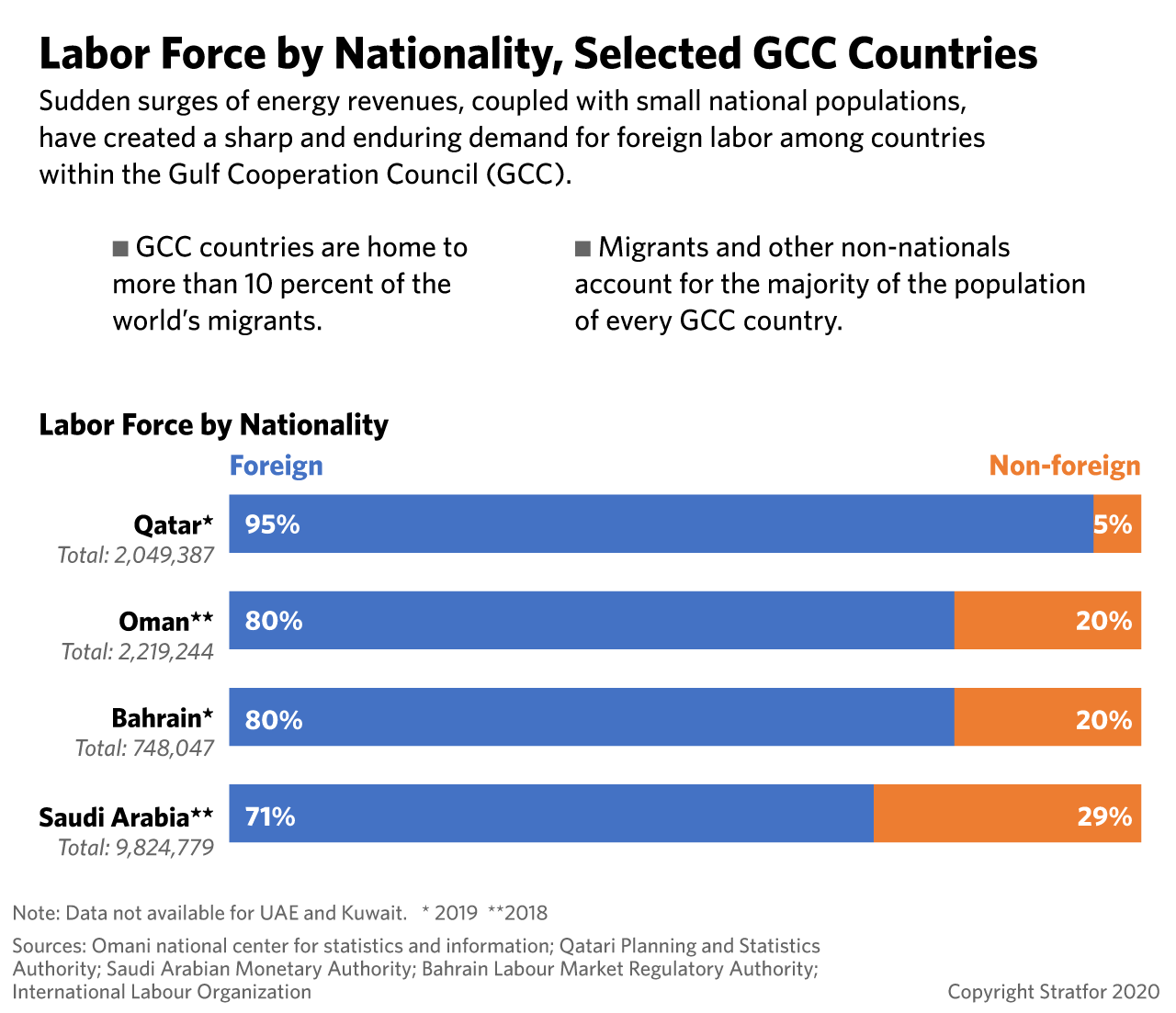
The added economic and social instability due to COVID-19 will accelerate some Arab Gulf states' efforts to nationalize their workforces by supplementing training programs for native residents.
- Kuwait, in particular, will take advantage of the sudden departure of many expatriates to fuel its aggressive plans to reduce the foreign workforce and provide more jobs for nationals. The Kuwaiti government recently discussed goals of ridding the workforce of all expatriates within five years, taking advantage of the current situation to re-introduce a plan that had previously been on the backburner.
- On April 29, Oman's finance ministry issued a directive requesting that state-owned companies replace expatriates with Omani national employees.
- In early April, Saudi Arabia allotted more money to the Saudi Human Resources Development Fund to help train 80,000 Saudi nationals — which constitute 3 percent of the country's workforce — for employment in the private sector. The effort is also intended to help reduce the country's unemployment rate from 12 percent to 10.5 percent by 2022, which is a stated goal of Riyadh's Vision 2030 reform plan.
The sudden loss of expatriate workers will slow the speed at which GCC economies can recover from the COVID-19 crisis, as well as extend the timeline for achieving diversification and other economic reform goals.
- Expatriates comprise most of the population of the GCC states, and thus a major part of their economies and labor force. The loss of so many residents all at once will thus contribute to a sudden loss in domestic consumption, further straining economic growth.
- Losing expatriates will also drain GCC economies of workers with high-quality labor skills that their domestic education and training systems do not yet provide, directly hindering their ability to diversify their economies away from energy.
- To mitigate the loss of labor and intellectual capital, Saudi Arabia, the United Arab Emirates and Qatar have all recently offered some leniency in terms of visa and migration regulations designed to help expatriate workers find other employment.
- Private companies in GCC states will also likely be more willing to accept previously unpopular workplace practices and policies, such as remote work and long-distance employment, which will enable some expatriates to maintain employment even if they don't live in the country.
If the GCC states welcome fewer expatriates over the long term, it will contribute to a reorganization of foreign migrant flows from countries where remittances provide a crucial source of revenue.
- Some of the largest expatriate populations in Arab Gulf states are from nations whose economies heavily depend on money sent home by their citizens working abroad, including Egypt and Lebanon.
- As more workers come home, the loss of remittances will exacerbate the economic fallout from COVID-19 in these already financially fragile countries.
