
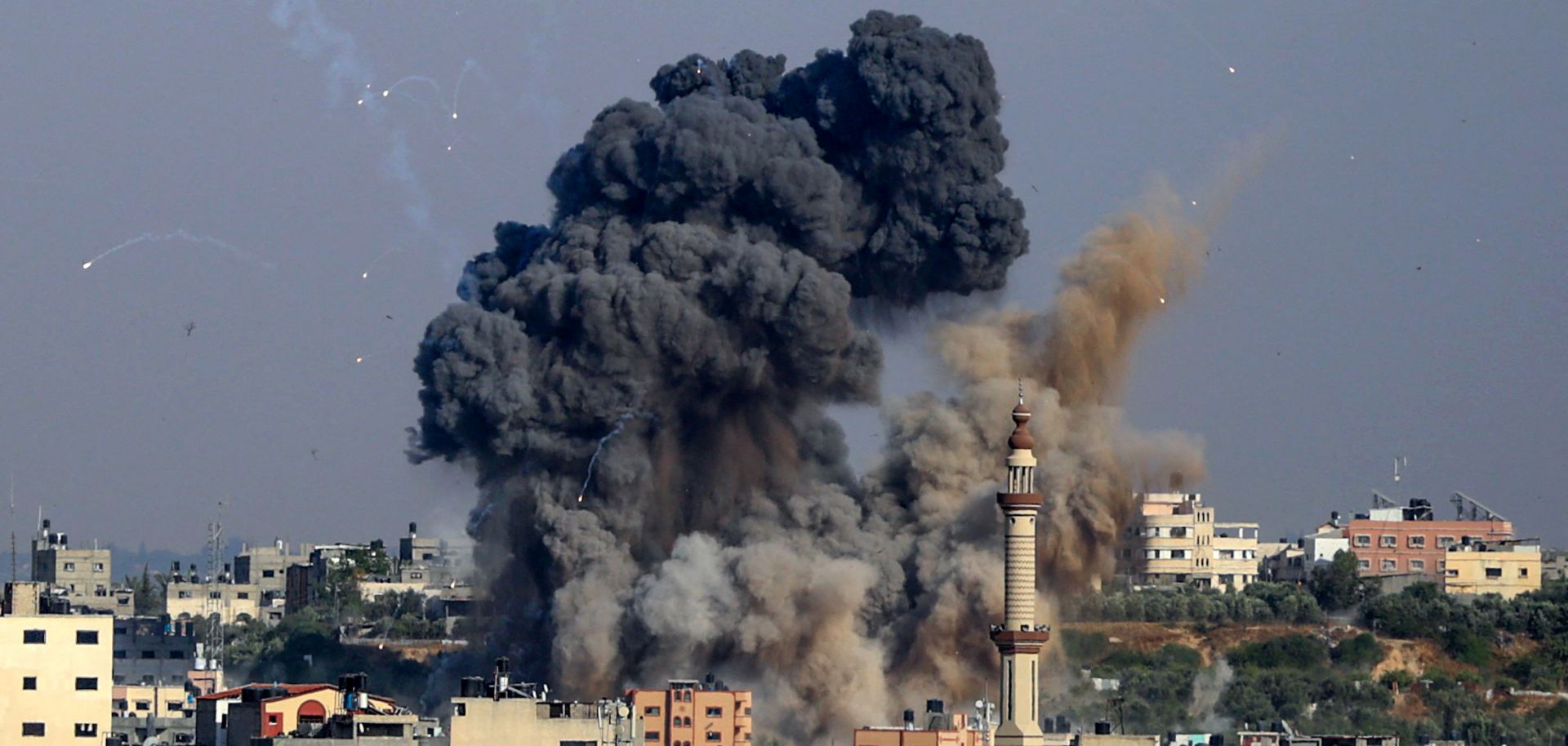
Smoke billows from Israeli airstrikes in Hamas-controlled Gaza City on May 11, 2021.
Grassroots pressure on the Israeli and Palestinian governments portend a prolonged border conflict that places more lives at risk and forestalls Arab-Israeli normalization. Militant groups in Gaza launched over 400 rockets at southern Israeli territory since May 10, killing two Israelis and wounding at least 24 more. In response, the Israeli Defense Forces (IDF) struck more than 130 targets in the Gaza Strip, killing 26 Palestinians, including 9 children. Political paralysis and deepened popular frustration on all sides of the conflict will make it harder for the Israeli and Palestinian governments to satisfy their angry constituents and reach an eventual resolution.
Popular anger among Palestinians and Israelis over contested neighborhoods in Jerusalem drove Gazan militants and the Israeli military to exchange fire over Gaza. Forced evictions of Palestinian families from the Sheikh Jarrah neighborhood of East Jerusalem have sparked Palestinian anger across the territories. Israeli nationalists have also been provoking Palestinians in contested areas in Jerusalem, resulting in clashes in places like the Damascus Gate. Recent rocket volleys from the Gaza Strip landing in central Israeli territory, meanwhile, crossed a red line for many Israelis as well, as most violence in the region is usually concentrated along the southern border. Reports of rockets striking targets in Tel Aviv on May 11 indicate a significant expansion of the conflict from its typical tit-for-tat escalation in southern Israeli and Gazan territory.
- The Palestinian Islamic Jihad movement specifically cited the situation at the Temple Mount and Aqsa Mosque in Jerusalem as the reason for its rocket launches. The group also claimed responsibility for the May 11 barrage of attacks on Tel Aviv. A lesser-known Palestinian militant group, Jaysh al-Umma, claimed some of the May 10 rocket launches as well, citing its need to respond to the situation in Jerusalem.
- Amid the surge of attacks, Israeli authorities closed Ben Gurion international airport on May 11.
Both governments will be unable to reach a political resolution without further deadly violence. The Israeli and Palestinian governments have tried and will continue to try to contain the current situation from spiraling, but there are so many triggers to unrest that more bloodshed appears inevitable. The Israeli government changed course several times in recent days to avoid sparking Palestinian anger that could escalate into violence, including by changing the path of a nationalist Israeli parade in Jerusalem on May 10 to avoid altercations along the route. For its part, Hamas officials have expressed interest in a cease-fire. But internal political constraints will likely prevent diplomatic solutions, as casualties in Gaza and Israel’s deliberate targeting of civilian residential buildings will leave Palestinian leaders little choice but to retaliate.
- Israeli politics has increasingly leaned toward the right, driven by growing public support for settlements and a more hard-line approach to Palestinian political and militant groups.
- Palestinian politics are paralyzed, as indicated by the recent indefinite postponement of the territories’ long-overdue legislative and presidential elections. The cold war between the two dominant Palestinian parties, Fatah and Hamas, provides the latter with some motivation to strike Israel and politically claim legitimacy as the only major party acting against Israel.
Events on the ground will thus ultimately decipher whether the situation escalates or de-escalates. More Israeli deployments to the Gaza-Israel border or reservist call-ups would be one of the most obvious signs of escalation, as it would indicate readiness to deploy in a ground invasion if necessary, which would be highly controversial and economically disruptive. Other developments that would indicate an escalation include daily rocket barrages from Gazan territory; continued expansion of attacks from the southern Israeli border; additional civilian casualties on either side; and/or new Israeli assassinations of Palestinian leaders. On the contrary, signs that would indicate a de-escalation include Palestinian or Israeli statements indicating openness to a cease-fire; Egypt or other Arab states expressing intent to mediate a cease-fire; and/or a drawdown of Israeli troops on the border.
More broadly, a continued barrage of attacks could also slow Israel’s normalization push by once again making Palestinian statehood a top-of-mind issue among Arab Gulf populations. The current situation in Jerusalem and Gaza is headline news across the Arab world and the Middle East, possibly indicating a temporary resurgence in the relevance of the Palestinian issue among Arabs and Muslims. Arab states have all publicly condemned the ongoing violence, even those with pragmatic relationships with Israel like Saudi Arabia. Public opinion in support of the Palestinians, relatedly, is also extremely high across the global Muslim community. Even if this surge is temporary, it is a form of grassroots pressure that will influence how those external actors react to and thus shape the conflict. The United Arab Emirates and Bahrain, who both signed normalization deals with Israel last year, will particularly struggle to thread the needle between maintaining their burgeoning ties with Israel and supporting the Palestinian cause they allege to protect.
- Kuwait had to issue and reissue a statement on the Gaza violence in response to strong pro-Palestinian public opinion.
- Saudi Arabia, meanwhile, issued its most strongly worded statement in support of the Palestinians in years.
