
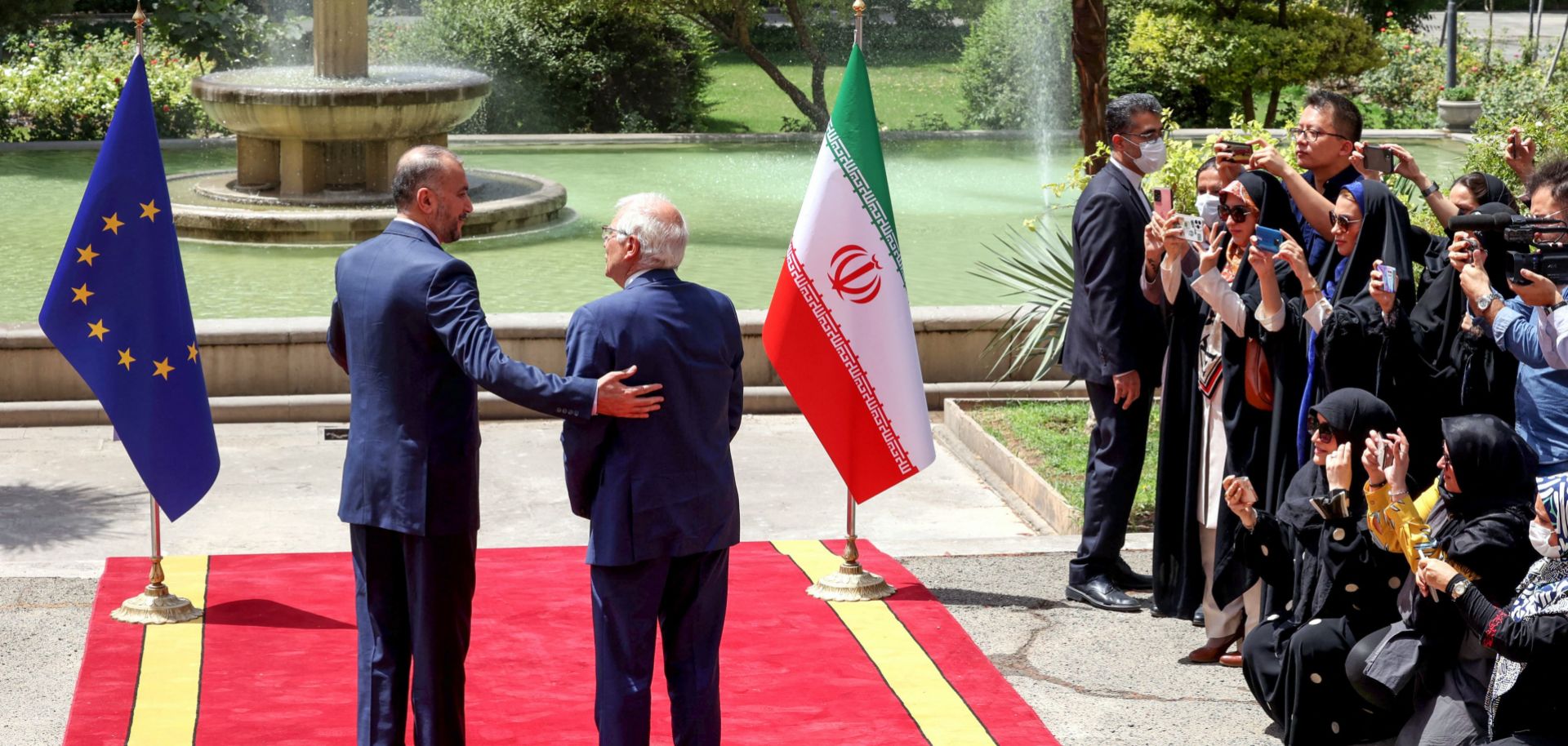
Iranian Foreign Minister Hossein Amirabdollahian (left) welcomes EU foreign policy chief Josep Borell in Tehran on June 25, 2022.
The resumption of Iran nuclear talks will help ease growing concerns about a regional conflict by signaling a potential path forward on a deal. But negotiators are unlikely to quickly resolve the sticking points that halted talks in March, which will continue to impede progress. On June 25, European and Iranian officials said that negotiations aimed at restoring the fraught 2015 nuclear deal, formally known as the Joint Comprehensive Plan of Action (JCPOA), would resume in the “coming days” after a three-month hiatus. Iran’s foreign ministry has since confirmed that talks would take place in Qatar’s capital of Doha beginning on June 28. The news follows EU foreign policy chief Josep Borrell’s recent trip to Iran, where he — standing alongside Iranian foreign minister Hossein Amirabdollahian — said reaching a nuclear agreement with Tehran was “more important than ever.”
- The eighth round of Iran nuclear talks halted on March 11 over Ukraine-related tensions between Russia and Western negotiators.
- An unnamed source cited in a recent Reuters report said U.S. Special Envoy for Iran, Robert Malley, was arriving in the Qatari capital of Doha on June 27 to meet with Qatar’s foreign minister. An Iranian official cited in the same Reuters report said Iran’s lead nuclear negotiator Ali Bagheri-Kani is also scheduled to travel to Doha for talks on June 28 and June 29.
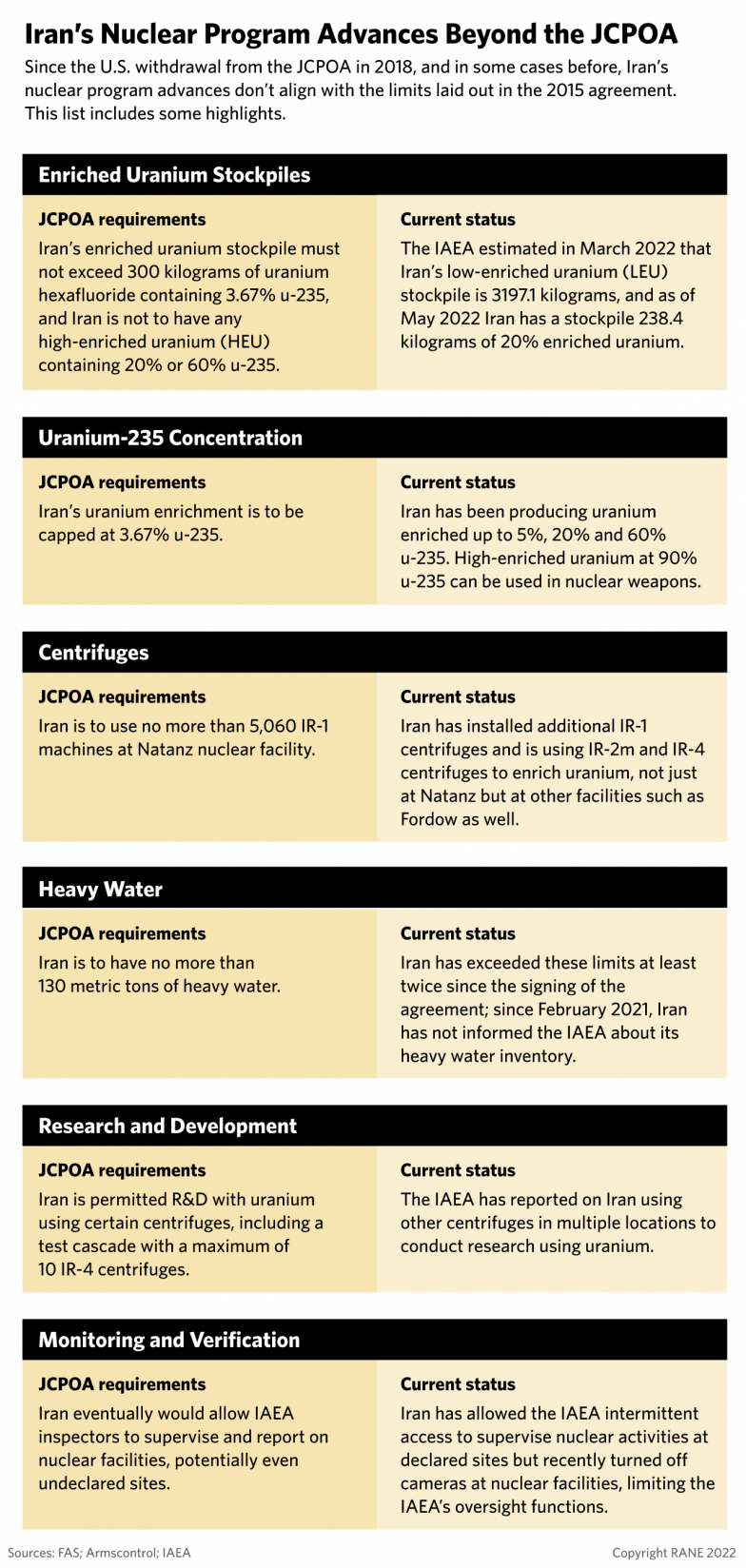
The issues that previously plagued negotiations — namely, Iran’s increasing nuclear activity and list of demands for resuming compliance with the JCPOA — remain unresolved and could thus again stall talks. After making progress in January and February, negotiators in Vienna were reportedly close to finalizing an agreement that would see Iran scale back the development of its nuclear program in exchange for the United States lifting sanctions on the Middle Eastern country's oil industry. But U.S. and Iranian negotiators continued to spar over Tehran’s demands that Washington lift sanctions beyond those imposed under the JCPOA, remove Iran’s Islamic Revolutionary Guard Corps (IRGC) from the U.S. list of designated foreign terrorist organizations, and somehow ensure future U.S. administrations can’t pull out of the deal. Iran has not signaled any intent to weaken its demands, portending continued gridlock between Washington and Tehran over these issues. Iran’s move to steadily advance its nuclear development over the past three months, while simultaneously restricting the United Nations’ ability to monitor that activity, also risks impeding progress in future talks by fueling diplomatic tensions and sowing more distrust over Tehran’s commitment to the enrichment, verification and monitoring terms in the JCPOA. In addition, Iran’s accelerating nuclear advancement also risks nullifying all the progress negotiators have made so far, as the closer Iran gets to having weapons-grade material for one nuclear device, the less effective the current deal will be in curbing Iran’s nuclear activity.
- During the past three-month pause in JCPOA talks, Iran has continued to increase its stockpiles of enriched uranium, and to enrich to levels close to the roughly 90% considered weapons-grade (which is well beyond the 3.67% allowed in the JCPOA agreement). This — combined with Iran’s recent move to disconnect more than two dozen U.N. cameras monitoring its nuclear activity and failure to explain uranium traces discovered at undeclared sites in the country — has prompted repeated warnings from the United Nations’ nuclear watchdog, the International Atomic Energy Agency (IAEA).
- European powers have also increasingly voiced their concerns about Iran’s advancing nuclear program. The three European countries that signed the JCPOA in 2015 — the United Kingdom, France and Germany — issued a joint statement on June 10 that urged Iran to “cease its nuclear escalation,” and “urgently conclude the deal currently on the table,” referring to the agreement that negotiators in Vienna were reportedly close to finalizing before talks were suspended in March.
The talks will also help ease regional tensions, even if they don’t ultimately lead to a nuclear deal. There’s a chance Iran has no intent to weaken its key demands and is only re-engaging in negotiations as a way to string along the diplomatic process. But Iran’s willingness to come to the table nonetheless indicates a desire to see what is possible. It also suggests Tehran’s growing imperative to secure sanctions relief as the Ukraine-induced global slowdown cuts deeper into the Iranian economy. The United States and its Western allies, for their part, will see the resumption of the talks as an opportunity to freeze dangerous Iranian nuclear advancement. As Iran’s negotiating team explores its options, Tehran is likely to avoid the most aggressive maritime, missile and/or covert actions that could disrupt the West’s willingness to cooperate — helping contribute to some regional stability.
- Iran’s increasingly fragile economic situation will further compel Tehran to secure sanctions relief. But the removal of U.S. sanctions would also remove a key scapegoat to place the blame for the country’s economic malaise. This will motivate Iran to remain engaged in JCPOA talks, while also deterring Tehran from accepting a deal that doesn’t cover its key demands, which could ultimately prolong the duration of negotiations.
- Regional actors also appear to support a return to the JCPOA, which will contribute to the possibility of talks resuming. Over the weekend, Israeli military intelligence said it now supports a return to the 2015 JCPOA, citing the potential to ease Iranian nuclear proliferation. Other regional powers like Saudi Arabia and the United Arab Emirates have also engaged in security-focused talks with the Iranian government in recent months; recent reports indicate that Riyadh and Tehran are considering reopening their respective diplomatic offices. Finally, the talks being held in Doha further underscores the Arab Gulf states’ desire to see a deal reached that could improve regional cooperation and security.
