
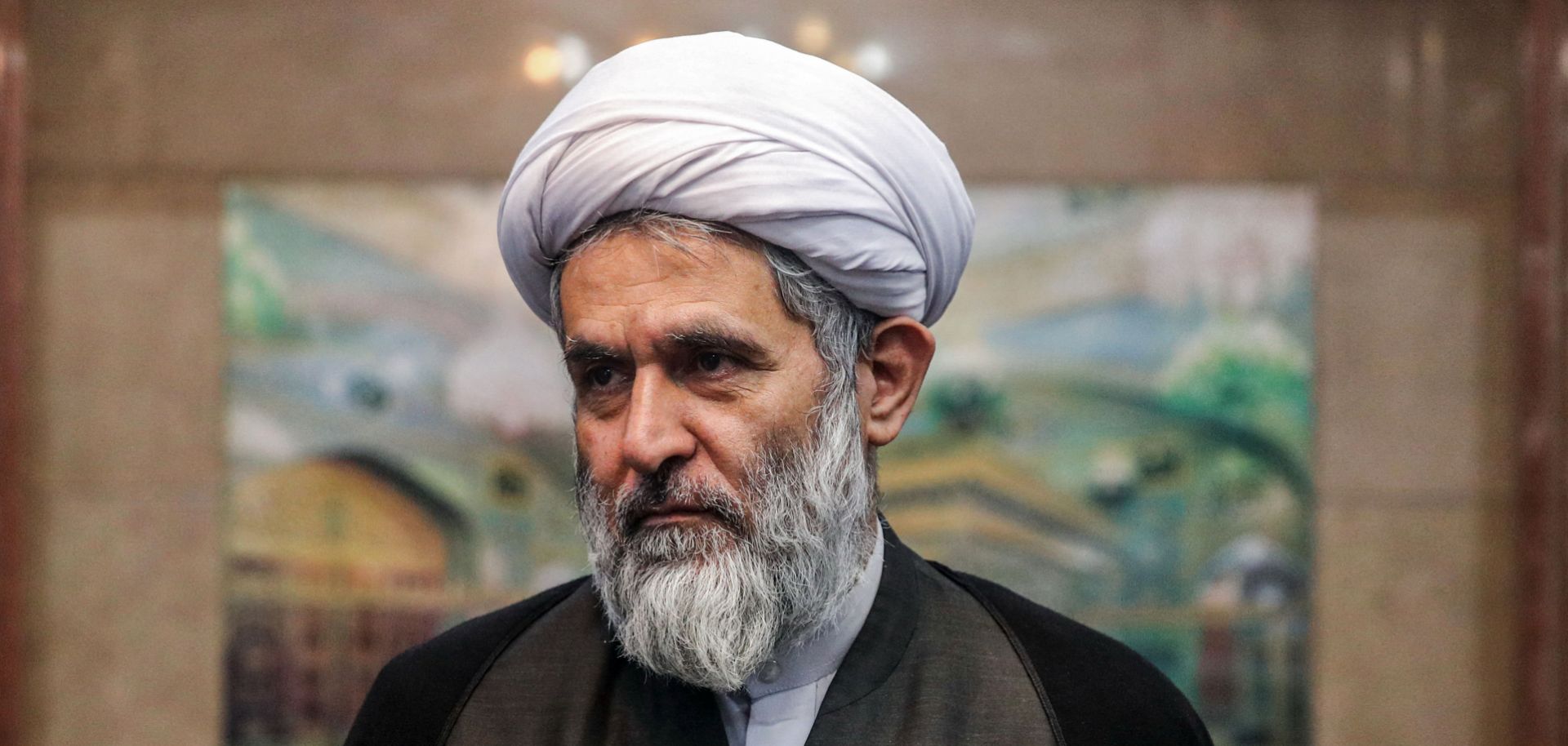
Hossein Taeb, the former head of the intelligence apparatus of Iran’s Islamic Revolutionary Guard Corps (IRGC), looks on during a meeting in Tehran, Iran, in 2018.
The dismissal of a top intelligence official indicates Iran’s desire to reduce tensions with Turkey, as well as improve its Islamic Revolutionary Guard Corps (IRGC)’s domestic influence and foreign capabilities ahead of a possible collapse of nuclear negotiations with the United States. Iranian state TV announced on June 23 that Hossein Taeb was removed as the head of the IRGC’s Intelligence Organization (IRGC-IO) and had been replaced by Mohammed Kazemi, who was previously in charge of the IRGC’s Intelligence Protection Organization. Taeb’s dismissal came on the same day Turkish officials reportedly arrested eight people (at least five of whom were Iranians) who were allegedly working for an Iranian intelligence cell that had been planning to abduct Israelis in Istanbul.
- Isreal and Iran’s shadow war has escalated significantly in recent weeks, beginning with the May 22 assassination of an IRGC Quds Force commander in Tehran that Iran has blamed on Israel. On May 30, Israel warned its citizens from traveling to Turkey over possible plots by Iran to respond to the assassination. Then on June 13, Israel raised its travel warning to Istanbul to the highest level over an alleged plot by Iran to kidnap Israelis visiting the Turkish metropolis.
- The reported arrests and Taeb’s removal also came as Israeli Foreign Minister Yair Lapid visited Ankara on June 23 to meet with Turkish Foreign Minister Mevlut Cavusoglu. After the meeting, Cavusoglu said that Turkey would not allow its country to be used to launch attacks against Israel and that messages had been sent accordingly.
By dismissing the IRGC’s longstanding intelligence chief, Iran appears to be trying to defuse tensions with Ankara, which have increased in recent years amid the discovery of several IRGC operations in Turkey. But this effort will find limited success due to shifting relations in the region. The IRGC’s Quds Force is responsible for extraterritorial operations, with the aid of Taeb’s Intelligence Organization. Over the past year, the Quds Force has allegedly tried to carry out multiple operations targeting Israeli citizens and Iranian dissidents in Turkey, which Ankara has viewed as a gross violation of its sovereignty. Iran’s actions in Turkey have also coincided with Ankara’s growing ties with Tehran’s top two regional rivals, Israel and Saudi Arabia. Closer relations between Israel, Saudi Arabia and Turkey risk effectively encircling Iran with adversaries that are increasingly in cooperation. All three countries are also U.S. allies or partners, which may become especially problematic for Iran in the next few months if stalled talks to restore the 2015 Joint Comprehensive Plan of Action (JCPOA) finally collapse and trigger a wider nuclear crisis between Tehran and Washington. Given these risks, Iran is probably hoping to lower tensions with Ankara by removing one of the leaders behind IRGC’s controversial operations in Turkey. But while the gesture could help maintain a pragmatic relationship between Iran and Turkey, Ankara is unlikely to scale back its outreach to Israel and Saudi Arabia, which Turkish President Recep Tayyip Erdogan is hoping will boost his ruling party’s 2023 electoral prospects by injecting Turkey’s beleaguered economy with new Arab Gulf and Israeli investment.
- In September, Turkey arrested an Iranian national and seven Turks over an alleged plot to kidnap an ex-Iranian military official who had fled to Turkey. In February, eight people were arrested in Turkey over an alleged Iranian plot to kill an Israeli-Turkish businessman living in Istanbul. In 2019, Iranian operatives also killed Masoud Molavi, an Iranian scientist who fled to Istanbul.
- Lapid’s trip to Turkey is the diplomatic follow-up to Cavusoglu’s May visit to Israel, which marked the first official visit to Israel by a high-ranking Turkish official in 15 years. On June 22, Saudi Crown Prince Mohammed bin Salman also visited Turkey for the first time since the 2018 assassination of Saudi dissident journalist Jamal Khashoggi in a Saudi consulate in Turkey.
Taeb’s removal is also an attempt to improve the IRGC’s operations following a series of recent intelligence failures, which risk undermining Iran's response to growing U.S. and Israeli threats, as well as the IRGC’s political influence within Iran. The IRGC’s operational credibility has been severely damaged in recent years, as its overseas operations targeting Israeli figures and Iranian dissidents have been repeatedly botched and/or uncovered by foreign intelligence agencies, which has severely damaged its operational credibility. The IRGC was also formally tasked with protecting Iran’s nuclear sites last year. But over the past 18 months, there have been repeated mysterious explosions and power outages that have damaged sensitive nuclear and missile sites, including the Natanz Fuel Enrichment Facility. With U.S.-Iran nuclear talks now hanging by a thread, the IRGC’s continued intelligence and counterintelligence failures, along with leaks to foreign intelligence agencies, are increasingly becoming a national security liability for Tehran. The collapse of JCPOA negotiations would lead to more covert activity by Israel and the United States against Iran and increase Iran’s need to respond and exert pressure via external operations — making the IRGC’s role in protecting Iran’s domestic nuclear and missile assets, as well as implementing Iran’s strategy of striking back against Israel through covert operations, all the more important. The IRGC’s continued mishaps could also jeopardize its influence over Iraq’s political system, which has increased under President Ebrahim Raisi. The IRGC and its allies will want to play a crucial role in the succession process once Supreme Leader Ali Khamenei (who has boosted the IRGC immensely) dies, which may be soon as the 83-year-old leader has long been suspected to be in poor health. But public criticism of the IRGC and its increasingly visible operational failures also risks weakening the agency’s domestic political sway and, in turn, its control over the appointment of a new supreme leader. Within this context, Taeb’s dismissal could signal a larger purge of IRGC officials aimed at boosting the agency’s legitimacy in the eyes of Iranians. Over the coming months, there will likely be a significant reorganization of the IRGC that entails dismissals and arrests as Tehran tries to increase the agency’s professionalization and uncover more Israeli and other foreign intelligence services’ informants and agents.
- In addition to the recent plots discovered by Israel in Turkey, foreign intelligence agencies have also uncovered Iranian plots in Cyprus, Germany and the United States over the last year.
- In the last two years, Israel has assassinated multiple high-ranking IRGC officials and nuclear scientists. In 2020, Israel killed Iran’s top nuclear scientist, Mohsen Fakhrizadeh, who was purportedly in charge of Iran’s nuclear weapons program before it was shut down in the early 2000s.
